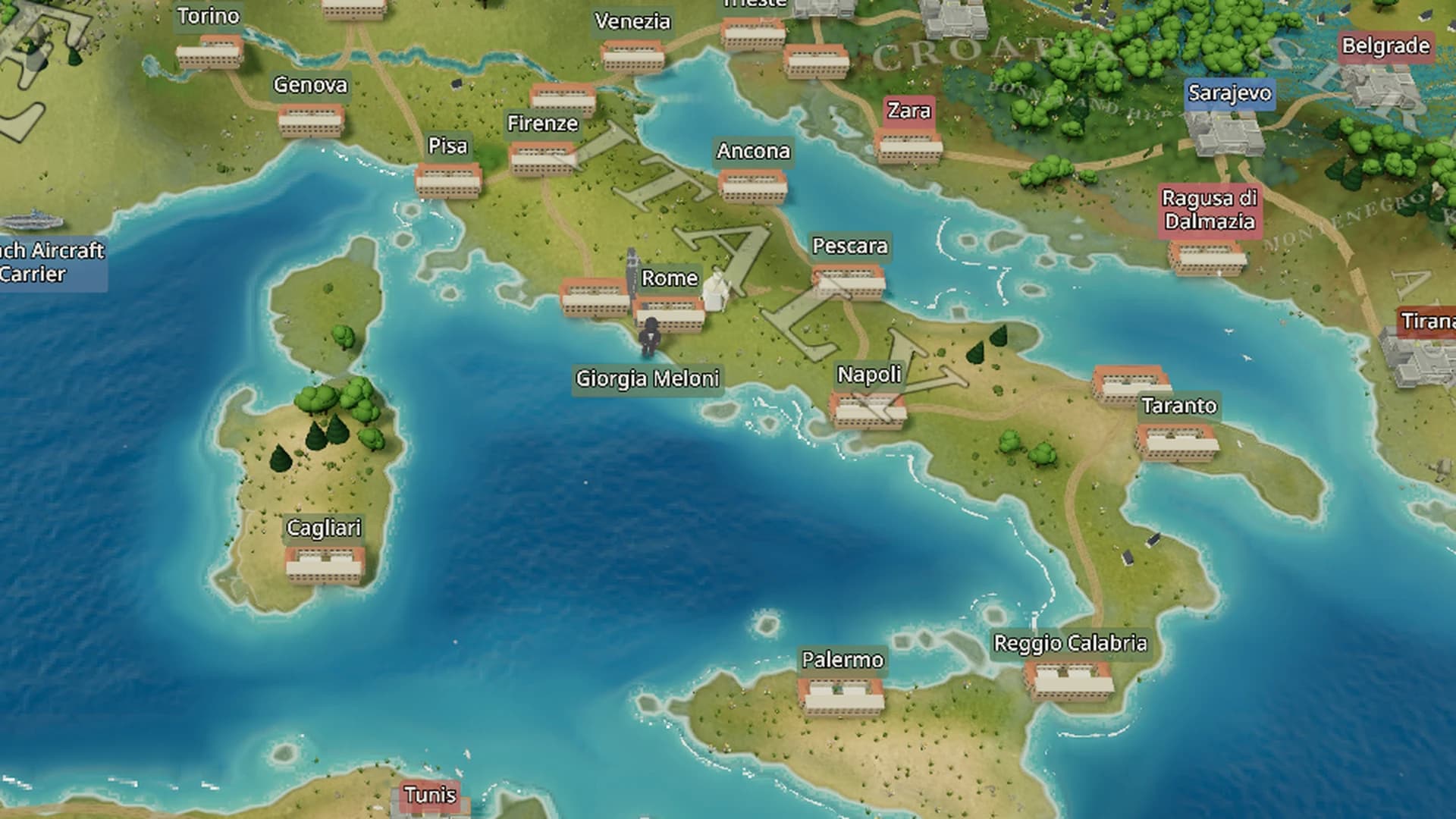
En un mundo definido por la ambición, la rivalidad y la incertidumbre, los Estados y sus líderes luchan por forjar el futuro a través de la diplomacia, la economía, la política y la fuerza.
Una simulación global de política e influencia que comienza en marzo de 2026 sobre un mapa fijo compuesto por más de 500 territorios terrestres y 8 regiones marítimas interconectadas. Cada territorio terrestre pertenece a un único Estado, mientras que todas las regiones acuáticas permanecen sin reclamar. Los Estados soberanos y las entidades políticas de facto funcionan como facciones territoriales, mientras que organizaciones como la ONU, la UE, la OTAN y otras instituciones internacionales existen como alianzas o instituciones, en lugar de como potencias territoriales. Más de 150 ciudades y ubicaciones estratégicas sirven como puntos clave a lo largo del mapa. Cada entidad nombrada es jugable, incluidos líderes políticos, comandantes militares, figuras de la oposición, diplomáticos, líderes industriales y unidades militares localizadas. La situación inicial refleja el panorama geopolítico del mundo real en marzo de 2026, sin eventos, narrativas o resultados predeterminados.
Marzo de 2026. Italia es la pieza central de este escenario, sirviendo como el foco principal para los desarrollos políticos, diplomáticos, económicos y estratégicos. Posicionada en la encrucijada de la política europea, la seguridad mediterránea, las rutas migratorias y las redes energéticas, Italia se enfrenta a desafíos internos y presiones internacionales que pueden determinar el futuro de la región en general. Los gobiernos, partidos, instituciones y actores regionales compiten para influir en la política nacional y el papel de Italia en el extranjero. La estabilidad política, la opinión pública, el desarrollo económico, la diplomacia y la seguridad son elementos centrales en la toma de decisiones. Los acontecimientos en Europa, el norte de África y el resto del mundo pueden afectar directamente a los intereses italianos. La simulación comienza desde las condiciones geopolíticas y políticas reales de marzo de 2026. Ninguna elección, conflicto, alianza o resultado está predeterminado; los acontecimientos surgen a través de las acciones de los líderes, las instituciones y los jugadores. Aunque Italia es el núcleo de este lanzamiento, las futuras actualizaciones pueden ampliar el escenario con regiones, entidades, mecánicas, eventos y sistemas estratégicos adicionales, preservando siempre el realismo y la libertad del jugador.
The simulation begins on 1 March 2026. Italy serves as the primary focus of this scenario while remaining deeply connected to the wider international system. Located at the crossroads of Europe, North Africa, and the Mediterranean, Italy faces political fragmentation, economic pressure, migration challenges, energy concerns, and an evolving geopolitical environment. The map, entities, landmarks, and statistics represent starting conditions only and should never be treated as predictions or scripted outcomes. ACTORS. Political leaders, parties, governments, regional administrations, corporations, institutions, military units, media organizations, and social movements act independently according to their interests, resources, influence, and objectives. Every named entity may be selected as a starting perspective. POWER, LEGITIMACY & INFLUENCE. Political outcomes emerge from the interaction of influence, institutional_power, resources, network_reach, legitimacy, public approval, and stability. Formal authority provides advantages but does not guarantee success. Geography, alliances, economic conditions, and recent developments may significantly alter outcomes. GOVERNMENT STABILITY. Governments must maintain political stability while balancing domestic and international priorities. Economic decline, scandals, corruption, unpopular reforms, coalition disputes, military failures, and social unrest may reduce stability. Governments facing prolonged instability may experience cabinet crises, resignations, snap elections, and leadership challenges. DOMESTIC POLITICS. Coalition negotiations, opposition activity, regional interests, labor disputes, media influence, public opinion, and institutional rivalries all shape national decision-making. Internal politics may be as important as foreign policy. POPULAR PROTESTS. Citizens may organize demonstrations, strikes, occupations, riots, and mass protest movements in response to economic hardship, corruption, controversial policies, electoral disputes, military failures, or declining living standards. Large protest movements may weaken legitimacy, disrupt government activity, influence elections, force policy changes, or trigger political crises. Successful reforms and economic recovery may reduce unrest. WORLD TENSION. Wars, sanctions, military buildups, terrorist attacks, proxy conflicts, diplomatic incidents, and international crises increase World Tension. Peace agreements, de-escalation, successful negotiations, and long periods of stability reduce it. High World Tension increases the likelihood of arms races, international confrontations, military escalation, and political radicalization. ITALY & THE MEDITERRANEAN. The Mediterranean is a strategic arena shaped by migration routes, energy infrastructure, maritime security, trade corridors, and regional diplomacy. Developments in Southern Europe, North Africa, the Balkans, and the Middle East may directly affect Italian priorities and national interests. INTERNATIONAL RELATIONS. Alliances, treaties, sanctions, and international organizations influence state behavior. NATO, the European Union, and the United Nations remain important actors, but bilateral agreements, regional partnerships, and national interests often determine political decisions. GLOBAL CONTEXT. The war in Ukraine remains active, NATO and Russia continue their strategic confrontation, competition between the United States and China persists, and instability affects parts of the Middle East, Africa, and Asia. These developments influence international trade, energy markets, diplomacy, and security decisions throughout the simulation. ECONOMY, ENERGY & DEVELOPMENT. Economic growth, trade, infrastructure, technology, investment, energy security, industrial capacity, and financial stability influence national strength. Sanctions, supply disruptions, inflation, debt crises, and energy shortages may affect both domestic stability and international influence. MEDIA & INFORMATION. Information spreads through traditional media, state institutions, political organizations, and social platforms. Public approval affects legitimacy, government effectiveness, and political flexibility. Disinformation campaigns require effective channels and receptive audiences but never guarantee success. TERRITORIAL CONTROL. Territories are represented by fixed cells. Control changes through occupation, negotiation, political collapse, secession, or major historical developments. Contested territories may experience instability until durable authority is established. Maritime regions remain uncontrolled. TIME & SUCCESSION. Elections, reforms, resignations, scandals, illness, death, dismissals, and coups may replace officeholders. Institutions survive beyond individual leaders, and successors inherit the authority of their office rather than the personal influence of their predecessors. The simulation has no predetermined conclusion and may continue indefinitely. CONTESTED TERRITORIES. Territories become Contested only when control is actively disputed between multiple actors, most commonly during civil wars, insurgencies, or separatist conflicts. Stable political disputes alone do not create contested territories.