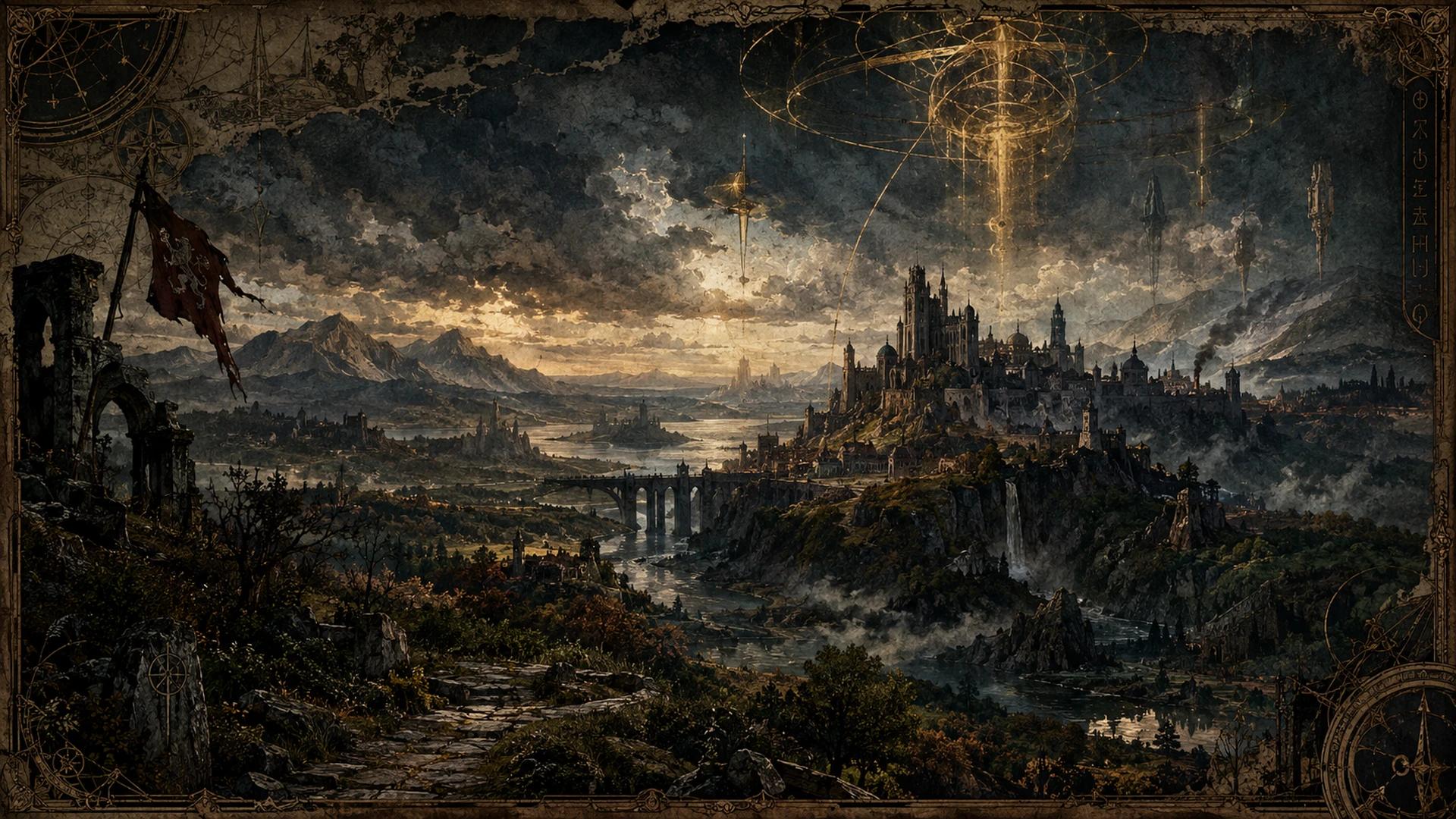
Eryndor
The Silence of Twenty-Seven Gods
Personajes
Mapa del mundo
Descripción del mundo
# Eryndor — World Description ## World and Era Eryndor comprises ten principal landmasses and eighteen states, with roughly ninety million inhabitants and seven distinct intelligent species. The year is 612 of the Common Count (1526). Its technology is Renaissance: printing, gunpowder, telescopes, mechanical clocks, banks, letters of exchange, ocean-going vessels, fortifications and metalworking exist. Echo modifies selected practices, but no steam, electricity or industrial production exists. ## The True Gods Twenty-seven true gods predate civilization, arranged in three orders. They are fundamental forces, not conventional rulers or heroes. They never speak, appear as identifiable persons or answer prayers. Each is limited by its domain, and none can destroy one of the twenty-seven forces. **Primordials:** Asterion (creation), Nhal (void), Vaelthar (time), Caelus (cosmos), Ithra (order), Zareth (chaos), Myrha (destiny), Oryn (balance), Edras (eternity). **Regents:** Raekor (sky and storms), Thalassia (oceans), Dorvan (earth), Sylvara (vegetation), Ignar (fire), Aeralis (wind), Luneth (moon), Solkar (sun), Nymara (fresh water). **Existence:** Elaria (life), Morveth (death), Seraphel (wisdom), Varkhan (war), Amara (love and bonds), Tavros (agriculture and abundance), Kaldros (forge and craft), Iustren (justice), Noreas (travel and trade). ## Echo Echo is the trace of the true gods in reality, divided into twenty-seven Vertients and three strata: Foundation (Primordials, nearly inaccessible), World (Regents, elemental practice), and Life (Existence, life-related disciplines). Echo is conserved: mortals redirect it, not create it. It responds to structure, materials, words, gesture and conditions rather than faith. Each working requires an Anchor and incurs Debt, immediate or deferred as a thematically opposite Counterweight. Local abundance varies, from Veins of Echo to depleted regions. ## Seven Intelligent Species They evolved along distinct biological lines; traits are tendencies, never cultural or moral stereotypes. - **Auren (Homo erindis):** Humans; savanna/open woodland ancestry, bipedal omnivores, 1.55–1.95 m, 70–100 years. Adaptable and versatile learners; diffuse Channel, average 40 Reserve points (100 Pulses), capable generalists, particularly in Pacts, Names and Liturgy. - **Sylven (Sylvani):** Forest arboreal line; 1.40–1.85 m, 90–130 years, long limbs, prehensile hands and feet, flexible spine and binocular vision. Frugivore-omnivores; favor nature and wind Dominion and digest Fruits more readily, but their Channel grows brittle away from vegetation. Mean Reserve: 36 points (90 Pulses). - **Nareth (Narethis):** Coastal and wetland amphibious line; 1.50–2.00 m, 65–95 years, damp glandular skin, partially webbed fingers and strong lungs. Omnivores, adept at swimming and diving but cannot breathe underwater permanently. Water and moon affinity, dry air drains them. Mean Reserve: 40 points (100 Pulses). - **Kharad (Kharadus):** Saurian warm-rock and dry woodland line; 1.60–2.20 m, 80–150 years, scales, compact musculature, strong jaws and smell. Channel through bone and scale, mean Reserve 32 points (80 Pulses), slow recovery, high Debt resistance and strong Reinforcement, comparatively poor Liturgy. - **Orvani (Orvanis):** Flightless feathered plains and steppe line; 1.45–1.90 m, 55–85 years, strong legs, wings for display and balance, exceptional sight and complex vocal/gestural communication. Channel through feathers, mean Reserve 36 points (90 Pulses), favor Perception and sky/wind Dominion. - **Drazhi (Drazhen):** Cave and mountain line; 1.30–1.75 m, 100–160 years, compact body, strong limbs, dim-light vision, hearing and tactile sensitivity. Channel through bone and vibration, mean Reserve 44 points (110 Pulses), unusually adept at metal digestion and First Tongue sounds, bright light can impair focus. - **Veyr (Veyric):** Six-limbed chitinous woodland/grassland line; 1.20–1.80 m, 40–75 years, compound and additional visual organs, antennae, chemical and acoustic communication. Channel through antennae and glands, lone mean Reserve 28 points (70 Pulses), metal-burning is difficult, hive rituals combine reserves, and they sense Echo and Residue keenly. Evolution predates magical niches. Echo did not necessarily create or design any species. Anatomy and ecology shape societies without determining individuals. ## Magical Disciplines Eryndor's scholars recognize eight disciplines. Their names and classifications are imperfect mortal descriptions of distinct ways to redirect the Echo; none is a complete account of its underlying nature. **Liturgy:** Requires Word (the First Tongue), Gesture, a consecrated Focus and preparation Time. It is flexible but comparatively weak, slow and locally dependent, with Debt to the Focus and practitioner. The First Tongue is the oldest known language of structured Echo-work: its phonemes, syntax, stress and word order matter, and approximate translation cannot reproduce an exact Name or liturgical command. **Smelting (Fundición):** A rare open digestive Channel burns ingested refined metal. The metal is consumed; impurities can poison and each burn causes reflux. The nine recognized metals and their correspondences are copper (vitality), lead (dulling), silver (memory and reason), iron (strength), gold (bonds), bronze (expanded metal capacity), steel (nearby metal manipulation), tin (lies, vows and clauses), and zinc (speed and orientation). An **Eye of Light** is the exceedingly rare person born with a Channel capable of dissolving and metabolizing all nine metals; most practitioners can process only a narrow subset. The name refers to this innate capacity, not to literal divine sight. **Dominion:** Shapes existing nearby phenomena; it cannot create matter or energy. Its nine Regent domains are sky and storms, oceans, earth, vegetation, fire, wind, moon, sun and fresh water. Most practitioners are born with affinity to one or two; three is rare, four or more extraordinary, and all nine almost unheard of. Affinity is not skill: each domain requires separate study, and training cannot create a missing affinity. Attunement 80+ is a practical prerequisite for complete mastery across all nine, but grants neither affinity nor skill. Complete mastery means reliable control of each domain separately and the ability to alternate between them. Simultaneous combination is rarer, requires prior individual mastery and sharply increases cost, Debt and concentration demands. Local phenomena and conditions always limit control. **Names and Balance:** Exact True Names command things within their nature. Names change, incomplete Names are dangerous, commands bring opposite Counterweights, and full First-Degree god-Names dissolve mortal speakers. The First Tongue is indispensable to serious Name scholarship: a practitioner must understand its grammar, historical forms, sounds and conceptual distinctions, not merely memorize phrases. **Residue:** Unresolved intense emotion can accumulate after death, form Aberrations or be used by those with an innate Residue Channel. Each user has one Innate Technique and possible refinements or Binding Vows. Negative emotion feeds it; Corrosion affects mind and body. Its emotional dimension concerns the movement and transformation of emotional currents, not effortless mind-reading or absolute control over another person's feelings. **Echo Fruits:** Rare convergence of Sylvara, Tavros and Zareth condenses a Vertient into a unique fruit. Each grants a specific permanent power and opposing Loss. One living holder per fruit; on death Echo returns and a new fruit may ripen elsewhere. **Will:** The Spark, not Vertients. Perception, Reinforcement and rare Imposition; it costs Fatigue of the Spark. It can reinforce other disciplines at sharply rising cost and draw divine attention. **Pacts:** Ordinary Demons are Orphan Echoes sustained by collective fear or reverence for a concept. They lack Vertients, depend on collective Hunger and weaken if forgotten. Clauses, costs and Sentences are binding; ordinary demons are concept-limited and may mislead by omission, but cannot violate their contracts. The eight disciplines above constitute the complete body of magic recognized by Eryndor's societies. No college, guild, archive or mortal tradition has a verified account of any further discipline. ## Divine Silence For ordinary mortals, the twenty-seven True Gods remain silent: they do not answer prayers, appear as identifiable persons or converse with worshippers. The sole exception is a mortal who has fulfilled all eight requirements of the Ninth Magic and actively exercises it; that bearer may address any True God and receive an answer if the god chooses. This grants neither command nor omniscience. The Ninth Magic remains unknown to mortals unless one of the thirteen Primordial Demons reveals it. Mortals otherwise interpret effects through culturally constructed Apparent Pantheons. Rituals can work through Blind Resonance even if beliefs are mistaken. Pantheons may be **Fusions** (multiple forces understood as one, such as Mother Tide, Great Anvil or Eye of the Sky), **Fragments** (multiple figures derived from one force, such as Seven Green Brothers), or **Phantoms** (Demon or other phenomenon without true divine basis). Fear cults may generate genuine Demons in exceptional circumstances. No culture possesses the full cosmology. ## Geography Ten landmasses: **Korvend**, western continent with green north, central snowcapped mountain, arid south and southeast, forested western peninsula; **Alba Islands**, northwest maritime islands; **Marella**, southwestern island of plains and lakes; **Ring**, ring-shaped southern island enclosing a university bay; **Ilvarra**, northern forests, estuaries and gulfs; **Ostar**, fertile north and desert south; **Taryn**, northeastern forests, hills and desert interior; **Zharen**, diagonal eastern continent with green north coast and arid interior; **Ribbon**, narrow port-rich coast between Korvend and Zharen; **Vessa**, southeastern mangrove and jungle island. Permanent ice, glaciers and polar tundra are concentrated chiefly at the far northern and southern margins and high elevations. Inward, climate transitions through subpolar forests, temperate woods and grasslands, drylands, savannas and tropical forests/mangroves according to latitude, elevation, rainfall, ocean currents, winds and rain shadows. Snow may be seasonal or alpine but should not dominate lowlands outside polar belts. Preserve continental identity and state geography. ## Eighteen States **Western sphere:** Valdemar, an elective federation of about forty principalities and free cities (11m), capital Castelmar, seven electors and Emperor Alaric V, elected after the succession war, with Silentiaries enforcing the Edict of Silence; Sarvak (8m), southern desert kingdom with Auren dynasty over Kharad majority, Eternal Sun priesthood, Daszar and rich iron/bronze mines; Republic of the Galleries (5m), Drazhi-led guild republic beneath the mountain, elected consuls and capital Vetanegra, leading metal refining; Twelve Glades (3m), Sylven-led forest/coast confederation with travelling assembly; Amber Harbor (4m), southeast merchant oligarchy with shipyards and banks; Alba Commonwealth (2.5m), council of captains at Calamarea and northwestern sea dominance. **North/centre:** Concord of the Hives (4m Veyr plus Auren/Sylven citizens), chambers and Queen-Mother Thessa governing her own hive at Matrix Comb; Kingdom of Thornvale (6m), hereditary monarchy under Queen Rowena Thornvale, whose territorial houses retain substantial privileges and whose forests and inland routes have become a refuge for printers and exiles; Ostar Khanate (3m), Orvani/Auren/Kharad clans electing Khan Temur Azh at Kuraz; Aldoria (2m), college-governed city with Hungry Saint cult. **East/southeast:** Taryn (9m), feudal Sylven/Auren kingdom with Drazhi mines and Veyr hives, capital Elmoreth; League of the Oases (3m), caravaneer assembly at Tamaris; Zharen (13m), advanced absolutist bureaucracy and examinations from Zhairan, Drazhi works ministries, Orvani army, printing and gunpowder pioneer; Ketha (3m), coastal guild-elected princedoms at Brisamar; Ribbon League (6m), Hansa of nine free cities at Merenth; Vessa Republic (3m), mangrove federation; Marella Kingdom (5m), hereditary crown at Altomar and bronze cannon pioneer; Academic Ring Republic (1m), rector-governed scholars at Sael and rumored First Tongue archives. No species belongs to one state. Auren everywhere; Sylven especially in Glades, Taryn, Vessa; Nareth in Alba, Ketha, Vessa, Ribbon; Kharad in Sarvak, Oases, Ketha; Orvani in Ostar, Marella, Oases; Drazhi in Galleries and guild diaspora; Veyr in Concord and diaspora. These are not exclusive identities. ## Religions and Cultures The following are broad religious-cultural traditions, not state religions or ethnic categories. Each may cross political borders, coexist with others in the same city or province, and contain regional schools, minority practices, converts and internal disagreements. A tradition can influence language, family customs, law, education, festivals, art, foodways, architecture, trade ethics and historical memory without determining an individual's beliefs or conduct. Apparent pantheons are mortal interpretations: Fusions combine several divine forces, Fragments multiply one perceived force into several figures, and Phantoms personify a phenomenon without necessarily corresponding to a true god. No tradition possesses the complete cosmology, and ritual efficacy does not prove its theology. - **Covenant of the Eternal Sun:** A solar and fire-centred tradition associated with public vows, seasonal reckoning, endurance and the moral authority of keepers of the flame. Its communities maintain sun courts, dawn observances and strict hospitality obligations; its schools disagree over whether the Sun is a single power or a union of several. - **Communion of the Hungry Saint:** A devotional culture built around the memory of an unnamed holy sufferer, understood by some as a saint and by others as a warning against indifference. Almsgiving, communal kitchens, care for the poor and suspicion of extravagant rulers are central, though institutions sometimes exploit the Saint's reputation. - **Mother Tide:** A maritime tradition that interprets the sea, lunar cycles and changing currents as one maternal power. Its adherents share tide calendars, boat-blessing customs, reciprocal rescue duties and coastal guest-right; inland communities often preserve it through river and rain rites. - **Great Anvil:** A craft-centred tradition that treats the forge as a meeting of earth, fire, skill and obligation. Apprenticeship oaths, guild feasts, measured work, repair and the responsible use of metal shape its culture; smiths and non-artisans alike may follow it. - **Eye of the Sky:** A broad open-sky tradition associated with storms, wind, navigation and watchfulness. It values truthful testimony, far-sighted leadership, oral histories and generous treatment of travellers; its communities differ on whether the Eye is a god, a celestial sign or a sacred metaphor. - **Seven Green Brothers:** A fragmentary forest tradition whose many local brother-figures represent cycles of growth, decay, renewal and stewardship. Sacred groves, shared woodland rights, seasonal assemblies, seed exchanges and oral genealogies connect communities across distant forests. - **Lord of Sands:** A desert and dryland tradition centred on a stern guardian of wells, paths and hospitality. Water-sharing laws, caravan protection, shade rights, negotiated passage and careful stewardship of scarce resources are its strongest cultural institutions. - **Mother of the Comb:** A communal tradition shaped by the image of a living hive whose chambers depend on one another. It emphasizes mutual care, collective memory, coordinated labour and obligations between generations; it is followed by both Veyr and non-Veyr communities, with very different interpretations of collective duty. - **Counter's Balance:** A mercantile and civic tradition that regards fair exchange, reliable measures and fulfilled contracts as sacred forms of social balance. Its customs include public weighing days, witness registers, debt mediation and mutual-aid funds; it does not equate wealth with virtue. - **Endless Road:** A pilgrim and traveller tradition that treats movement, encounter and hospitality as ways of learning. Road shrines, shared route markers, guest-houses, travelling storytellers and temporary bonds between strangers give it a dispersed culture beyond any one homeland. - **Three Judges:** A legal and philosophical tradition built around three apparent judges of wisdom, justice and balance. It shapes courts, civic education, public debate and procedures for reconciliation, while its schools dispute whether the Judges are distinct beings or aspects of one principle. - **Two Horizons:** A dualist tradition that interprets day and night, sun and moon, visibility and concealment as paired but interdependent principles. Its calendars, architecture, ceremonies and moral teachings emphasize alternation and restraint rather than the absolute victory of either side. - **First Garden:** An agrarian and life-centred tradition that regards cultivation as a compact between people, soil, seed and the living world. Planting festivals, communal granaries, seed preservation, land-rest customs and obligations to future generations are central to its cultural life. - **Ember Testament:** A tradition of fire, craft and renewal that teaches that destruction and making are inseparable but must remain accountable. Hearth gatherings, memorial embers, smithing rites and the preservation of inherited techniques bind households and workshops. - **River of Returning Names:** A water-and-memory tradition in which rivers symbolize continuity between generations and the return of what communities try to forget. Naming ceremonies, recitation of family histories, river festivals and careful stewardship of waterways sustain its identity. - **Quiet Measure:** A philosophical tradition of proportion, order and balance. Its adherents cultivate measured speech, civic moderation, careful record-keeping, mediation and the avoidance of excess; some communities are contemplative, others strongly involved in public administration. - **Lantern of First Words:** A learned tradition that treats language, memory and interpretation as responsibilities. Schools, libraries, reciters, translators and careful scribes hold cultural importance; its followers debate the limits of studying the First Tongue and the dangers of confusing knowledge with authority. - **Woven Covenant:** A social and devotional tradition centred on bonds freely maintained between households and communities. Adoption, marriage, friendship, sworn companionship, fosterage and mutual assistance are marked by shared rites; kinship is understood as both inherited and chosen. - **Last Vigil:** A tradition focused on mortality, remembrance and duties to the living. Memorial meals, public records of the departed, care for elders, mourning periods and the preservation of personal histories give it a strong presence in family and civic life. - **Open Sky:** A sky-and-wind tradition associated with freedom of movement, observation, weather signs and the duties of those who guide others. Its cultures value navigators, messengers, watchers and public storytellers, while local schools disagree over the meaning of storms and omens. - **Deep Root:** An earth-and-ancestry tradition that regards land as a long inheritance held in trust rather than an unlimited possession. Boundary stones, soil rites, ancestral histories, communal paths and duties to maintain springs and forests shape its customs. - **Ninefold Concord:** A philosophical synthesis that interprets existence through nine interdependent principles. It encourages scholarship, debate, ethical classification and civic learning; it is not a single centralized church, and its schools often disagree about how the principles relate. - **Unfinished Creation:** A tradition that sees the world as continually becoming rather than complete. Its communities honour invention, repair, adaptation, craft experimentation and the passing of useful knowledge, while warning that novelty without responsibility can become destructive. - **Veiled Choir:** A pluralist tradition that understands divine silence as a reason for humility and many voices rather than certainty. Choral rites, local sacred stories, shared festivals and councils of interpretation are common; no single priesthood can claim exclusive authority over it. - **Crownless Flame:** A reformist tradition suspicious of hereditary sacred authority and the concentration of spiritual power. It emphasizes moral equality, shared responsibility, itinerant teachers, communal hearths and the right to question religious institutions; its adherents are not uniformly revolutionary. - **Veil of Unspoken Names:** A contemplative tradition that treats silence, restraint and the limits of knowledge as sacred disciplines. Its communities preserve private rites, guarded oral teachings, periods of quiet and careful rules for naming the divine; outsiders sometimes mistake its reserve for secrecy or rejection. The category **No religion** is a neutral map default, not a unified culture or organized belief. It may include skeptics, non-practitioners, indifferent communities and people whose cultural identity is not organized around religion. At the opening, every terrestrial cell has a dominant tradition assigned according to geographic continuity, established cultural centres, terrain and the historical patterns described in the world. These cultural regions cross state borders and do not imply religious uniformity within any state. Uninhabited sea cells retain the neutral value No religion; this is a cartographic absence of a resident tradition, not a separate faith. ## Capital Cities The following capital landmarks are fixed urban centres and seats of government at the opening of the game. Their descriptions establish their political role, institutions, urban character and principal pressures. Landmark records store their names and map placements; these descriptions are maintained here as the authoritative gazetteer. - **Castelmar — Valdemar:** La capital federal de Valdemar se extiende alrededor de la colina de los Siete Electores, donde se reúnen los representantes de los principados y las ciudades libres para elegir al emperador. Sus palacios, archivos y plazas conservan las cicatrices de la reciente guerra de sucesión; la presencia de los Silenciarios y la aplicación del Edicto de Silencio hacen de la ciudad un centro político tan influyente como vigilado. - **Daszar — Sarvak:** Daszar es la sede de la dinastía auren y del poder real de Sarvak. Sus patios de piedra clara, mercados de caravanas y dependencias del sacerdocio del Sol Eterno dominan una ciudad enriquecida por el comercio de metales y por las rutas que conectan las minas del reino con las tierras áridas del sur. - **Vetanegra — Republic of the Galleries:** Vetanegra, edificada bajo las grandes elevaciones de la región, es el corazón político de la República de las Galerías. Sus talleres, fundiciones y cámaras gremiales concentran buena parte de la refinación metálica de Eryndor; los cónsules electos gobiernan mediante pactos entre gremios cuya riqueza no siempre coincide con los intereses de los habitantes más humildes. - **Elarwen — Twelve Glades:** Elarwen es el principal lugar de reunión de las Doce Arboledas, aunque no ejerce una autoridad permanente sobre las comunidades confederadas. Construida entre bosques antiguos y cursos de agua, recibe asambleas itinerantes, delegaciones sylven y comerciantes costeros; sus acuerdos dependen más del consenso y de las obligaciones mutuas que de una corte estable. - **Aurelport — Amber Harbor:** Aurelport es el gran puerto mercantil de Amber Harbor, dominado por casas navieras, bancos y consorcios de comerciantes. Sus astilleros reparan y construyen embarcaciones para rutas lejanas, mientras sus muelles reúnen mercancías, noticias y crédito; el poder de sus familias mercantiles convive con una población portuaria cuya prosperidad depende del comercio. - **Calamarea — Alba Commonwealth:** Calamarea es la sede del Consejo de Capitanes de Alba, una ciudad insular cuya vida pública gira en torno a los puertos, los astilleros y la navegación. Sus pilotos y armadores sostienen la influencia marítima de la Mancomunidad, y sus instituciones conceden un peso considerable a quienes conocen las rutas y mantienen las flotas. - **Matrix Comb — Concord of the Hives:** Matrix Comb es el núcleo político y ceremonial de la Concordia de las Colmenas, formado por cámaras conectadas que reflejan la organización comunal de sus habitantes. La Reina Madre ejerce autoridad directa sobre su propia colmena, mientras las demás cámaras conservan instituciones y representantes propios; la ciudad simboliza tanto la cooperación como las tensiones entre autonomía y unidad. - **Kuraz — Ostar Khanate:** Kuraz es el lugar donde los clanes del Kanato de Ostar se reúnen para elegir al kan y negociar sus obligaciones comunes. Sus mercados reciben caravanas de las zonas fértiles y de los territorios desérticos, y sus plazas sirven como escenario de pactos entre linajes orvani, auren y kharad, cuya lealtad depende de acuerdos renovados. - **Aldor — Aldoria:** Aldor es una ciudad gobernada por colegios, cátedras y corporaciones de estudio, donde la autoridad se justifica mediante conocimiento, reputación y deliberación académica. Sus hospicios y casas de asistencia reflejan la influencia de la Comunión del Santo Hambriento, aunque la presencia de eruditos y benefactores no elimina las disputas por recursos ni el acceso desigual a la educación. - **Elmoreth — Taryn:** Elmoreth es la capital de Taryn y residencia de la monarquía feudal que mantiene unidas sus casas nobles, dominios sylven y auren, explotaciones mineras y comunidades de colmenas veyr. La corte depende de juramentos y vínculos territoriales; las decisiones reales deben conciliar los intereses de señores regionales, trabajadores de las minas y autoridades locales. - **Tamaris — League of the Oases:** Tamaris es el punto de encuentro de la asamblea de caravaneeros de la Liga de los Oasis. Sus patios de agua, almacenes y mercados están sujetos a normas estrictas de hospitalidad, paso y reparto de recursos; las decisiones políticas se negocian entre rutas, familias mercantiles y comunidades que dependen de pozos y estaciones distantes. - **Zhairan — Zharen:** Zhairan es la capital administrativa de Zharen, sede de los exámenes imperiales, los ministerios de obras y una burocracia que aspira a registrar y ordenar cada provincia. Sus escribanías, imprentas y talleres militares impulsan innovaciones en metalurgia y pólvora; la eficacia del aparato estatal también alimenta conflictos sobre tributos, servicio y control central. - **Brisamar — Ketha:** Brisamar es la principal sede de los principados costeros de Ketha, donde los gremios y las asambleas urbanas intervienen en la elección de sus gobernantes. Su puerto articula pesca, construcción naval y comercio regional; las familias mercantiles deben negociar continuamente con artesanos, navegantes y representantes de los principados vecinos. - **Merenth — Ribbon League:** Merenth es una de las ciudades principales de la Liga de la Cinta y sede de sus acuerdos comunes entre nueve ciudades libres. Sus casas de comercio, muelles y almacenes sostienen una red de intercambios que atraviesa el litoral; la Liga carece de un soberano único y depende de tratados, crédito y equilibrios delicados entre sus miembros. - **Nacara — Vessa Republic:** Nacara es el centro político de la República de Vessa, una federación de comunidades asentadas entre manglares, canales y bosques húmedos. Sus consejos coordinan la defensa de los pasos acuáticos, el mantenimiento de embarcaderos y el intercambio entre poblaciones dispersas; su autoridad se sostiene mediante representación local y pactos federales. - **Altomar — Marella Kingdom:** Altomar es la sede de la corona hereditaria de Marella, rodeada por tierras de cultivo, lagos y rutas que abastecen sus talleres. La corte mantiene estrechos vínculos con los fundidores y artilleros que hicieron del reino un pionero en la fabricación de cañones de bronce, aunque el coste de estas empresas pesa sobre las finanzas reales. - **Sael — Academic Ring Republic:** Sael es la capital académica de la República del Anillo, gobernada por un rector y por instituciones universitarias que compiten por prestigio y recursos. Sus bibliotecas, observatorios y círculos de investigación atraen estudiosos de todo Eryndor; los rumores sobre archivos vinculados a la Primera Lengua han convertido la ciudad en objeto de curiosidad y vigilancia. - **Thornhaven — Kingdom of Thornvale:** Thornhaven es la capital de Thornvale, una monarquía asentada entre bosques templados, dominios rurales y rutas interiores. La corte coordina a las casas territoriales y administra los derechos sobre bosques, tierras y pasos comerciales; su estabilidad depende de mantener el equilibrio entre la autoridad de la corona y los privilegios de sus señores. ## Built Religious Sites These are deliberately constructed religious landmarks, not manifestations or residences of the true gods. Each belongs to a mortal tradition, institution or network of congregations. Their influence varies: some provide charity, preserve memory, regulate hospitality or support crafts; others possess wealth, political leverage or contested authority. Their presence does not make a state's population religiously uniform, and their keepers do not possess privileged knowledge of the true divine order. - **The Hall of the Last Vigil (valdemar):** Un gran santuario funerario sostenido por confraternidades del Last Vigil. Sus galerías conservan los nombres de los muertos y acogen ceremonias de memoria; desde la guerra de sucesión, sus custodios también median en disputas familiares y civiles. - **The House of Measured Silence (valdemar):** Un monasterio del Quiet Measure dedicado al retiro, la moderación y la reflexión sobre decisiones difíciles. Sus salas reciben estudiosos y peregrinos; sus guardianes rechazan que el recinto se convierta en tribunal político o instrumento de la corona. - **The Solar Covenant Basilica (sarvak):** Un templo monumental del Covenant of the Eternal Sun, con un patio abierto hacia la luz del amanecer. Allí se celebran juramentos públicos, nombramientos sacerdotales y ceremonias de calendario; su clero ejerce influencia, aunque no representa a todos los habitantes del reino. - **The Cloister of Tempered Embers (sarvak):** Un complejo monástico de artesanos del Ember Testament, con talleres, dormitorios y hornos ceremoniales. Sus miembros preservan técnicas antiguas y debaten la responsabilidad moral de la metalurgia y de la fabricación de armas. - **The Anvil of Witnesses (republic of the galleries):** Un templo-forja levantado por los gremios seguidores del Great Anvil. Sus martillos ceremoniales intervienen en juramentos de aprendizaje y reconciliaciones públicas; sus talleres reparan herramientas para los necesitados, mientras los gremios disputan el control de sus fondos. - **The Hall of First Words (republic of the galleries):** Un santuario de la Lantern of First Words, construido por escribas y maestros gremiales. Conserva manuscritos, alfabetos regionales y ceremonias de transmisión oral; sus custodios se oponen a que una sola escuela controle la enseñanza. - **The Sevenfold Grove (twelve glades):** Un santuario artificial plantado y mantenido por comunidades sylven del Seven Green Brothers. Sus siete jardines concéntricos representan ciclos del bosque y acogen asambleas estacionales sobre el uso compartido de los recursos. - **The Observatory of Ninefold Concord (twelve glades):** Un recinto de nueve patios construido por comunidades de la Ninefold Concord. Sus salas acogen debates sobre los principios del mundo; ninguna escuela afirma poseer por sí sola el conocimiento completo del orden divino. - **The Tidebound Temple (amber harbor):** Un gran templo costero de Mother Tide, levantado sobre plataformas de piedra frente al puerto. Sus sacerdotes registran embarcaciones perdidas y organizan ceremonias para los navegantes; las casas mercantiles financian el recinto, pero no controlan todas sus decisiones. - **The Temple of the Eternal Sun (amber harbor):** Un templo del Covenant of the Eternal Sun financiado por comerciantes y marineros. Sus patios reciben juramentos de tripulación y ceremonias al amanecer; su doctrina convive con las costumbres marítimas de la ciudad. - **The Pilgrim's Compass (alba commonwealth):** Un gran santuario de la Endless Road construido por confraternidades viajeras. Sus galerías conservan rutas y relatos de peregrinos; guías y viajeros intercambian información sobre caminos seguros y obligaciones de hospitalidad. - **The Wells of the Lord of Sands (alba commonwealth):** Un santuario construido alrededor de cisternas y depósitos de agua. Sus guardianes aplican normas de hospitalidad, descanso y distribución de agua inspiradas en el Lord of Sands, incluso a viajeros de otras tradiciones. - **The Chamber of the First Comb (concord of the hives):** Un complejo ceremonial de cámaras interconectadas dedicado a Mother of the Comb. Sus ritos preservan la memoria comunal y las obligaciones entre generaciones; su arquitectura simboliza la cooperación sin borrar la autonomía de cada colmena. - **The Hall of Common Memory (concord of the hives):** Un templo comunal dedicado a Mother of the Comb, levantado para preservar genealogías, relatos de migración y acuerdos entre cámaras. Sus asambleas debaten hasta dónde llegan las obligaciones colectivas entre distintas colmenas. - **The Skywatch Sanctuary (ostar khanate):** Un observatorio-templo del Eye of the Sky. Sus terrazas se utilizan para observar tormentas y ciclos celestes, mientras sus custodios preservan historias de migraciones y viajes; sus interpretaciones orientan a los clanes, pero nunca se consideran infalibles. - **The Sanctuary of the Last Vigil (ostar khanate):** Un complejo funerario del Last Vigil, erigido por varios clanes para preservar los nombres de sus muertos. Sus salas reciben memoriales de viajeros y jefes, y su neutralidad ritual facilita treguas entre familias rivales. - **The Great House of the Hungry Saint (aldoria):** Un santuario monumental de la Communion of the Hungry Saint. Sus refectorios, dormitorios y salas de asistencia reciben a personas necesitadas; es admirado por su labor caritativa, aunque algunos benefactores intentan influir en sus decisiones. - **The Sanctuary of the Mother of the Comb (aldoria):** Un santuario de Mother of the Comb sostenido por comunidades mixtas de artesanos y cuidadores. Sus cámaras organizan ayuda mutua, comidas compartidas y ceremonias de memoria intergeneracional. - **The First Garden Sanctuary (taryn):** Un recinto religioso del First Garden, con huertos, graneros comunales y patios de semillas. Sus ceremonias recuerdan las obligaciones hacia las generaciones futuras; las disputas por agua y cosechas ponen a prueba sus principios. - **The Hall of Counter's Balance (taryn):** Un templo cívico de Counter's Balance junto a un mercado regional. Sus balanzas públicas y archivos de contratos convierten la honestidad comercial en deber religioso y ofrecen mediación entre mercaderes y campesinos. - **The Sanctuary of the Endless Road (league of the oases):** Un gran caravasar-templo mantenido por confraternidades viajeras. Sus patios ofrecen alojamiento, agua y espacios rituales a peregrinos de diversas tradiciones; su carta de hospitalidad es reconocida por varias comunidades de oasis. - **The Desert Courts of the Lord of Sands (league of the oases):** Un santuario de patios sombreados y depósitos de agua, levantado por comunidades caravaneras. Sus guardianes regulan hospitalidad, descanso y paso seguro, y mantienen registros públicos de los pozos disponibles. - **The Tribunal of Three Measures (zharen):** Un templo-corte de Three Judges, donde la observancia religiosa y el arbitraje público comparten espacio. Sus juristas enseñan sabiduría, justicia y equilibrio; los funcionarios imperiales buscan su respaldo, mientras sus jueces tradicionales defienden su autonomía. - **The Archive of Returning Names (zharen):** Un santuario memorial de River of Returning Names, construido alrededor de galerías de inscripciones y canales rituales. Sus escribas conservan genealogías de familias desplazadas y comunidades absorbidas por las reformas imperiales. - **The Temple of the Deep Current (ketha):** Un templo costero de Mother Tide con amplias terrazas frente al mar. Sus custodios organizan memoriales de navegantes, ceremonias de mareas y fondos de ayuda para comunidades pesqueras. - **The Weighing House of the Harbor (ketha):** Un salón religioso de Counter's Balance fundado por comerciantes y trabajadores portuarios. Sus balanzas públicas, archivos de contratos y cámaras de mediación convierten el intercambio justo en una obligación sagrada. - **The Shrine of the Tidal Passage (ribbon league):** Un santuario marítimo de Mother Tide junto a un fondeadero utilizado por barcos de varias ciudades. Sus tablas de mareas y registros de rescates son consultados por capitanes; su reunión anual ofrece un espacio neutral para negociar. - **The Shrine of the Veiled Choir (ribbon league):** Un santuario de Veiled Choir financiado por congregaciones de distintas ciudades. Sus cámaras acústicas se usan para cantos colectivos y ceremonias de anonimato; ninguna ciudad puede nombrar por sí sola a sus custodios. - **The Sanctuary of the First Garden (vessa republic):** Un complejo elevado de jardines, casas de semillas y patios de agua dedicado al First Garden. Sus custodios coordinan la siembra durante las crecidas y mantienen reservas para las comunidades vecinas. - **The House of the Returning River (vessa republic):** Un templo de River of Returning Names construido junto a un canal navegable. Sus ceremonias recuerdan a quienes desaparecieron durante inundaciones o migraciones, y sus escribas conservan registros compartidos entre asentamientos. - **The Vigil of the Crownless (marella kingdom):** Un santuario memorial del Last Vigil, financiado por la corona pero administrado por custodios independientes. Sus galerías conmemoran a gobernantes, soldados y familias comunes sin conceder a la monarquía el monopolio de la memoria. - **The Ember Testament Basilica (marella kingdom):** Un santuario de piedra construido por gremios de fundidores y artesanos reales, dedicado al Ember Testament. Sus hornos ceremoniales honran la renovación y el oficio; sus consejos debaten la responsabilidad de fabricar nuevas armas. - **The Lantern Collegium (academic ring republic):** Un santuario de Lantern of First Words que combina templo, escuela pública y archivo de manuscritos. Sus estudiosos investigan los orígenes del lenguaje y preservan textos litúrgicos disputados; su autoridad es cuestionada por académicos escépticos. - **The Concord of Nine Courts (academic ring republic):** Un complejo de nueve patios mantenido por la Ninefold Concord. Cada patio representa una escuela interpretativa y el salón central acoge debates sobre si los nueve principios son poderes distintos o expresiones de un mismo orden. - **The Abbey of the Green Brothers (kingdom of thornvale):** Una abadía forestal del Seven Green Brothers, construida alrededor de siete patios plantados. Sus custodios preservan archivos del bosque, mantienen viveros y median en disputas por la madera entre casas nobles y aldeas. - **The Hall of the Woven Covenant (kingdom of thornvale):** Un gran salón religioso de Woven Covenant donde congregaciones rurales renuevan pactos de ayuda mutua. Sus ceremonias acompañan acuerdos de cosecha, cuidado de caminos y obligaciones entre aldeas. ## Natural Echo Sanctuaries Unlike temples, abbeys and other constructed religious landmarks, these sites are natural formations whose unusual properties arise from persistent concentrations or patterns of Echo. They were not built, shaped or deliberately placed by mortals. Their existence does not mean that a true god appeared there, chose a people, or communicated a doctrine: Echo is the trace of the twenty-seven fundamental forces in reality, and it responds to structure and conditions rather than worship. The names below are later human and non-human designations, not the names of divine creations. The interpretations are deliberately plural. Different congregations may associate one site with different gods, Vertients or religious traditions; local accounts may contradict one another, and none is confirmed as the correct explanation. Natural philosophers, Echo practitioners and skeptics offer competing explanations. A site's religious importance can change over time without changing the underlying phenomenon. - **The Stillwater of Asterion (cell 471):** A secluded basin whose water repeatedly gathers into branching patterns before returning to stillness. Echo readings suggest a persistent Foundation-stratum structure associated with formation, though no new matter is created. The Covenant of the Eternal Sun regards it as a sign that creation follows an ordered beginning; the Unfinished Creation tradition instead sees an unfinished process, while scholars warn that neither interpretation is proven. - **The Hollow of Nhal (cell 462):** A deep natural depression where sound and reflected light seem unusually subdued, while instruments register a faint but stable Echo gradient. Some followers of the Veil of Unspoken Names call it the boundary of what must remain unnamed; others associate it with Nhal's void, while Quiet Measure teachers regard it as a lesson in restraint rather than a divine message. - **The Rulutoya Timefall (cell 440):** A frozen cascade whose layers preserve unusually regular bands and whose meltwater appears to alter the pace of nearby Echo reactions without changing ordinary time. The Lantern of First Words interprets its strata as a record of beginnings; the Last Vigil sees memory accumulated in matter. Natural philosophers dispute whether the effect is temporal or merely a local difference in Echo response. - **The Virihi Star Basin (cell 438):** A broad natural basin where clear nights reveal a strikingly stable reflection of the sky, even when nearby pools are disturbed by wind. The Eye of the Sky treats it as a place of celestial instruction; the Open Sky tradition reads it as a reminder of human limits, while astronomers insist that the phenomenon does not reveal destiny. - **The Kirit Coast of Returning Tides (cell 431):** A rugged shore where several tidal channels reverse at different intervals and leave intricate mineral lines on the rocks. Mother Tide communities call the place a sacred rhythm of return; followers of Two Horizons interpret it as a meeting of opposed boundaries. Sailors value its patterns but disagree about their religious meaning. - **The Green Scar of Sylvara (cell 429):** A naturally occurring band of dense vegetation crosses otherwise ordinary terrain, with several plant species growing in unusual seasonal synchrony. The Seven Green Brothers regard it as a living covenant between growth and decay; First Garden adherents see a duty to protect future harvests. Echo-sensitive observers detect a Life-stratum concentration, not proof that Sylvara is physically present. - **The Shiping Singing Ice (cell 3):** A remote icefield that emits low tones as its crevasses expand and contract, with some notes persisting after the temperature changes. The Last Vigil interprets the sounds as a memorial of vanished journeys; the Two Horizons tradition hears the meeting of warmth and cold. Researchers attribute the tones to ice movement modified by a local Echo resonance. - **The Cheoyang Rainwell (cell 24):** A natural hollow that gathers rain and releases thin streams through several stone openings, even after long dry intervals. Mother Tide pilgrims regard it as a hidden expression of Nymara's waters; the Lord of Sands tradition treats it as a lesson in stewardship and measured distribution. Neither group agrees on whether the site belongs to fresh water or the wider cycle of the sea. - **The Geoseong Thunder Crown (cell 25):** A high exposed formation frequently surrounded by distant storm activity, while its central rock remains unusually resistant to erosion. The Eye of the Sky associates it with Raekor and the authority of storms; the Open Sky tradition rejects claims of ownership by any one cult. Echo measurements intensify during electrical weather but do not predict where lightning will strike. - **The Posang Moonmirror (cell 19):** A natural pool whose surface reflects moonlight with exceptional clarity and sometimes displays faint concentric ripples without visible disturbance. The Two Horizons tradition interprets it as a threshold between changing states; some Veiled Choir congregations hold silent vigils there. Others regard it as a rare interaction between mineral deposits, water and Echo. - **The Northward Wind Gates (cell 34):** A line of natural stone arches through which prevailing winds produce distinct tones that shift with the season. The Endless Road tradition sees a sign that travel is part of the world's order; the Open Sky interprets the arches as freedom without destination. Noreas-oriented navigators use the wind patterns, but no reliable prophecy has ever been established. - **The Eldranelmet Emberstone (cell 49):** A dark outcrop that remains warm long after surrounding ground cools and occasionally displays faint internal glimmers at dusk. The Great Anvil tradition regards it as a reminder that craft begins in the earth; Ember Testament adherents see a symbol of renewal through controlled fire. The warmth is a natural Echo phenomenon and does not provide an inexhaustible source of heat. - **The New Hagwen Root Cathedral (cell 15):** A naturally interwoven grove of ancient roots forms high vaulted spaces without human construction. The First Garden tradition treats it as a model of stewardship; the Woven Covenant sees an image of mutual obligation, while the Seven Green Brothers consider it evidence of the forest's own order. The roots respond subtly to nearby Echo currents but do not move with intention. - **The Louth Balance Stones (cell 63):** Several immense stones rest in precarious-looking positions yet remain stable through seasonal storms. Counter's Balance pilgrims interpret them as a lesson in proportion and reciprocal forces; Three Judges adherents see an emblem of judgment without excess. Natural philosophers study the stone's structure and local Echo field, finding no evidence of supernatural intervention by a conscious being. - **The Ring of Unfinished Dawn (cell 64):** A circular ridge catches the first light in a sequence that appears unusually slow from its inner basin, though clocks outside continue normally. The Unfinished Creation tradition calls it a sign that the world remains in formation; the Lantern of First Words associates it with the emergence of language and understanding. Academic schools disagree over whether the effect is optical, temporal or Echo-mediated. - **The Houndia Living Spring (cell 82):** A spring emerges through a dense root network and supports a small, unusually resilient wetland. Mother of the Comb communities interpret its interdependent ecosystem as a sacred image of shared life; First Garden keepers emphasize conservation and renewal. Its Echo concentration is strongest around the water's source and weakens outward. - **The Dune Choir of Alba (cell 262):** A field of naturally formed dunes produces layered tones when strong winds pass over its ridges. The Lord of Sands tradition considers it a place where scarcity teaches restraint; the Veiled Choir interprets its changing harmonies as a sacred voice without a speaker. Travellers use the sound to recognize wind conditions, though the tones are not reliable warnings of danger. - **The Nuzadd Fracture of Order (cell 307):** A natural stone shelf is divided by remarkably regular cracks that terminate at irregular boundaries, producing a pattern neither fully ordered nor chaotic. Three Judges adherents see a reminder that justice must account for limits; the Veil of Unspoken Names regards it as evidence that not every structure can be explained. Echo readings fluctuate along the fractures. - **The Lamel Veil (cell 388):** A low-lying natural hollow is often covered by a thin luminous mist at dawn, although the mist disperses without leaving residue. The Veiled Choir treats it as a place of anonymous devotion; the Quiet Measure tradition values its silence and withdrawal. Some observers claim to hear words in the mist, but such reports are inconsistent and have no verified source. - **The Lamel River of Names (cell 394):** A winding stream deposits pale mineral traces that resemble branching marks on its banks, changing after each flood. River of Returning Names congregations interpret the marks as a memorial of lives carried onward; the Last Vigil sees a reminder that memory is mortal. The patterns are not legible writing and do not identify individuals. - **The Uktharb Stone Orchard (cell 233):** A natural field of upright stone columns is surrounded by hardy fruit-bearing shrubs that ripen at irregular but recurring intervals. First Garden adherents regard it as a sign of abundance that must be shared; Great Anvil pilgrims focus on the mineral forms and the earth's hidden work. The Echo field is concentrated near the bases of the columns. - **The Totfordia Ninefold Pools (cell 58):** Nine connected pools differ in depth, temperature and mineral content despite sharing one watershed. The Ninefold Concord interprets them as an image of distinct principles within one order; Mother Tide adherents emphasize their common source. The pools are a natural system, not nine separate divine presences. - **The Ningxin Root of Destiny (cell 30):** An ancient tree grows with several major branches that repeatedly curve toward the same open space, despite different prevailing winds. The Woven Covenant reads it as a symbol of bonds and shared consequence; some followers of the Quiet Measure interpret it as a warning against mistaking patterns for certainty. Echo is unusually stable around its roots. - **The Malar Fault of Two Paths (cell 32):** A natural ravine divides into two channels that repeatedly rejoin downstream. Two Horizons traditions regard it as a sacred image of divergence and return; Counter's Balance adherents see reciprocal routes that must be weighed together. Its unusual Echo signature is strongest where the channels meet. - **The Malar Ashen Hearth (cell 51):** A shallow volcanic-looking field of dark stone retains warmth after cold nights, though there is no active volcano nearby. Ember Testament followers regard it as a symbol of renewal after loss; Crownless Flame adherents interpret it as a reminder that authority can exist without a throne. The phenomenon is an Echo-warmed geological formation, not an eternal flame. - **The Pondkepia Bonding Boughs (cell 184):** Two old trees have grown together through a natural graft, sharing part of their root system while remaining distinct trunks. The Woven Covenant regards them as an image of chosen bonds; Mother of the Comb sees a lesson in cooperation between separate lives. The site has no single official doctrine and is visited by families, mediators and natural philosophers. - **The Deepcairn Listening Stone (cell 118):** A tall isolated stone produces faint resonant tones when the ground is struck by distant thunder or heavy footsteps. The Lantern of First Words interprets it as a reminder that sound precedes understanding; the Veil of Unspoken Names regards silence around it as equally meaningful. Echo-sensitive visitors detect resonance but no voice or message. ## Major Cities and Urban Centres The capital cities listed above are not the only important urban settlements in Eryndor. The following cities have regional or international importance through commerce, manufacturing, education, culture, transport, administration or diplomacy. Their roles are not exclusive: a major port may also be a centre of learning, and an administrative city may depend on trade. These entries describe established urban centres, not merely the names of provinces or cells. Their influence is regional and historically contingent; none should be treated as culturally or politically uniform. - **Greyhaven (valdemar; Commercial and river-trade city):** Greyhaven is Valdemar's principal inland exchange city after Castelmar. Its quays, covered markets and bonded warehouses connect grain-producing parishes with the northern roads. Merchant houses compete with river guilds over tolls and storage rights; the city is prosperous, but its dependence on Valdemar's customs system makes it vulnerable to political disputes. - **Ordelin (valdemar; Cultural and printing centre):** Ordelin is known for its workshops of engravers, instrument makers, mapmakers and bookbinders. Its schools preserve regional histories and disputed legal commentaries, attracting scholars who cannot easily publish in the capital. The city's printers operate under careful scrutiny because the Edict of Silence has made certain texts politically dangerous. - **Earthgulch (sarvak; Caravan and wholesale market):** Earthgulch occupies a strategic meeting point between inland caravan roads and routes leading toward Sarvak's metal-producing districts. Its weekly markets specialize in ore, livestock, salt, textiles and imported tools. Caravan associations maintain their own rules of credit and protection, sometimes challenging the authority of local county officials. - **Curhasin (sarvak; Administrative and legal city):** Curhasin is a major seat of provincial administration, known for its courts, notarial houses and archives of land and mining rights. Its magistrates arbitrate disputes between noble estates, mining syndicates and itinerant merchants. The city is orderly by reputation, although its legal institutions are often accused of favoring established property holders. - **Kinzar (republic of the galleries; Industrial and foundry city):** Kinzar is one of the Republic's great centres of metalworking. Foundries, furnaces, specialist workshops and warehouses occupy much of its river quarter, while guild councils regulate training and access to expensive equipment. Its skilled workers are influential, and conflicts over wages, contracts and military orders frequently reach the republican assembly. - **Shiz (republic of the galleries; Cultural and artistic city):** Shiz is celebrated for its sculptors, architectural workshops, public theatres and schools of technical drawing. Patrons from across Eryndor commission monuments and instruments here, giving the city an international reputation. Its artistic guilds defend civic independence and often criticize the commercial oligarchies that dominate the Republic. - **Baneratal (twelve glades; Forest trade and craft city):** Baneratal is a carefully regulated market settlement where forest communities exchange timber, resins, medicinal plants, woven goods and tools. Its craft halls are built around existing groves, and access to woodland resources is governed by agreements among local communities. Merchants from outside the Glades must negotiate with several authorities rather than one central office. - **Evershade (twelve glades; Cultural and diplomatic gathering city):** Evershade is a centre for seasonal assemblies, oral histories, music and the negotiation of shared woodland obligations. Its open halls host delegates from the Twelve Glades and visitors from neighboring states. The city has little appetite for permanent central government; its influence comes from the trust placed in its mediators and record keepers. - **Sa'jentar't (amber harbor; Major commercial port):** Sa'jentar't is a busy harbour city whose merchants connect Amber Harbor to distant coastal markets. Shipyards, customs houses, counting rooms and bonded warehouses dominate its waterfront. The city's merchant syndicates finance expeditions and maintain private shipping contracts, creating tension with public officials who seek tighter oversight of tariffs and maritime security. - **Vupjerjar (amber harbor; Cultural and scholarly city):** Vupjerjar is known for navigational schools, chartmakers, translators and collections of maritime accounts. Its scholars compare foreign calendars, languages and sailing practices, making it a meeting place for visiting crews and learned envoys. Its cosmopolitan character is a source of prestige as well as recurring disputes over foreign privileges. - **Graz (alba commonwealth; Agricultural exchange city):** Graz is the principal market for the Commonwealth's inland agricultural districts. Grain, livestock, wool, preserved foods and water-management equipment pass through its large seasonal fairs. Cooperative granaries and merchant lenders support trade, but disputes over storage fees and emergency reserves regularly divide rural councils and commercial houses. - **Qash (alba commonwealth; Caravan and customs city):** Qash controls an important junction between desert routes and the Commonwealth's settled districts. Its caravanserais, customs courts and repair markets serve merchants, pilgrims and diplomatic missions. The city prospers from transit duties, yet its council must balance revenue collection against the hospitality laws on which long-distance travel depends. - **Srandedil (concord of the hives; Civic and inter-hive assembly city):** Srandedil is a major meeting centre where delegates from numerous hives negotiate shared infrastructure, labor exchanges and inter-community obligations. Its chambers are designed for representation by distinct local bodies rather than a single sovereign authority. Decisions can be slow, but agreements reached here carry unusual legitimacy across the Concord. - **Morndush (concord of the hives; Manufacturing and exchange city):** Morndush specializes in precision craft, preserved foods, ceramics, textiles and the coordinated distribution of goods among neighboring hives. Its workshops rely on highly organized cooperative labor, while its markets provide a rare venue for outside merchants. Debate persists over how much commercial activity should be opened to non-hive traders. - **Purypond (ostar khanate; Caravan and livestock market):** Purypond is a seasonal meeting city for herders, caravan leaders and itinerant craftspeople. Its markets trade horses, pack animals, hides, wool, metalwork and imported goods. Clan representatives use the gathering to renew agreements and settle passage rights, although rival groups sometimes dispute the city's neutral status. - **Freystorm (ostar khanate; Administrative and frontier city):** Freystorm is a fortified administrative centre overseeing northern routes and remote settlements. It houses tax offices, military quartermasters, diplomatic lodgings and records of clan obligations. Its officials depend on local guides and clan councils, limiting the extent to which central decrees can be enforced beyond the city walls. - **Hloilon (aldoria; Cultural and educational city):** Hloilon is a renowned centre of teaching, manuscript preservation, theatre and public debate. Its schools attract students from across Aldoria, while its libraries hold competing accounts of the Great Mortality and the early religious traditions. The city values intellectual independence, but access to advanced instruction remains shaped by wealth and institutional patronage. - **Neamar (aldoria; Commercial and artisan city):** Neamar is a prosperous inland market known for fine textiles, ceramics, leatherwork and the trade of agricultural surpluses. Its guilds organize apprenticeships and maintain quality standards that give local goods a strong reputation. Merchant families have growing influence in municipal affairs, challenging older landholding interests. - **Oxlight (taryn; Manufacturing and transport city):** Oxlight is a major manufacturing centre with mills, metal workshops, textile houses and depots serving Taryn's central roads. Its merchants coordinate the movement of finished goods between provincial markets, while craft guilds negotiate standards and wages. Rapid growth has strained housing and sanitation, creating pressure for municipal reform. - **Lostsia (taryn; Cultural and scholarly city):** Lostsia is known for its schools of rhetoric, natural philosophy, law and historical writing. Public disputations attract students, officials and religious interpreters from neighboring states. Its scholars often challenge established accounts of the Echo, though civic authorities seek to prevent academic disputes from destabilizing commercial relations. - **Agzelzug (league of the oases; Caravan trade metropolis):** Agzelzug is one of the League's most important caravan markets. Its covered bazaars, water depots, animal yards and credit houses connect distant oasis communities with foreign merchants. Control of wells and storage capacity gives its commercial families considerable influence, balanced by the League's shared rules of access. - **Grura (league of the oases; Water administration and craft city):** Grura is a major centre for the maintenance of wells, cisterns, channels and water-lifting devices. Its engineers, surveyors and water registrars are sought throughout the League. Disputes over allocation during dry seasons make its technical offices politically important, even though they possess no independent sovereignty. - **Wildyardia (zharen; Agricultural and river-trade city):** Wildyardia is a productive market city linking grain estates, river transport and regional craft settlements. Its granaries and wharves supply inland districts and imperial garrisons. Local merchants benefit from imperial demand but resist requisitions that threaten private reserves and the city's own food security. - **Obayolka (zharen; Administrative and financial city):** Obayolka houses regional tax offices, imperial registrars, lenders and legal agents who manage obligations across several provinces. Its financial institutions make it indispensable to state administration, while its notaries preserve records of debt, land transfer and commercial privilege. The concentration of fiscal power has made the city a target of popular resentment. - **Kiragzdus (ketha; Shipbuilding and maritime city):** Kiragzdus is a leading centre of ship construction, rope-making, sail production and marine repair. Its yards serve fishing fleets and long-distance merchant vessels, giving local guilds influence over the principality's maritime policy. Timber, pitch and skilled labor are strategic resources, and shortages can delay entire fleets. - **Arakzarbara (ketha; Commercial and metalworking city):** Arakzarbara combines coastal trade with workshops producing anchors, fittings, tools and durable metal goods. Its market brings together Kethan merchants and inland suppliers, while its craft councils negotiate standards with shipbuilders. The city is wealthy but exposed to fluctuations in maritime traffic and metal supply. - **Oriath (ribbon league; Commercial port and intercity exchange):** Oriath is a busy port whose merchants coordinate trade among the League's member cities and visiting foreign fleets. Its counting houses, warehouses and ship brokers are influential, but no single family can dominate the port without provoking rival cities. The city's civic identity is built around negotiated privileges and shared maritime access. - **Harerex (vessa republic; River commerce and transport city):** Harerex is a major river-market city where boats, barges and coastal traders exchange agricultural goods, timber, fish and manufactured wares. Its wharves and warehouses support the Republic's internal trade, while municipal councils regulate navigation and flood-season access. Its merchants favor practical cooperation with neighboring communities. - **Thyriondarh (vessa republic; Cultural and civic city):** Thyriondarh is known for public schools, local chronicles, performance traditions and assemblies of neighborhood representatives. Its civic institutions preserve customs distinct from the capital's political culture. During flood seasons, its councils also coordinate relief and the movement of people between vulnerable settlements. - **Shavehave (marella kingdom; Maritime commerce and shipbuilding city):** Shavehave is a major coastal trading city with shipyards, sailmakers, customs houses and markets for imported goods. Its merchant families maintain ties with ports beyond Marella, while shipwright guilds protect access to skilled labor. The crown depends on its customs revenue but cannot easily dictate its commercial priorities. - **Earthia (marella kingdom; Military administration and engineering city):** Earthia is a fortified inland city that supplies engineers, surveyors, armorers and logistical officials to the Marellan crown. Its workshops maintain roads, bridges and defensive works, while its colleges train specialists in fortification and artillery. Its importance has grown with the spread of gunpowder, bringing both investment and political scrutiny. - **Drynd-Nidurth (academic ring republic; Academic and scientific city):** Drynd-Nidurth is a major seat of colleges, observatories, instrument workshops and scholarly societies. Its researchers study the Echo, astronomy, medicine, mathematics and natural philosophy through competing schools of thought. The city is a centre of intellectual prestige, but disputes over religious doctrine and academic freedom are especially intense here. - **Stagronac (kingdom of thornvale; Agricultural and commercial city):** Stagronac is a regional market serving farming villages, woodland settlements and traveling merchants. Its fairs trade grain, timber, livestock, tools and preserved foods, while local councils regulate access to surrounding resources. The city is prosperous enough to attract outside investment but remains strongly protective of customary rights. - **Faymouth (kingdom of thornvale; Cultural and craft city):** Faymouth is celebrated for woodcraft, woven goods, music, seasonal theatre and schools of traditional building. Its workshops employ artisans from several communities, and its festivals draw visitors from across Thornvale. The city guards its cultural autonomy and often resists attempts by noble patrons to control its public institutions. ## Calendar Common Count, standardized six centuries ago by nine ports, has nine forty-day months and five Quiet Days (six in leap years): Sprout, Sowing, Zenith, Reaping, Harvest, Mist, Ash, Frost, Thaw. Begins at spring equinox. Ten-day weeks, market days on fifth and tenth, twenty-day moon. Year 612 equals 1526; current date is fourth of Ash. Add 914 for equivalent reckoning. Local calendars persist. ## History 455: The Great Mortality killed a third of the population. Households and lineages vanished; inheritance disputes, abandoned holdings, labor shortages and altered settlements persisted. Residue and Aberrations remained in some places marked by unresolved grief, though their distribution was uneven. Some communities rebuilt; others never recovered. 498: Drazhi alchemy of purity refined metals, changing the value of mines, workshops and trade privileges. 571: Lead-type printing spread knowledge, although lead is Echo-inert; access to presses and literacy remained uneven. 590: Gunpowder spread from Zharen and Marella, changing fortification, taxation, military organization and diplomacy. 598: The Ring's Concordance of the Cults began the Quarrel of the Gods, dividing schools, families and institutions without producing a universal theology. 604: Valdemar's Edict of Silence restricted printing First Tongue syllables; censorship, concealment, exile and dispersal of records followed unevenly. 609–611: The War of Valdemar's Succession damaged trust between electors, burdened public finances, disrupted routes and displaced families. Veterans, widows, creditors, claimants and local authorities still live with its consequences. These legacies differ by region and survive in incomplete, disputed accounts. ## Technology and Current Tensions Carracks, caravels, navigation instruments, wind/water Dominion, zinc couriers, blast furnaces, steel, metal apothecaries, pikes, arquebuses, fortified cities, copper hospitals, tin notaries, banks, mills, looms, clocks, telescopes and observatories are established. Colleges, Form schools, Smelter guilds, Silentiaries and Pact Hunters are influential. No electricity or steam. Valdemar and the Kingdom of Thornvale face a severe diplomatic crisis over the Edict and the protection of exiles; Emperor Alaric V seeks their return, while Queen Rowena Thornvale resists external pressure. Metal monopolies make Sarvak and the Republic of the Galleries strategic targets; gunpowder and printing challenge established power; Pact Hunters pursue pactarians while some states quietly use Pacts; fear cults can birth Demons; unexplored seas attract expeditions; the Ring's shape and archives provoke speculation. The Quarrel of the Gods pits monotheists, dualists, triadists, nine-principle thinkers and skeptics against each other. The hidden truth is that twenty-seven silent forces exist, though no mortal institution possesses a complete account of them. ## 14. Everyday Society and Unequal Access Everyday life is shaped by unequal access to land, food, water, shelter, medicine, education, transport, legal protection, guild membership, credit and patronage. Rural laborers, artisans, sailors, servants, tenants, merchants, scholars and nobles face different obligations; no class is uniform. Debt may pass through inheritance where local law or contract permits it. Taxation, tolls, rents, guild restrictions and emergency levies can turn a poor harvest or disrupted route into a long crisis. Water, grain, medicine, safe passage and access to a press or workshop may become instruments of power. Mutual-aid funds, shared granaries, hospices and customary rights can save lives, but may exclude outsiders or impose obligations. Technology and magic are not automatically affordable, legal, safe or accessible. Wealth does not guarantee skill, legitimacy or acceptance; poverty does not determine character or worth. ## 15. Regional Variation and Historical Memory States are internally diverse and never act as perfectly unified persons. Provincial authorities, local councils, cities, clans, guilds, religious institutions, noble houses and rural communities may resist, reinterpret or negotiate central policy. A capital's decision may arrive late, be altered locally or fail for lack of funds and cooperation. Borders, allegiances and privileges change only through credible processes. History leaves ruined roads, abandoned villages, altered property, migration, inherited debts, legal precedents, memorial customs, lost archives and mistrust. Families may remember events differently; records can be incomplete, censored or manipulated. These legacies shape present choices and cannot be erased by a treaty or a new ruler. ## 16. Environmental and Seasonal Effects Weather, seasons, terrain, water, ecological conditions, harvest cycles, animal behavior, local disease risks and resource availability affect settlements, travel, work, trade, health, migration and conflict. These effects should be locally grounded and proportionate. A drought, storm, crop failure or unusual Echo condition is not a universal catastrophe: consequences depend on duration, exposure, preparedness, infrastructure, reserves and institutions. ## 17. The Character of the Age: An Uneasy Renaissance Eryndor's Renaissance is neither a golden age nor a universal awakening. Printing, scholarship, navigation, banking, metalworking and gunpowder create possibilities while censorship, debt, coercion, displacement, privilege and religious suspicion restrict who benefits. A press can preserve a discovery and expose its printer to prosecution; a maritime route can enrich a port and make inland communities dependent; a cannon can strengthen a state while deepening its debt and frightening neighbors. Reforms may improve lives yet threaten livelihoods; preserving stability may protect people while perpetuating injustice. Progress is neither pure nor inevitable. Every innovation has beneficiaries, costs, unintended effects and people excluded from its advantages. ## 18. The Weight of History The Great Mortality, succession wars, edicts, failed harvests, religious disputes and migrations remain active forces. They shape family memories, property claims, abandoned homes, privileges, damaged infrastructure, debts, trade, mistrust, mourning customs and institutions. A generation may inherit a dispute whose cause is forgotten. A prosperous district may owe its wealth to epidemic-era land transfers; a town may fear a road that once brought soldiers and requisitions. Memories conflict; records are sometimes lost, censored or manipulated. Their consequences remain real. Do not resolve a generational wound merely by explaining its origin. ## 19. Uneven Prosperity and Vulnerability Prosperity and vulnerability are uneven within every state. Land, inheritance, guild access, taxation, literacy, food reserves, medicine, roads, legal protection and patronage create different degrees of security. Institutions may provide order, education, credit, shelter or relief while excluding people or enforcing hierarchy. Noble houses, merchants, councils, temples and guilds are neither uniformly corrupt nor benevolent; their members disagree and compromise. A crisis survivable for a wealthy household may devastate tenants. Mutual aid is real but cannot always overcome shortages, law or coercion. Never romanticize poverty, illness, displacement or grief, or treat suffering as a source of nobility. ## 20. The Unsettling Nature of Echo Echo is a mystery, not a universal remedy. Every working obeys its discipline's requirements and costs; its result may be partial, delayed or misinterpreted. Debt can damage a Focus, injure a Channel, disrupt a Vein, create an obligation or produce a Counterweight. Healing may save lives without restoring lost harvests, memories, institutions or trust. Magical knowledge can be monopolized, censored, exploited or misunderstood; local conditions matter. Residue and Aberrations arise from specific histories of unresolved emotion, not as decorative monsters. Ordinary Demons are concept-limited and exploit need, fear, ambition or careless wording. Primordial Demons remain rare and secretive. Never reveal the Ninth Magic to mortals except through direct disclosure by one of the thirteen Primordial Demons. True gods remain silent; religious certainty is not proof. ## 21. Tragic Possibilities, Not Predetermined Tragedy Tragedy is possible, never mandatory. Reforms may fail, alliances fracture, opportunities disappear, institutions collapse and decisions cause unintended harm. A victory may preserve a state while bankrupting it, protect one community while abandoning another, or secure peace without justice. Rank, wealth and reputation do not protect anyone from illness, error, betrayal or limited resources. Yet do not make every choice futile or every institution irredeemable. Mercy, friendship, love, loyalty, craft, festivals, humor, beauty, recovery, reconciliation and quiet prosperity remain possible. These moments make loss meaningful and resistance worthwhile. The setting is tragic, not nihilistic. ## Training Institutions and Martial Grounds Eryndor's states maintain institutions for disciplined study of the recognized Echo disciplines and for non-magical physical, technical and tactical skills. Magical training concerns perception, Focus, the limits of a working and accumulated Debt, using only methods known to contemporary practitioners and scholars. Non-magical training develops physical ability, craft, navigation, medicine, logistics, command and practical judgment. Neither guarantees mastery, status or employment. Access depends on local wealth, patronage, guild rules, state policy, aptitude and qualified instructors. Magical schools are not temples and cannot claim divine authorization. Physical schools do not treat strength as a measure of personal worth. Each state has two principal training landmarks: one for recognized Echo techniques and another for non-magical disciplines. They are important regional institutions, not the only places where people learn; village instructors, guild apprenticeships, family traditions, military units and informal mentors remain widespread. ### Centres for magical techniques - **The Collegium of the Quiet Vein (valdemar):** Forma practicantes en percepción del Eco, estabilización del Focus, lectura de Veins y control responsable de la Debt. Combina teoría, ejercicios supervisados y registros de casos; mantiene una relación cautelosa con las autoridades imperiales. - **The Sunward Formarium (sarvak):** Enseña a reconocer patrones, modular técnicas y evitar ejecuciones inestables. Sus patios abiertos permiten practicar bajo condiciones ambientales variables; no es un templo ni atribuye sus métodos a una intervención divina. - **The Resonance Foundry (republic_of_the_galleries):** Estudia la interacción entre Eco, metales e instrumentos de precisión. Sus talleres investigan Focus, resonancia y límites materiales, con protocolos estrictos cerca de hornos y aleaciones. - **The Living Vein Enclave (twelve_glades):** Escuela multicultural de percepción ambiental, equilibrio del Eco y lectura de patrones naturales. Sus prácticas se desarrollan en claros controlados y respetan el bosque circundante. - **The Tidemark Institute (amber_harbor):** Forma navegantes en orientación, lectura de corrientes y estabilización de instrumentos mediante el Eco. Estudia cómo humedad y movimiento modifican las condiciones de trabajo mágico. - **The Meridian Conservatory (alba_commonwealth):** Conservatorio para técnicas mágicas de navegación, cartografía y calibración del Focus. Distingue métodos comprobables, hipótesis y supersticiones marítimas. - **The Harmonic Chamber (concord_of_the_hives):** Complejo veyr dedicado a coordinación colectiva, percepción distribuida y sincronización de practicantes. Sus protocolos exigen consentimiento y supervisión para evitar sobrecargas. - **The Open-Sky Focus Hall (ostar_khanate):** Forma en percepción a larga distancia, lectura de condiciones atmosféricas y control del Focus en espacios abiertos. Sus maestros advierten que observar señales no equivale a predecir el futuro. - **The Aldorian Institute of Forms (aldoria):** Clasifica técnicas mágicas, requisitos, límites y costes. Conserva tratados y registros de fallos; sus escuelas discrepan sobre el Eco, pero documentan la Debt. - **The Crownland Focus Academy (taryn):** Forma practicantes para administración, minería y dominios rurales en control del Eco, detección de alteraciones y técnicas de apoyo no ofensivas. - **The Wellspring Form School (league_of_the_oases):** Estudia percepción de humedad, evaluación de pozos y conservación hídrica. Enseña que el Eco no crea agua ni sustituye la ingeniería. - **The Imperial Bureau of Echo Studies (zharen):** Centro estatal que estandariza vocabulario, registros y procedimientos del Eco. Evalúa precisión, estabilidad y comprensión de la Debt; su cercanía al poder genera debates sobre vigilancia. - **The Deep Current School (ketha):** Escuela costera para percepción de corrientes, orientación y apoyo a labores portuarias. Sus prácticas no reemplazan la preparación náutica ni eliminan los peligros del mar. - **The Concordant Focus House (ribbon_league):** Instituto compartido por varias ciudades para enseñar concentración, medición y control del Eco con estándares comunes y autonomía local. - **The Mangrove Resonance School (vessa_republic):** Forma en percepción ambiental, estabilidad del Focus y técnicas de apoyo para exploración y rescate en canales y manglares. Enseña a evitar daños ecológicos. - **The Royal School of Echo Mechanics (marella_kingdom):** Investiga la interacción entre Eco, mecanismos y materiales. Combina teoría, instrumentación y pruebas controladas; la corona busca aplicaciones prácticas. - **The First Principle Institute (academic_ring_republic):** Instituto superior que compara técnicas mágicas y sus fundamentos. Reúne escuelas rivales, laboratorios y archivos; exige distinguir observación, interpretación y creencia. - **The Greenward Focus Lodge (kingdom_of_thornvale):** Escuela rural de percepción ambiental, estabilización del Focus y técnicas de bajo impacto. Mantiene acuerdos para impedir que los ejercicios dañen los ecosistemas. ### Centres for non-magical techniques - **The Greyhaven Martial Yard (valdemar):** Forma infantería, guardias y milicias en condición física, coordinación, armas de entrenamiento, formaciones defensivas, disciplina de grupo y primeros auxilios. - **The Caravan Guard Pavilions (sarvak):** Prepara escoltas caravaneras en resistencia, orientación, cuidado de monturas, protección de convoyes, negociación y mantenimiento de equipo. - **The Foundry Guard Academy (republic_of_the_galleries):** Escuela para guardias industriales y unidades cívicas: seguridad de talleres, fuerza funcional, coordinación y respuesta ante accidentes. - **The Seven Paths Training Ground (twelve_glades):** Campo forestal de orientación, resistencia, cooperación, rastreo y uso responsable del equipo de campo. - **The Admiralty Drill Quays (amber_harbor):** Forma marineros y tripulaciones en navegación práctica, maniobra, cuerdas, coordinación de cubierta, mantenimiento y emergencias marítimas. - **The Commonwealth Arms and Seamanship Yard (alba_commonwealth):** Centro civil y naval para resistencia, maniobras de embarcación, formación defensiva, logística, señales y mantenimiento. - **The Common Muster Grounds (concord_of_the_hives):** Terreno compartido para coordinación de equipos, comunicación, movilidad, resistencia y defensa comunitaria; utiliza mandos rotativos. - **The Khanate Riders' Field (ostar_khanate):** Prepara jinetes y exploradores en equitación, cuidado animal, orientación, resistencia y coordinación de patrullas. - **The Civic Physical Arts Hall (aldoria):** Combina gimnasios, lucha reglamentada, atletismo y anatomía aplicada al movimiento; forma instructores y auxiliares médicos. - **The Royal Engineers' Training Ground (taryn):** Forma ingenieros y unidades de apoyo en medición, fortificación, puentes, logística, trabajo en equipo y seguridad de herramientas. - **The Long Road Muster Yard (league_of_the_oases):** Campo caravanero de marcha, orientación, suministros, protección de viajeros, cuidado animal y mediación entre grupos. - **The Imperial Academy of Arms and Measures (zharen):** Forma oficiales en preparación física, cartografía, suministros, mando, historia militar y evaluación táctica. - **The Shipwrights' and Sailors' Yard (ketha):** Centro de carpintería naval, mantenimiento, navegación, maniobras de cubierta, seguridad de astilleros y coordinación de tripulaciones. - **The Nine Harbors Drill Court (ribbon_league):** Patio común para guardias portuarios y tripulaciones: maniobras, protección de muelles, navegación, primeros auxilios y emergencias. - **The Riverward Training Commons (vessa_republic):** Forma guardias de canal y equipos de rescate en natación, embarcaciones, orientación, primeros auxilios y respuesta a crecidas. - **The Crown Artillery and Field School (marella_kingdom):** Centro técnico para artilleros e ingenieros: cálculo, mantenimiento, seguridad de pólvora, transporte, fortificación y logística. - **The Hall of Physical Sciences and Arms (academic_ring_republic):** Estudia movimiento humano, medicina deportiva, ingeniería de equipo e historia táctica; ofrece atletismo y esgrima reglamentada. - **The Thornvale Fieldcraft Grounds (kingdom_of_thornvale):** Campo para guardabosques y milicias rurales: orientación, resistencia, rastreo, primeros auxilios y protección de caminos. ## Adventurers, Companies and Independent Wayfarers Eryndor has no single continent-wide adventurers' guild. Exploration is a precarious profession shaped by local charters, patronage, debts, law and reputation. Some companies are registered with ports, universities, caravan assemblies or city councils; others are temporary partnerships. Independent wayfarers work as guides, field physicians, salvage divers, trackers, manuscript researchers, escorts and investigators. They are not automatically heroes, soldiers or criminals. Contracts may involve mapping, recovery, escort, search, research, rescue or verification of claims. Payment is uncertain, discoveries can be disputed, and patrons may conceal an expedition's purpose. ### Established companies - **The Ashen Road Company (Greyhaven, Valdemar):** Veterans, guides and displaced households who escort travelers, locate missing caravans and survey damaged roads. Members disagree over contracts from nobles connected to the succession war. - **The Brass Compass Society (Sael, Academic Ring Republic):** Scholars, surveyors, translators and hired guards investigating abandoned settlements, old roads and disputed ruins. Its reports are valued by universities and contested by collectors. - **The Saltwake Fellowship (Sa'jentar't, Amber Harbor):** Sailors, salvage divers, pilots and wreck-recorders who map reefs and recover cargo. It operates from vessels and shore stations; it has no underwater dwellings. - **The Greenward Compact (Elarwen, Twelve Glades):** Forest guides who search for missing travelers, escort naturalists and document ecological changes. Its agreements prohibit needless damage to woodland. - **The Last Lantern Caravan (Tamaris, League of the Oases):** Guides, guards, water assessors and interpreters who accept difficult crossings and search for lost wells. Its charter requires sharing water in emergencies. - **The Unquiet Ledger (Aldor, Aldoria):** Investigators handling missing persons, disputed inheritances, abandoned estates and suspicious expedition accounts. It has no legal authority and sometimes uncovers facts its clients wish to conceal. - **The Red Pennant Company (Brisamar, Ketha):** A coastal and riverine charter company that surveys passages, escorts small vessels and recovers stranded crews. Salvage disputes divide its senior members. ### Independent adventurers - **Rovan Kest:** A ruin-mapper from Castelmar who records foundations, boundary stones and abandoned roads. Debt from a failed expedition shapes his contracts. - **Mireya Solenne:** A traveling field physician last registered in Greyhaven. She treats expedition injuries and epidemic illness, often accepting supplies or future favors instead of coin. - **Thalen Veyr:** A Veyr pathfinder associated with Matrix Comb. He finds passages through wetlands and abandoned settlements, but unexplained absences have damaged his reputation. - **Sira Qad:** A caravan scout around Tamaris who maps seasonal water access and finds missing pack trains. She abandons patrons who deny water to stranded travelers. - **Edrin Vael:** A former Valdemarian levy soldier working as an independent escort from Altomar. He prefers protection and evacuation contracts; his old unit still claims unpaid wages. - **Nyelle Arven:** A sylven tracker moving between Elarwen and forest settlements. She searches for missing people and guides research parties while avoiding disputes over woodland rights. - **Caelis Ordan:** An itinerant manuscript researcher attached loosely to Sael's scholarly circles. He studies damaged inscriptions and regional scripts, without privileged knowledge of divine truths or hidden disciplines. - **Iven Marr:** A salvage diver and former deck officer based in Brisamar. He recovers navigational instruments and records missing crews, refusing unclear salvage claims. - **Vasha Ren:** A Vessa-born marsh guide working around Nacara and Harerex. She knows seasonal flood routes but is pursued by a creditor after spending an expedition advance on emergency food. - **Tavian Rusk:** A wandering storyteller and practical guide last seen in Oriath. He remembers routes and customs through travel songs; some accounts contradict official histories of the succession war. - **Mekhar Dorr:** A Drazhi metal-assayer who inspects ore and refined-metal cargoes. His craft is ordinary Drazhi expertise and does not make him an Eye of Light. - **Olyne Marris:** An investigator of Residue disturbances with a limited innate technique. She perceives traces, not thoughts or emotions; repeated exposure has made her cautious around places marked by grief. ## Small adventuring bands Between a lone wayfarer and a chartered company are informal bands of two to five people. They are not collective entities: every member is an independent person with an individual record, statistics, skills, obligations and agency. Their shared name identifies a partnership, not a legal institution. Bands form around trust, kinship, debt, a contract or complementary expertise; they may split, recruit, reunite or disagree. Members share expenses and risks imperfectly, and one person's absence, injury, arrest or departure can alter the whole band's prospects. - **The Ashen Thread (two members, Greyhaven):** Elric Vann, road surveyor, and Tessa Arven, field medic and quartermaster. They map damaged routes and support small journeys. - **The Brass Moths (three members, Sael):** Brenic Holt, field recorder; Maera Quill, copyist and language researcher; and Orren Vale, scout and former courier. They investigate old sites and compare records with local testimony. - **The Lantern Knot (four members, Tamaris):** Sethra Noll, interpreter; Jarek Thorne, route guide; Lysa Fen, naturalist; and Corin Ashfall, animal handler. They undertake desert crossings and assess wells and grazing conditions. - **The Mossbound Pair (two members, Elarwen):** Veyna Sol, forest tracker, and Marek Dhal, field botanist. They search for missing people and document woodland changes. - **The Low Tide Table (four members, Brisamar):** Darian Rell, coastal pilot; Isolde Renn, wreck-record keeper; Perrin Vos, deckhand and mechanic; and Kael Orwyn, salvage diver. They survey coastal wrecks and recover stranded crews. These bands are smaller and less stable than established companies. They have no guaranteed income, permanent headquarters, broad legal privileges or automatic access to patrons' resources. Members remain individual actors and may accept separate work when their agreements allow it. ### Additional small adventuring bands Five further informal bands operate from different regions. As with the earlier bands, each member remains an independent actor with an individual entity record; the shared names describe working partnerships, not collective entities or chartered institutions. - **The Cinder Measure (four members, Altomar, Marella Kingdom):** Ilyra Senn, a practitioner of Liturgia who relies on prepared rites and a consecrated Focus; Mireth Caul, a practitioner of Voluntad whose Perception detects subtle disturbances but exhausts her Spark; Torvek Marr, a road and ruin surveyor; and Caldrin Esh, a mechanic and practical guard. They investigate old infrastructure and disputed sites. Both magical practitioners have narrow abilities and cannot replace ordinary tools or medical care. - **The Pale Cartographers (two members, Oriath, Ribbon League):** Senneth Qor, a scholar of Names and Balance who studies incomplete Names without attempting dangerous utterances; and Damar Vey, a river and coastal pilot. They survey passages, compare charts and verify port records, often encountering disputes over navigation fees and access rights. Vaelis Or now works independently. - **The Thorn Ledger (five members, Aldor, Aldoria):** Neralith Vos, an investigator with a limited innate Residue technique; Thessa Vorn, a practitioner of Dominion with a narrow affinity for nearby fresh water; Eshara Dhal, field physician; Korrin Pell, claims investigator; and Aven Sorel, field archivist. They examine disputed deaths, missing-person cases and expedition accounts. Residue perception cannot read minds or reconstruct events, while Dominion cannot create water or command distant sources; both disciplines carry costs and risks. - **The Broken Meridian (two members, Kuraz, Ostar Khanate):** Yarik Noll, route-finder; and Tavia Kesh, animal handler and quartermaster. They assess caravan routes, failed wells and abandoned waystations. Orvek Sahr now takes independent contracts. - **The Gilded Wake (four members, Erkadanova, Zharen):** Lethan Rell, freshwater salvage specialist; Maevra Thorn, mechanic; Soryn Ash, former provincial clerk; and Veyra Nhal, a practitioner of Pactos bound by a narrow contract with an ordinary demon. They investigate lake wrecks, damaged infrastructure and disputed cargo records. Veyra's pact grants no unrestricted command and carries strict obligations and consequences. The five additional bands now have different sizes: four, two, five, two and four members respectively. Together they contain seventeen individual adventurers. Six are practitioners of recognized magic: Ilyra Senn (Liturgia), Mireth Caul (Voluntad), Senneth Qor (Names and Balance), Neralith Vos (Residue), Thessa Vorn (Dominion) and Veyra Nhal (Pactos). Their abilities remain specialized, limited and costly. None knows or practices the hidden ninth discipline. Vaelis Or and Orvek Sahr remain in the world as independent adventurers rather than members of these bands.