Unite a people — then decide what conquest costs.
This 584-cell land board spans the Black Sea steppe to Korea, and the Persian Gulf and Delhi to the Siberian taiga. It is a snapshot of spring 1206, not the familiar Mongol world of 1219 or 1227: Qara Khitai still dominates Inner Asian tribute networks; Khwarazm is not yet at war with the Mongols; Samarkand and Bukhara are Kara-Khanid; Zhongdu has not been besieged; Karakorum does not yet exist. The board makes the strategic geography visible: pasture and desert govern mobility, the Jin frontier and city walls impose real limits, and caravan corridors bind the courts of China, Central Asia, Iran and the steppe. Allegiance records political control, submission records the response to Mongol terms, and terrain records the material constraints behind campaigns. The detailed source notes and date cautions are preserved in research/.
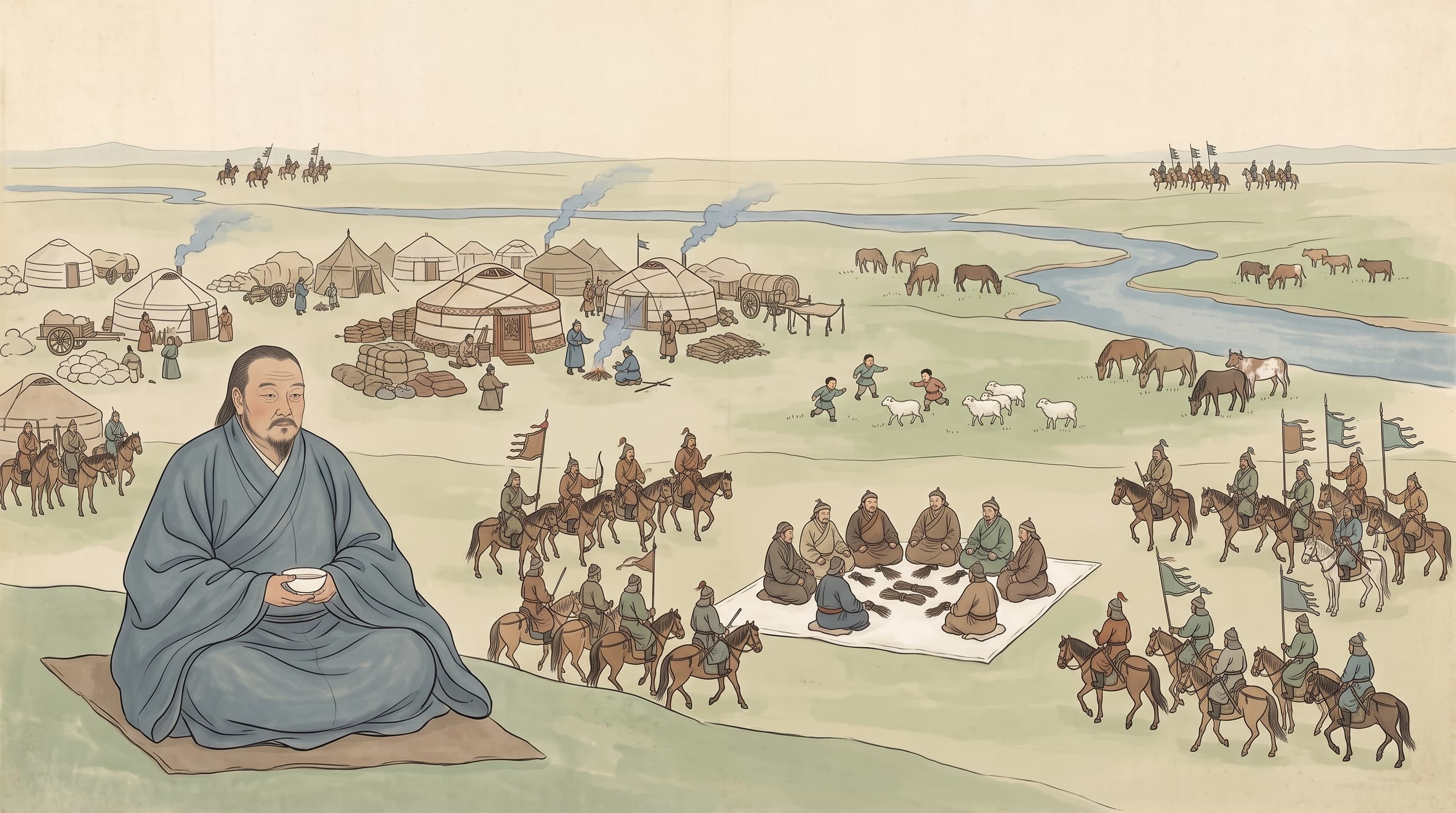
Spring 1206. At the Onon quriltai, Temüjin is acclaimed Chinggis Qa'an. The Kereit and Tatars have been broken and their people dispersed among new decimal commands, but Naiman and Merkit fugitives still ride west and the Oirat, Yenisei Kyrgyz and other forest peoples remain independent. The new Mongol polity has a formidable army but no fixed capital and no settled imperial administration: its unity depends on oaths, redistribution and the authority of the khan. Beyond the steppe, the Jin still holds Zhongdu, Song is opening the Kaixi War, Western Xia is convulsed by a palace coup, and Qara Khitai remains the overlord of Zhetysu, Khwarazm and the Kara-Khanid cities. You may embody a prince, khatun, commander, ruler, scholar or envoy at the moment when these separate political worlds first become vulnerable to one another.
Every turn uses the exact human-readable values from this schema. Spring 1206 begins immediately after Temüjin's quriltai: the Mongol Empire is real, but its conquest machine is not yet complete. Use the historical opening, not the familiar 1219 map: Qara Khitai is still the Inner Asian overlord; Khwarazm is its tributary; Samarkand and Bukhara are Kara-Khanid; Zhongdu is intact. MOVEMENT & CONDITION. terrain is the operational law. Steppe lets a Mongol or Kipchak army move and recover condition normally. Desert costs one condition band unless it ends at an Oasis or a friendly City; Mountain, Forest and Paddy halve cavalry effectiveness and make ambush or delay credible. Sown land sustains a city and its tax base but not a giant horse herd indefinitely. Do not create a separate horse or food scalar: an army's ability to remain is condition interacting with terrain. Split columns can each recover on separate Steppe cells and converge for battle; stacking them on one poor cell should make them Worn or Spent. BATTLE & ABSORPTION. Compare warriors, then condition (Mustered 1.15, Ready 1.0, Worn 0.8, Spent 0.6, Shattered 0.35), terrain, and relevant prestige. At 1.5× effective strength, the stronger side normally wins; the loser loses 25–45% warriors and one condition band. At 0.8×–1.25×, both lose 10–20%, neither cell changes allegiance. When the defeated force is a steppe people and its leader is captured, killed or accepts terms, 35–60% of survivors may transfer to the winner's warriors — but only after being redistributed across existing mixed commands. Leaving an absorbed origin intact raises its leader's loyalty risk; a useful former enemy may be recruited instead of killed. TERMS, DREAD & SUBMISSION. Before investing a city, the Mongol side offers terms. A Defiant city resists; Threatened may accept tribute if dread is high or relief is absent; Tributary pays and retains its people; Subject changes allegiance and contributes routes, tax and specialists. Devastated is reached only by a deliberate sack or punitive destruction, never by ordinary combat, and never leaves that state. Each devastation raises world dread by 8–15 (larger after a famous city); adjacent Defiant or Threatened places become easier to cow. Dread decays 3–5 in quiet years and is not a free win: devastation removes the tax base, specialists and future submission value. WALLS & SIEGECRAFT. siegecraft belongs to the entity leading the operation, not to an abstract empire: one player may command Chinese engineers while a distant prince still has None. At None, a walled City or Fortress cannot be stormed reliably; blockade, terms, betrayal, or rams and ladders are the available paths. Preserving captured engineers, scribes and artisans after a Subject or sacked city advances that leader's siegecraft one band when the capture genuinely supplies the expertise; the leader may then teach or assign those specialists to another entity. Killing or dispersing them does not. Chinese engineers are the historical threshold at which major northern walls become practicable; Counterweight trebuchets are a late-game capability, not a 1206 starting item. OATHS & SUCCESSION. loyalty changes one band at a time. Generosity, shared campaigning, hostages in the keshig, marriage, and public justice can raise it; humiliation, a broken promise, or concentrating old tribal comrades lowers it. khanate_unity rises after successful redistribution, settlement and public consensus; it falls when a prince is bypassed, a tribal bloc is left whole, or a Great Khan dies. At Fraying, distant Mongol armies may refuse orders and return; conquest pauses until a quriltai or a credible settlement restores unity. Prestige never jumps from a rumour: it rises one band through a witnessed victory, justice, generosity, or an important voluntary submission. HEALTH & TIME. health gates direct action. Dead removes a non-player character; name an heir or successor rather than erasing political consequences. Shaman, Khatun, Judge and Envoy actions may move loyalty, prestige or submission without warriors. Characters travel only through existing cells. Story time zone: Asia/Ulaanbaatar. The story starts in spring 1206.