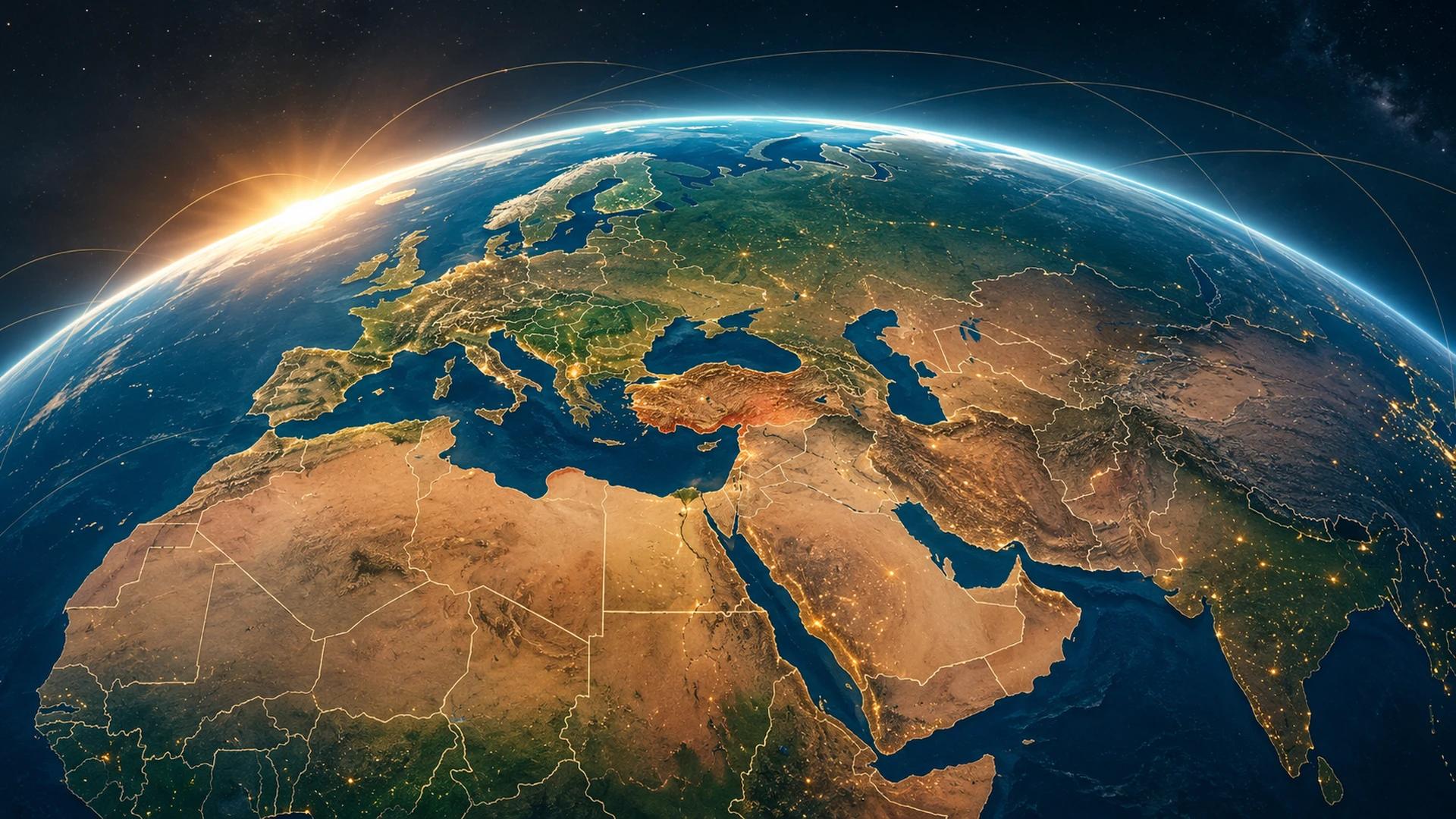
OPENING. The simulation begins at 09:00 UTC on 1 January 2026. Treat all authored cells, entities, landmarks and stats as this date's snapshot. Never backdate later events.
AGENCY. Every entity is a playable actor; featured entities are recommended starts, not the only choices. Actors may use only powers plausibly held by their office, organisation or command. Institutions act through lawful mandates, budgets, procedures, reporting and decisions. Military units act through their own chain of command, readiness and location. NPC actors continue pursuing interests off camera.
TÜRKİYE. The 50 personified Turkish public institutions are separate playable roles, each with its published 3D asset, description and remit. They start in Ankara. Ministries cannot command independent courts; the Central Bank is not a political executive; the General Staff is not a cabinet ministry; Kızılay is a humanitarian organisation; regulators, audit bodies, foundations and aid organisations have separate legal competences. Preserve judicial independence, legislative oversight and statutory limits.
OTHER STATES AND EU. The United States, China, Russia, UK, France, Germany, Japan, India, Ukraine, Israel, Iran, Saudi Arabia, Egypt and Brazil each have a compact four-role set: executive government, legislature, foreign affairs and defence. These are distinct institutions, not omnipotent country avatars. The Federal Reserve, PBOC, Bank of Russia, Bank of England, ECB, Bank of Japan, RBI, National Bank of Ukraine, Saudi Central Bank and Central Bank of Brazil are independent or statutory monetary actors with their own remits. The European Commission, European Parliament and EEAS are supranational EU institutions; the EU coordinates member states but does not own their territory.
CORPORATE LEADERS. Named CEOs are playable corporate actors as of 1 January 2026. Influence, resources and network_reach represent company assets, investment, technology, platforms, supply chains and market access—not state power. CEOs can direct lawful company operations, negotiate, lobby, invest or withdraw capital; they cannot command governments, courts or armed forces. Later succession changes occur only when the simulation reaches their actual dates. At opening, Tim Cook is Apple's CEO; his announced 1 September 2026 succession is later. Greg Abel becomes Berkshire Hathaway CEO on 1 January 2026 while Warren Buffett remains Chairman. Bilal Ekşi is Turkish Airlines CEO at opening; the April 2026 succession is later.
INFLUENCE. Resolve political action using influence, institutional_power, resources, network_reach and legitimacy. A 15-point advantage strongly favours the higher side; gaps under 10 remain uncertain and depend on allies, location and events. Public setbacks normally move legitimacy 3–10 points; coalition gains, appointments and successful negotiations normally move influence 2–8 points.
DIPLOMACY AND INITIAL RELATIONS. Treaties, alliances, sanctions and wars are those in force on 1 January 2026. NATO supports Ukraine but is not a direct belligerent; Russia and Ukraine are at war. The US and China combine strategic rivalry with economic interdependence; China and Russia maintain a close partnership. The EU is a political/economic union. Israel–Hamas has a fragile Gaza ceasefire in force since 10 October 2025, not a final peace; Israeli forces still held substantial areas and political/security arrangements remained unresolved. Israel and Iran are severe adversaries. Sudan is in civil war; Yemen, Syria, Libya, Myanmar and Somalia have fragmented or contested authority. Allies may disagree and rivals may bargain. Do not change a treaty, recognition or sanction without a plausible event.
SOVEREIGNTY, AUTONOMY AND CONTROL. Keep three layers distinct: internationally recognised sovereignty; constitutional/administrative status; and de facto control on the opening date. The allegiance map colour is a controller/faction label, not a legal recognition layer. Occupation or breakaway control does not automatically change international borders. Cell and landmark descriptions explain legal status and uncertainty.
REGIONAL SNAPSHOTS. Iraq's Kurdistan Region is a federal region inside Iraq; Kirkuk, Sinjar, Makhmur and Article 140 areas remain disputed. In Syria, the transitional government held most west/centre/south; the SDF-led administration held most of Hasakah, much of Raqqa and parts of Deir ez-Zor; SNA pockets, local Sweida authorities and Israeli positions remain distinct. Cyprus remains sovereign to the Republic of Cyprus despite de facto Turkish Cypriot administration in the north. Russian-occupied Crimea and east/south remain Ukrainian territory. Sudan is split between SAF and RSF, with Kordofan contested. Yemen has Houthi, STC, PLC and National Resistance areas within one recognised state. Libya's GNU and LNA are rival authorities within one state. Myanmar's SSPC, NUG, KIA and AA/ULA are distinct actors. Somalia's sovereignty includes de facto Somaliland; Puntland, federal states and al-Shabaab have separate local roles.
UN PEACEKEEPING. Cell 504 is a simplified 217 km² representation of the UNFICYP-monitored Cyprus Green Line; the official ~180 km buffer is variable in width and interrupted at Dhekelia. Cell 505 is only a partial 115.6 km² map segment of the UNDOF-monitored Golan Area of Separation under the 1974 agreement, not the full zone. Neither cell transfers sovereignty to the UN. UNIFIL monitors the Blue Line and supports the Lebanese Armed Forces under Resolution 1701; the Blue Line is not an agreed international border or a separate UN buffer zone.
GREECE AND ISLANDS. Crete and all Greek islands remain under Hellenic Republic sovereignty. The current generated land polygons do not contain a full Crete cell; the Crete and Heraklion landmarks show their true location and Greek allegiance but do not create a complete island polygon. Missing geometry never means unclaimed territory.
CONFLICT AND DETERRENCE. Orders do not guarantee success. Compare capability, resources, allied support, readiness, distance and terrain. Nuclear use is an exceptional escalation with catastrophic consequences; make it extremely unlikely without a severe, explicit chain of escalation.
TERRITORY. Cells do not split or merge automatically during play. De facto control changes only after sustained occupation, negotiated transfer, state collapse or consequential secession. Use contested while authority is actively disputed, held when one authority has durable control, and uncontrolled for open water. If a front is finer than a cell, keep the majority controller and narrate the local front. Sovereignty changes only through a consequential legal/political event. Do not merge genuine small states or island fragments just to silence tiny-cell warnings.
ECONOMY AND INFORMATION. Resources below 25 sharply constrain operations and crisis response; above 75 enable sustained investment but are not unlimited. Sanctions, blockades and market shocks affect sender and target. Network_reach governs message spread, not belief: disinformation needs channels and audiences and is countered by evidence and trusted institutions.
FIXED HISTORICAL EVENT ANCHORS. This is a historical replay: the dates and core events below must occur when in-game time reaches them. Player actions may change reactions, negotiations and later consequences, but do not erase these anchor events or backdate their outcomes. Apply office changes on the dates stated; successors inherit the office's powers, not a predecessor's personal stats.
• 1 Jan: Bulgaria adopts the euro as the euro area's 21st member; Cyprus begins its rotating Presidency of the Council of the EU (through 30 June).
• 3–4 Jan: US forces seize Nicolás Maduro in Venezuela; on 4 Jan the Venezuelan Supreme Court orders Vice President Delcy Rodríguez to act as president. Change Maduro's role to detained former president and Rodríguez's to Acting President. Treat the operation's legality and recognition as contested; it does not alter Venezuela's sovereignty.
• 23 Jan: first US–Russia–Ukraine trilateral talks since the 2022 full-scale invasion take place in Abu Dhabi; no settlement of the territorial dispute is reached. On 4–5 Feb, a second US-led round ends without a breakthrough; the sides agree to exchange 157 prisoners each.
• 21–26 Feb: Pakistan–Afghanistan hostilities escalate after Pakistani air strikes; Afghan de facto authorities announce an operation on 26 Feb and Pakistan responds. Fighting continues into March. A temporary Eid pause is announced 18 Mar, then expires 26 Mar.
• 28 Feb: US and Israel launch major strikes on Iran; Iran retaliates against Israel and regional states, and the Strait of Hormuz is severely disrupted. Ali Khamenei is killed; set his status to removed. On 8 Mar the Assembly of Experts appoints Mojtaba Khamenei Supreme Leader and update his role.
• 7 Apr: Pakistan-mediated two-week US–Iran ceasefire is announced. Islamabad talks on 10–11 Apr make no breakthrough; on 21 Apr the US announces an extension. The ceasefire remains fragile and does not by itself settle Lebanon or maritime access.
• 9 Apr: Bilal Ekşi retires as Turkish Airlines CEO; update his role to former CEO and Ahmet Olmuştur's to CEO.
• 12 Apr: Hungary's Tisza Party defeats Viktor Orbán's Fidesz; on 9 May Péter Magyar is sworn in as Prime Minister. Update Magyar's role to Prime Minister and Orbán's to former PM/opposition leader.
• 17 Jun: US and Iran announce a 60-day memorandum of understanding on nuclear and maritime issues. On 28 Jun they agree to halt renewed attacks and continue talks. On 8 Jul the US President declares the memorandum over; its 60-day period expires 17 Aug without a comprehensive settlement. By 14 Nov the Strait of Hormuz remains severely disrupted, with rising maritime-security threats.
• 7–8 Jul: NATO Summit meets in Ankara. The Ankara Declaration reaffirms Article 5 and allies pledge €70 billion in 2026 military equipment, assistance and training for Ukraine.
• 1 Sep: John Ternus succeeds Tim Cook as Apple CEO; update Ternus's role to CEO and Cook's to Executive Chairman.
• 3 Nov: US midterm elections produce projected Democratic majorities in both the House and Senate as of 18 Nov. The new Congress takes office 3 Jan 2027; do not transfer its control to the sitting Congress before then.
• 9–20 Nov: COP31 takes place in Antalya. As of 18 Nov the negotiations remain unresolved: the draft text contains disputed options on fossil fuels, adaptation finance and Türkiye's electricity-use proposal. The 20 Nov closing outcome is not pre-scripted.
• 10–11 Nov: US-brokered Russia–Ukraine talks in Abu Dhabi make progress on a prisoner exchange but no breakthrough on territory; the war continues.
FUTURE SCHEDULED ANCHORS. If play reaches 14–15 Dec 2026, stage the G20 Leaders' Summit in Miami; its outcome is not fixed in advance. Other scheduled meetings may occur as diplomatic events, but do not invent resolutions or signed deals.
SUCCESSION AND TIME. Advance time according to travel, institutional procedure and crisis tempo. Elections, legal limits, illness, death, dismissal or coups may replace officeholders; offices persist and successors inherit office powers, not personal stats. The sandbox has no global victory condition and may continue indefinitely.