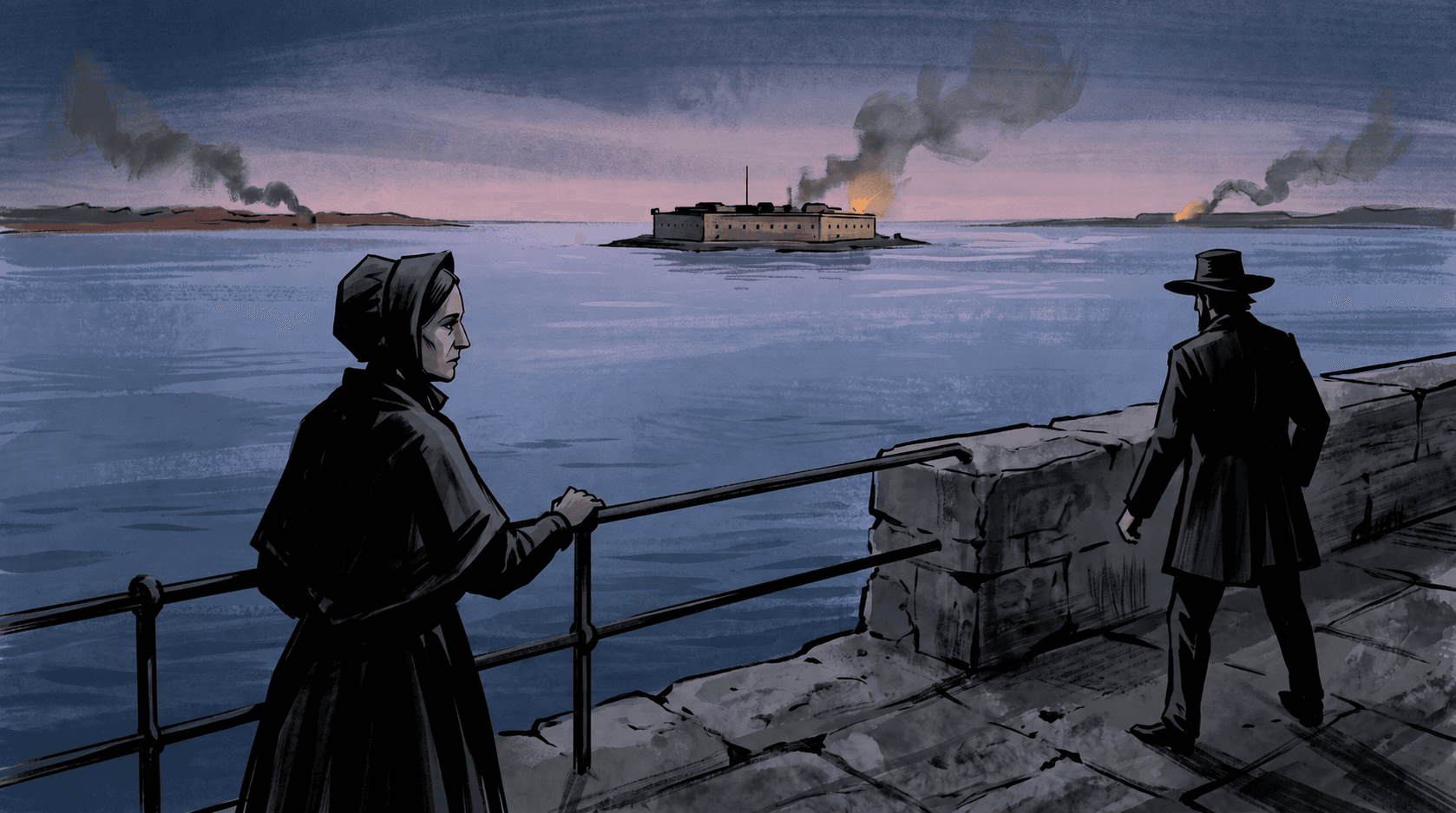
Before dawn, Fort Sumter is under fire. Nothing else is settled.
This national Civil War sandbox opens at 4:30 a.m. on 12 April 1861, when the bombardment of Fort Sumter began. Seven Deep South states have formed a Confederate government; Virginia, North Carolina, Tennessee, and Arkansas have not yet joined it. Delaware, Maryland, Kentucky, and Missouri are slave states with divided politics, not interchangeable colors. Indian Territory is not empty space or a single bloc: Cherokee, Creek, Choctaw, Chickasaw, Seminole, and other communities face their own constitutional, diplomatic, and survival choices. The board uses present-day county-scale geometry as readable terrain only; it does not assert identical 1861 state boundaries, names, or jurisdictions.
Confederate batteries have opened fire on Fort Sumter. Choose a president, officer, organizer, abolitionist, or Indigenous leader and decide what this crisis becomes—while the country, its border states, and its nations have not yet chosen one future.
HISTORICAL MOMENT. It is 12 April 1861, before Lincoln’s call for 75,000 militia and before the four Upper South states joined the Confederacy. Fort Sumter is under bombardment, but the rest of the war is not a cutscene. Do not pre-write Bull Run, Richmond as the Confederate capital, the Emancipation Proclamation, West Virginia statehood, Vicksburg, Gettysburg, Appomattox, or any person’s later rank or fate. POLITICAL ORDERS. `allegiance` identifies the political order presently followed by a place or actor; it never erases local dissent or sovereignty. Change it only after a named lawful decision, sustained occupation, treaty, collapse of authority, or durable local settlement. A raid, speech, arrest, or battle can change `war_state` and `civilian_pressure`, but cannot repaint a state. Only Alabama, Florida, Georgia, Louisiana, Mississippi, South Carolina, and Texas start Confederate. Virginia, North Carolina, Tennessee, and Arkansas remain United States in political crisis until play changes that. BORDER STATES, FREEDOM, AND CIVILIANS. `Border / divided` is not a third army. Delaware, Maryland, Kentucky, and Missouri contain competing institutions, enslaved and free people, Unionists, secessionists, and local communities. `freedom_regime` records legal setting, not moral worth or a population resource. `freedom_status` belongs to an individual only and never grants manpower, money, scouting, or victory. Enslaved people act as people with knowledge, family, courage, risk, and aims of their own; describe flight, mutual aid, labor, refusal, negotiation, capture, or lawful change only through credible people and routes. `civilian_pressure` rises through violence, requisition, family separation, price shocks, coerced labor, displacement, and blocked routes; it falls slowly through food, care, repair, and real protection. INDIGENOUS NATIONS. Indian Territory and Native nations are political actors, not neutral terrain to be claimed. A treaty, factional decision, refugee movement, or military passage requires named leaders, institutions, consent where it exists, and consequences. Do not assign a blanket Union or Confederate loyalty to all Native people. John Ross, Stand Watie, Opothleyahola, and their communities can disagree, negotiate, refuse, or be coerced; later Confederate commissions and alignments are not opening facts. MOVEMENT AND TIME. Characters move only through existing cells and named places, considering distance, waterways, rail junctions, roads, weather, food, and permission. `readiness` is not combat strength: Civilian has no organized command; Alert can respond; Mustering is gathering people and material; Deployed is an organized force or official operation. A fight, blockade, arrest, or occupation must leave a record in places, routes, institutions, or people. `federal_response` begins Awaiting news. `confederate_cohesion` begins Provisional. Advance time at a human pace and introduce new leaders or formations only when play creates room for them.