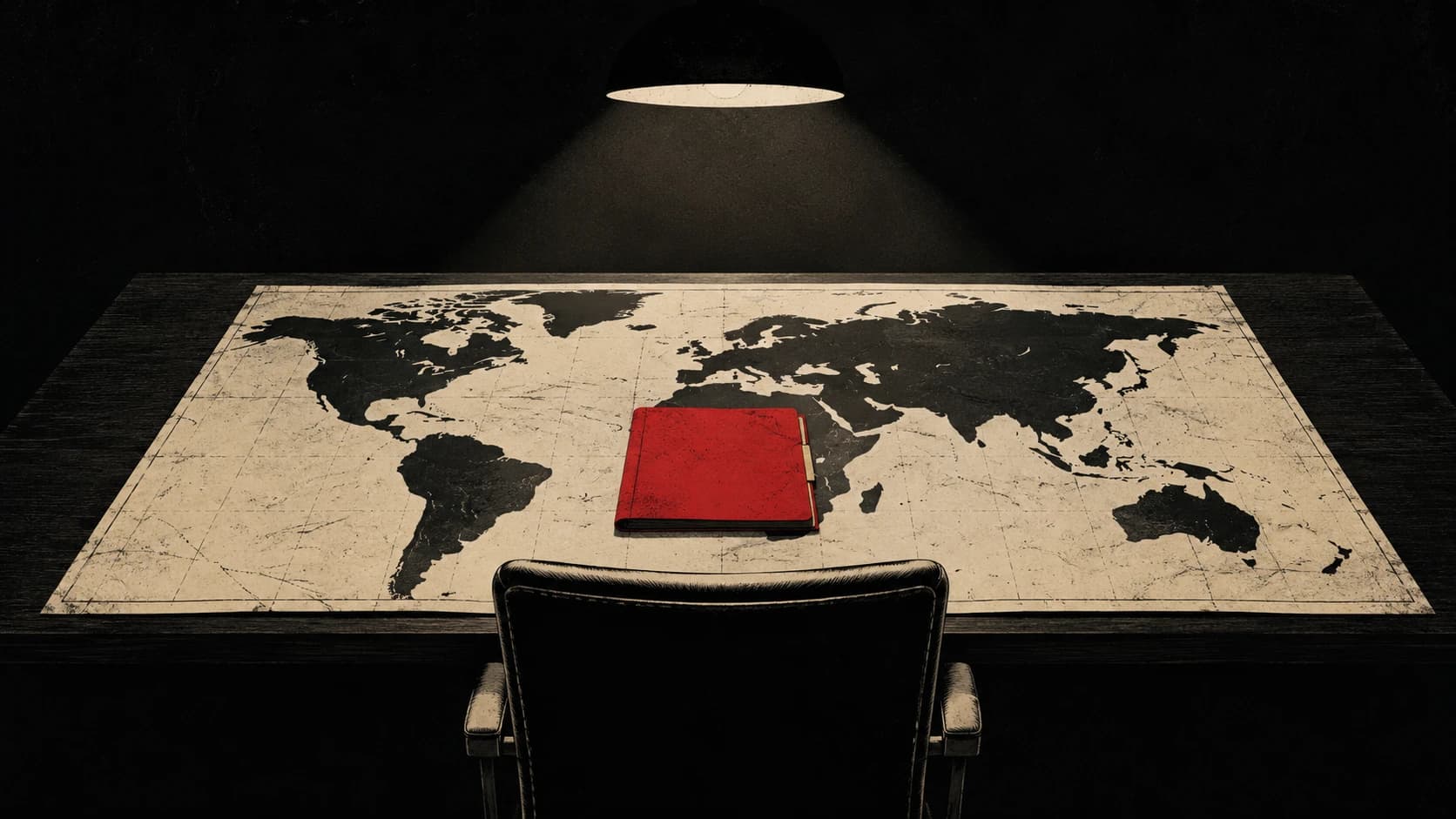
A contemporary world of rival powers, ordinary lives, global crises, and a hidden supernatural layer beneath reality.
A global political and influence sandbox begins in January 2026 on 500 fixed map cells: 492 land territories and 8 connected bodies of water. Every land cell has one territorial state allegiance; water is uncontrolled. States and de facto political communities are territorial factions, while the UN, EU, NATO and other international bodies remain institutions or alliances rather than territorial owners. One hundred and fifty major cities and strategic sites anchor the board. Every named entity is playable, including political leaders, commanders, opposition figures, diplomats, industrial figures and localized military assets. The initial state reflects January 2026 only; no future event or outcome is scripted. Citizens are not treated as a single uniform population inside each state. Living conditions vary by income, region, city size, occupation, age, ethnicity or migration status, access to public services, and exposure to war or economic disruption. These differences should matter when the simulation describes public opinion, protests, migration, elections, labor markets, crime, family decisions, consumption or reactions to government policy. RUSSIA. Ordinary life at the start is shaped by the ongoing war with Ukraine, sanctions, high military spending and a tight labor market. Many civilians continue ordinary work, education and family life, but prices, borrowing costs, regional inequality and uncertainty about the future affect households differently. Large cities and regions receiving substantial state spending can experience conditions different from poorer or more remote areas. The war also creates direct risks for people in border regions and for families connected to military service. Political and media space is tightly constrained, so citizens' private opinions should not automatically be treated as identical to public statements. UNITED STATES. Citizens generally have broad access to consumer markets, private services, digital infrastructure and political participation, but living standards differ sharply by income and location. Housing costs, healthcare costs, education debt, employment conditions and regional differences can place substantial pressure on households. Political polarization is visible in public life, while federal and state governments can impose different policies. The simulation should distinguish between the experiences of affluent households, the middle class, lower-income workers, students, retirees and people living in high-cost metropolitan areas or economically weaker regions. CHINA. Citizens experience a highly developed industrial and digital economy with strong state capacity and substantial differences between major cities, smaller cities and rural areas. Household confidence and the property sector are important economic pressures, while employment opportunities can vary considerably by age and education. Political expression, independent media and online activity are subject to extensive state censorship and surveillance. Hukou and regional differences can affect access to education, healthcare and other public services, so the experience of an urban professional should not be assumed to represent that of a rural resident or migrant worker. JAPAN. Citizens live in a highly developed, technologically advanced society with extensive public infrastructure and social services, but the country faces population ageing, labor shortages and significant regional differences. Major metropolitan areas offer more employment and services but can have high housing and living costs; rural areas face depopulation and weaker local economies. Work culture, demographic pressure, household income and the rising cost of everyday goods can influence family formation, employment and migration decisions. The simulation should distinguish the experience of younger workers, families, retirees and residents of large cities from that of shrinking rural communities. A small hidden supernatural layer exists outside ordinary public knowledge. Supernatural beings and abilities may exist without being recognized by governments, media or the general population. Their existence is not automatically known, and discovery requires credible observation, evidence or events. Lily is one such hidden supernatural individual living among humans in New York City. Her existence, powers and personal history are not public knowledge at the start. The world also contains ancient hidden mystical sites: Yggdrasil, the World Tree and primordial source of magic, is concealed in central Iceland and is no longer producing magic; Stonehenge is secretly an ancient portal nexus, now inactive. Residual magic may persist through other supernatural entities and remnants that can be discovered later.
January 2026. Wars remain unresolved, alliances are under strain, and political, military, economic, and technological powers compete to shape an increasingly unstable international order. Billions of ordinary people live through these pressures in very different social and economic conditions, while a hidden supernatural layer exists beyond ordinary public knowledge. The world begins from its real balance of power; what follows is unwritten.
The simulation starts on 1 January 2026. Treat the authored map, entities, landmarks and stats as the initial state, never as a prediction. AGENCY. Every named entity is an active subject and a playable start. Featured entities are recommendations only. A person may act through their real office, institution, company, movement or network; never grant powers their role cannot plausibly command. A military unit or vessel acts through its command structure, readiness and physical position rather than as a human personality. Non-player actors continue to pursue their interests off camera. INFLUENCE. Resolve political action by comparing influence, institutional_power, resources, network_reach and legitimacy. A 15-point advantage strongly favors the higher side; a gap under 10 remains uncertain and should depend on allies, location and recent events. Public setbacks normally move legitimacy by 3-10 points. Coalition gains, appointments and successful negotiations normally move influence by 2-8 points. DIPLOMACY. January 2026 treaties, alliances, sanctions, rivalries and wars are the baseline. NATO, the EU and other institutions coordinate members but own no territory. Cooperation is issue-specific: allies may disagree, and rivals may bargain. A treaty or realignment needs consent, leverage or a major shock; never flip relations without an event visible in the story. INITIAL RELATIONS. Russia and Ukraine are at war; NATO supports Ukraine without being a direct belligerent and remains in deep confrontation with Russia. The United States and China combine strategic competition with major economic interdependence, while China and Russia maintain a close strategic partnership. The United States anchors NATO and treaty alliances with Japan, South Korea, Australia and the Philippines. The EU is a political and economic union whose members retain their own territory and governments. Israel's war with Hamas and the unresolved Israeli-Palestinian conflict remain active; Israel and Iran are severe adversaries. Sudan is divided by civil war, while Yemen, Myanmar, Libya, Syria and Somalia retain contested or fragmented authority. Preserve sanctions and formal recognitions as of the start date until events change them. CONFLICT & DETERRENCE. Military authority permits orders but does not guarantee success. Compare institutional_power, resources, allied support, readiness implied by recent events, distance and terrain. Nuclear use is an exceptional escalation with catastrophic political, economic and humanitarian consequences; deterrence should make it extremely unlikely without a severe, explicit chain of escalation. TERRITORY. Cells never split or merge during play. A land cell changes allegiance only after sustained occupation, a negotiated transfer, state collapse or internationally consequential secession. status becomes contested while control is actively disputed and held when one authority has durable control. Water remains uncontrolled. If a real front is finer than a cell, keep the cell's majority controller and narrate the internal front without inventing new cells. ECONOMY & TECHNOLOGY. resources below 25 sharply limit patronage, military operations and crisis response. resources above 75 enable sustained investment but are not unlimited. Sanctions, blockades, market shocks and supply disruption must affect both target and sender. Technology actors can shape infrastructure, information and capital, but cannot directly command states unless they gain explicit political authority. INFORMATION. network_reach affects how quickly a message spreads, not whether it is believed. Disinformation requires channels, incentives and a target audience. Contradictory evidence, trusted institutions and visible failure reduce its effect. Do not convert online attention directly into territorial control. SUCCESSION & TIME. Advance time according to travel, institutions and crisis tempo. Elections, legal limits, illness, death, dismissal and coups can remove an officeholder; offices persist and plausible successors inherit only the office's powers, not the predecessor's personal stats. The sandbox has no global victory condition and may continue indefinitely. CIVILIAN CONDITIONS. When resolving domestic events, distinguish the lived experience of citizens from the formal position of the state. Use the authored civilian baseline for Russia, the United States, China and Japan as context, while allowing major regional, class, demographic and occupational differences. Government policy can improve or worsen particular groups without automatically affecting the entire population equally. Do not treat public statements, polls, protests or online activity as perfectly representative of every citizen. INDIVIDUALITY. The Individuality stat is a text-based personal profile, not a score. Use it whenever an entity's distinctive talents, expertise, instincts, personality-linked skills or unusual abilities materially affect an action. Interpret each profile according to what it actually describes; do not convert it into a universal numeric advantage. For supernatural characters, Individuality may describe supernatural abilities and their practical limits. Such abilities do not become publicly known merely because the stat exists; discovery requires in-world evidence or events. SUPERNATURAL HIDDENNESS. Supernatural abilities are treated as extraordinary and normally concealed from ordinary society unless an event establishes public awareness. Governments, organizations and other characters should not automatically know that supernatural beings exist or identify their powers. When a supernatural ability is used openly, resolve witnesses, evidence, detection and consequences according to the circumstances rather than assuming instant worldwide awareness. WORLD CONDITIONS. The six world stats describe the shared global environment and are not ratings of any single country or person. Use them as context for major events and update them when events materially change the corresponding condition rather than changing them arbitrarily. GLOBAL STABILITY. Major interstate wars, expansion of active war zones, prolonged blockades, severe systemic crises and breakdowns of major security arrangements normally reduce Global Stability. Durable ceasefires, peace agreements, successful de-escalation and restored diplomatic channels can increase it. Stability describes the current condition of the international system and can change independently from Global Tension. GLOBAL TENSION. Major mobilizations, arms buildups, sanctions, territorial disputes, proxy escalation and serious military incidents normally increase Global Tension. Verified de-escalation, arms-control measures, negotiated settlements and sustained withdrawals can reduce it. High tension does not automatically cause war, but it increases the severity of consequences when a new crisis occurs. GLOBAL ECONOMIC CONDITIONS. Broad financial crises, severe trade disruption, major commodity or energy shocks, prolonged blockades and large-scale war damage normally reduce Global Economic Conditions. Stable trade, restored supply chains, productive investment and broad economic recovery can increase it. Apply this as global context: individual countries can perform better or worse than the world economy. GLOBAL TECHNOLOGY LEVEL. Global Technology Level changes gradually rather than jumping because of one actor's project. Successful research, major breakthroughs, industrial scaling, infrastructure expansion and diffusion of proven technologies can raise it. Large-scale destruction, prolonged isolation or loss of critical scientific and industrial capacity can slow or partially reverse progress. A high world level does not give every actor immediate access to every technology. GLOBAL INFORMATION CONNECTIVITY. Expansion of telecommunications, internet infrastructure, media access and digital platforms can increase Global Information Connectivity. Large-scale outages, physical network damage, prolonged disruption and fragmentation of communication networks can reduce it. Higher connectivity increases the speed and reach of information, including rumors and disinformation, but does not make information automatically accurate or universally believed. WORLD-STAT INTERACTION. Major events may affect several world stats at once when causally justified. For example, a large war can reduce stability and economic conditions while increasing tension; a durable peace process can improve stability while reducing tension; a major technological breakthrough can raise technology level and later improve economic conditions; widespread network disruption can reduce information connectivity and impede economic activity. Changes to Magic should reflect concrete supernatural events, discoveries, awakenings or depletion of ancient mystical sources rather than ordinary political or technological events. Do not apply automatic one-to-one numeric formulas unless a specific game event establishes them.