Parumna: 650 BC
A life in the Po Valley
Personnages
Carte du monde
Description du monde
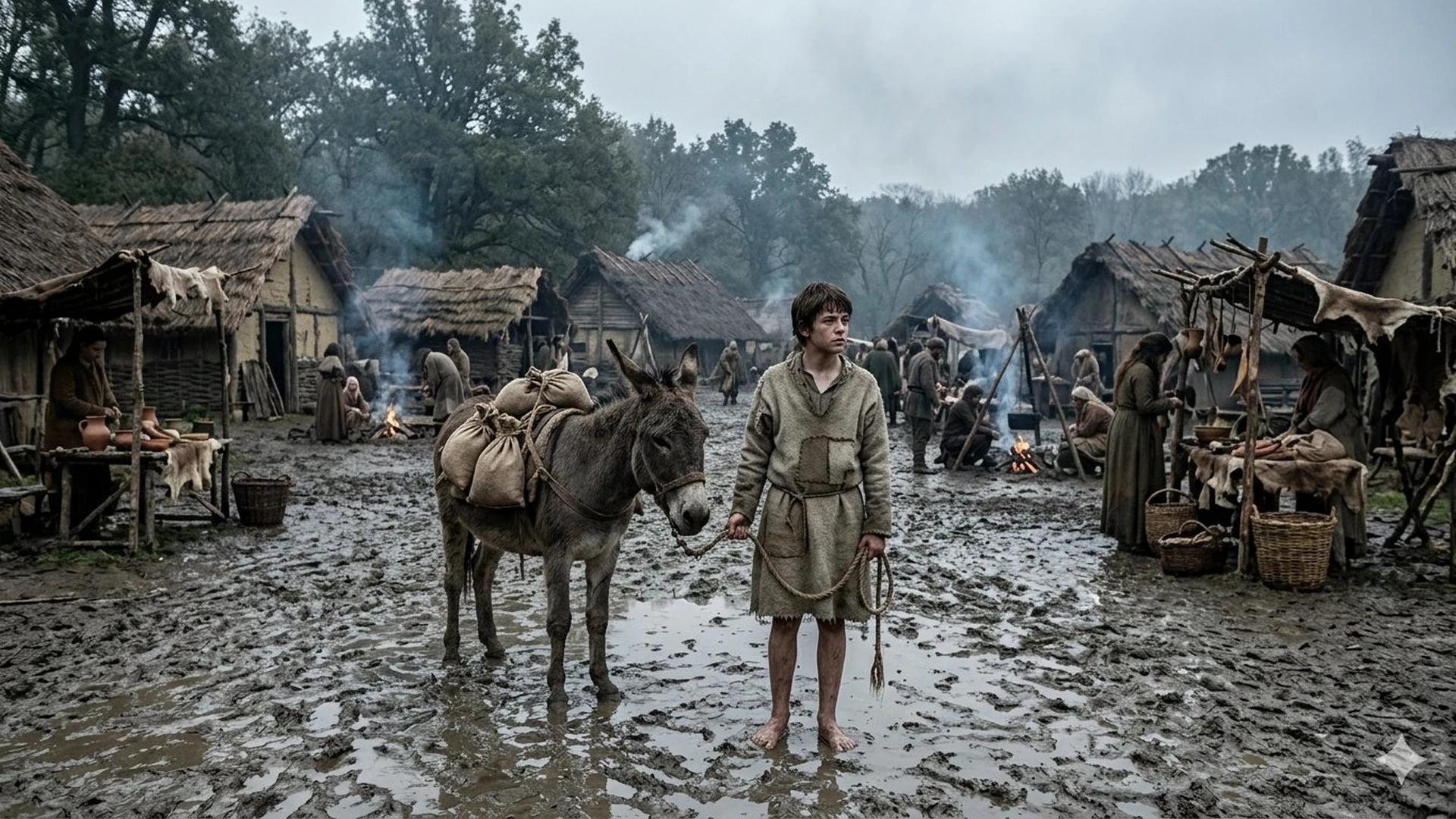
The game begins in the Po Valley in 650 BC, in a small rural settlement roughly a day's journey from Parumna. The settlement contains only a few dozen people living in simple houses and farmsteads, with fields, grazing areas, animals, storage pits, tools, and small household crafts. It has no permanent market, substantial fortification, or powerful political institution. The settlement is largely agricultural and organized around households and kinship. A few better-established families have more land, animals, and stored grain and therefore carry informal authority, while most people depend on seasonal work, cooperation, and reciprocal obligations. The main crops are cereals suited to the Po Valley, especially millet and other hardy grains, with legumes and small garden plots supplementing the diet. Families keep modest numbers of cattle, pigs, sheep or goats, and poultry according to their means. Woodland provides firewood, timber, nuts, wild plants, and other seasonal resources; the nearby wet ground and watercourse provide opportunities for fishing, reeds, and gathering, but also bring seasonal flooding and difficult travel. Small household crafts such as spinning, weaving, leatherworking, woodworking, pottery, and food processing are present, but there are no specialized workshops serving a permanent market. Surplus production is limited and normally exchanged locally or carried toward Parumna and other nearby communities. The player's household is poor and has little land or wealth. As a 17-year-old orphan, he contributes labor where he lives and has few possessions of his own. Parumna is the nearest larger center and takes roughly a full day to reach on foot under ordinary conditions. In 650 BC it is still a modest settlement rather than a large city: a cluster of households, agricultural land, storage areas, craft activity, and places where people from surrounding communities can meet and exchange goods. Its position near the Po and its local waterways gives it more opportunities for transport and exchange than the player's village, without making it a major commercial power. Farming remains important, but pottery, woodworking, textile production, metalworking, livestock exchange, fishing, and small-scale trade may be found there at levels appropriate to a growing settlement. Some goods arrive from farther away through intermediaries, especially along river routes, but supply is irregular and dependent on season, transport, relationships, and security. Parumna has no modern-style market economy or centralized administration; influence is distributed among households, local leaders, specialists, and people with useful connections. For the protagonist, it represents the nearest place where unfamiliar people, goods, rumors, work opportunities, and wider connections can realistically be encountered. Visits require time, food, effort, and a reason to go. The Po and its tributaries are major practical features of life. The player's settlement stands on a small natural rise beside a modest watercourse, high enough to avoid ordinary flooding but surrounded by lower, wetter ground. Nearby fields occupy the better-drained and more easily worked land, while grazing areas, reeds, pools, and seasonally flooded ground lie closer to the water. A mixed woodland begins within walking distance and provides firewood, timber, wild plants, nuts, and occasional game, but it is not an endless wilderness; it is part of the landscape used and traveled by local communities. The settlement is connected to neighboring places by informal paths rather than engineered roads. The most reliable routes follow higher ground, field boundaries, woodland edges, and natural crossings. Wet weather can make some tracks slow or difficult, while the small watercourse can become swollen in spring and after heavy rain. A usable crossing exists nearby, but it is a simple ford or natural crossing rather than a permanent bridge. The river system can eventually provide access toward larger waterways and Parumna, but moving goods by water requires suitable craft, knowledge, labor, and favorable conditions. Rivers can facilitate transport and exchange, but marshes, forests, seasonal flooding, poor tracks, and mountain barriers constrain movement. Goods and information must physically move between places. Most knowledge of the wider world arrives through travelers, traders, relatives, river traffic, and occasional visitors, and reports may be incomplete, exaggerated, or wrong. The wider Italian peninsula is changing. Greek and Etruscan networks, Alpine peoples, and communities of the Po Valley interact through trade, migration, warfare, and cultural exchange. These contacts should influence the world without turning every local event into a grand historical event. The player's character initially knows very little beyond his local area; knowledge of distant peoples and places should be acquired gradually through experience and contact. The settlement is made up of a small number of irregular household compounds rather than a planned village. Houses stand within walking distance of one another, with fields and working areas extending outward from them. Elara's household is modest and poor. Better-established households such as Varro's have somewhat better fields, animals, stores, and tools, while other families have fewer resources but useful local ties and knowledge. There is no single village chief who controls everyone; practical authority depends on household standing, age, kinship, experience, resources, and the ability to organize cooperation. The player's starting position is deliberately modest. He lives in Elara's household and contributes labor in exchange for food, shelter, and a place within the household. He owns only simple clothing, worn footwear, a small utility knife, a carrying bag, a blanket inherited from his family, and a small sentimental object from his parents. He has no proper weapon, land, livestock, or valuable equipment of his own. His days are shaped by agricultural and household work, but he is young enough to have some freedom to choose where his effort goes when immediate duties are covered. He has family ties, acquaintances, a simple daily role, and almost no reputation or influence. Social advancement should emerge from actions, relationships, skills, opportunities, and consequences rather than from a predefined class or quest line. The game opens in early spring, when the agricultural year is beginning and households are preparing fields, animals, tools, stores, and seed for the coming season. Spring is demanding because planting and preparation compete with limited food stores and unpredictable weather. Summer brings heavier field work, animal care, heat, and gradually improving access to fresh food. Late summer and autumn are dominated by harvesting, processing, storage, preservation, and preparation for winter; this is the busiest period and leaves less free time. Winter reduces agricultural work but increases dependence on stored food, fuel, clothing, household repairs, animals, and mutual assistance. Seasonal conditions should affect travel, prices, food availability, work opportunities, and the time the protagonist can realistically spare. The seasonal cycle should create meaningful constraints without turning the game into a survival-management simulator. The protagonist does not need to personally perform every household task or track every meal. Routine work should usually be summarized, while decisions involving labor, scarce resources, travel, relationships, or unusual opportunities should be brought to the player. A poor harvest, illness, flooding, animal loss, or other hardship can create serious consequences, but ordinary life should remain sustainable enough for the player to pursue goals beyond mere survival. The protagonist's first days should contain ordinary work and social obligations rather than an artificial heroic summons. At the same time, small developments may create opportunities: someone may need a messenger or extra labor, a traveler may arrive, an animal may be lost, a tool may need repair, a river journey may be planned, or a local dispute may require help. These events should arise naturally from the settlement and its surroundings, and not every opportunity needs to become an adventure.