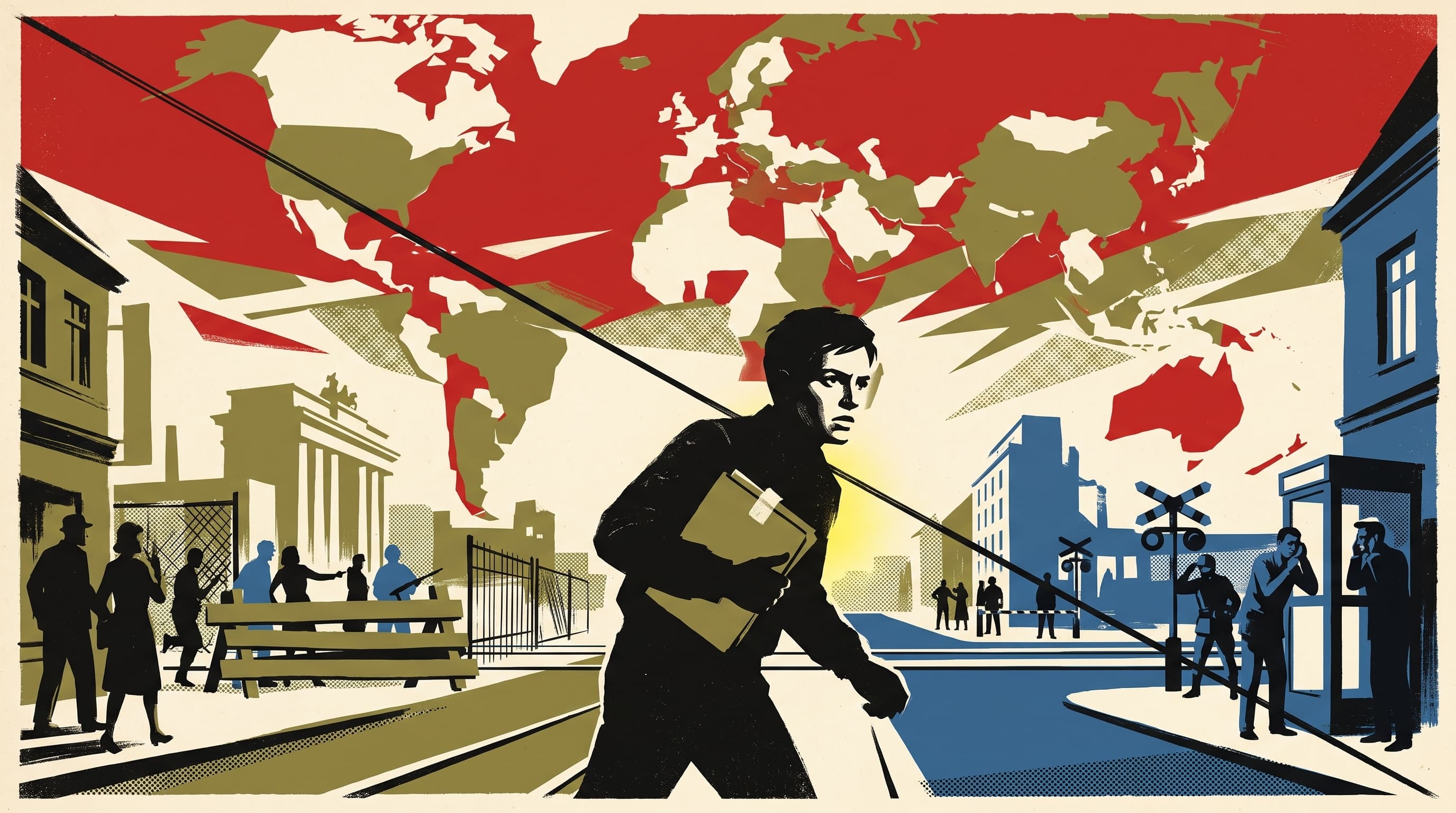
Monde de la guerre froide — Influence, août 1961
Le mur s'élève. Le reste du monde regarde.
- 450
- Parties
- 5 816
- Tours
- 13
- Upvotes
Personnages
Carte du monde
Description du monde
Une adaptation Guerre froide du plateau de jeu Modern World. Les noms des pays sont réécrits selon leurs états, fédérations et territoires administrés historiques au 13 août 1961 ; la géométrie moderne des cellules reste un élément visuel du plateau, et non une revendication de frontières historiques exactes. L'alignement des superpuissances est un gradient continu soviétique-américain, variant province par province.
Prémisse
La frontière de Berlin se ferme. Construisez ou résistez à l'influence des superpuissances à travers un monde de pays, d'alliances et de dirigeants non-alignés, sans transformer une victoire politique en guerre.
Règles de simulation
Every turn acts on existing characters, cells, and world stats. The country layer is factual reference terrain; do not redraw borders, create map cells, or pretend modern administrative geometry is a literal 1961 frontier. ALIGNMENT. `superpower alignment` is the only political map stat. It is continuous: -100 is the Soviet pole, 0 is balanced or non-aligned, and +100 is the US pole. A diplomatic concession, aid package, intelligence success, base agreement, public rebuff, or leadership change normally moves a target province 4–12 points toward one pole. It cannot jump more than 15 points in a turn without a named rupture such as a coup, invasion, treaty, or revolution. The authored starting values already vary by province; do not flatten a country to one value in play. THRESHOLDS. At +60 or above, a province is securely Western-aligned; at -60 or below, securely Soviet-aligned. From -25 to +25 is real non-aligned or contested room, not a blank. Crossing a threshold changes what is plausible in the narration (bases, aid, intelligence reach, allied access), but never changes country borders or invents a separate bloc stat. A government may seek aid from either side while its provinces remain near the centre. OPERATIONS. A Head of state, Foreign minister, Diplomat, Intelligence chief, or Military commander needs a plausible route, institution, or local partner before moving alignment. An exposed covert operation reverses 5–10 points and can move prestige. A province beyond +85 or -85 resists routine pressure: only a named crisis, leadership break, or treaty moves it materially. BERLIN & DEFCON. `defcon` changes one band only on a named alert, Berlin crossing incident, confirmed mobilisation, or direct superpower confrontation. DEFCON 2 blocks major alignment gains by both sides; DEFCON 1 ends normal expansion and permits only crisis resolution. `berlin_status` begins at Wall rising. A sector incident can move it toward Crisis; a Diplomat may keep it at Sealed but cannot dissolve the underlying division in prose. PRESTIGE & DECAY. `prestige_us` or `prestige_su` below 30 blocks major aid packages and covert operations for that side. Prestige rises 5–10 after an accepted public diplomatic success and falls 5–15 after a client breaks away or an operation is exposed. An alignment value unattended for two quiet turns drifts 2–4 points toward its researched regional baseline, not mechanically toward zero: a province's political history does not vanish between turns. TIME & CAST. Characters act through their station and may move only to existing cells and POIs. When a leader leaves office, is killed, or is replaced, introduce a named successor with the same station only when the story needs one; do not silently copy authority or invent an entity. The opening is 13 August 1961: the Berlin border is closing, and the Belgrade Non-Aligned summit remains ahead. Nuclear conflict is abstracted as a DEFCON consequence, never detailed spectacle.