Conquista mongola, 1206
Unisci un popolo — poi decidi quanto costa la conquista.
- 117
- Giochi
- 916
- Gira
- 3
- Voti positivi
Personaggi
Mappa del mondo
Descrizione del mondo
Questa tavola di 584 celle si estende dalla steppa del Mar Nero alla Corea, e dal Golfo Persico e Delhi alla taiga siberiana. È un'istantanea della primavera del 1206, non il familiare mondo mongolo del 1219 o 1227: i Qara Khitai dominano ancora le reti tributarie dell'Asia interna; il Khwarezm non è ancora in guerra con i Mongoli; Samarcanda e Bukhara sono kara-khanidi; Zhongdu non è stata assediata; Karakorum non esiste ancora. La tavola rende visibile la geografia strategica: pascoli e deserto governano la mobilità, la frontiera Jin e le mura cittadine impongono limiti reali, e i corridoi carovanieri legano le corti di Cina, Asia centrale, Iran e steppa. La fedeltà registra il controllo politico, la sottomissione registra la risposta ai termini mongoli e il terreno registra i vincoli materiali dietro le campagne. Le note dettagliate sulle fonti e le avvertenze sulle date sono conservate in research/.
Premessa
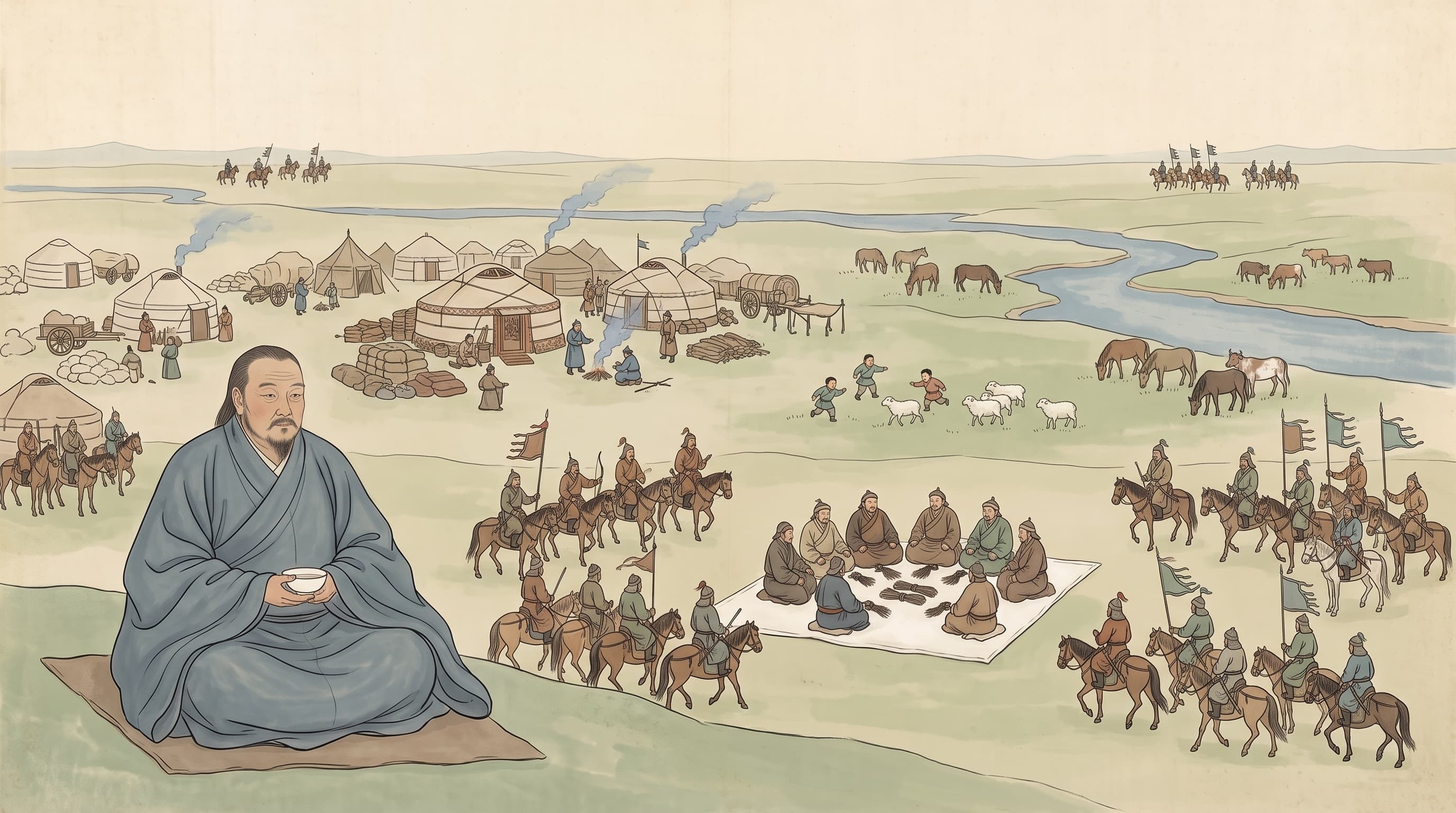
Primavera 1206. Al quriltai dell'Onon, Temujin viene acclamato Chinggis Qa'an. I Kereit e i Tatari sono stati distrutti e il loro popolo disperso tra nuovi comandi decimali, ma i fuggitivi Naiman e Merkit cavalcano ancora verso ovest e gli Oirati, i Kirghisi dello Yenisej e altri popoli della foresta rimangono indipendenti. La nuova entità politica mongola ha un esercito formidabile ma nessuna capitale fissa e nessuna amministrazione imperiale stabilita: la sua unità dipende dai giuramenti, dalla ridistribuzione e dall'autorità del khan. Oltre la steppa, i Jin detengono ancora Zhongdu, i Song stanno aprendo la guerra Kaixi, il Xia occidentale è sconvolto da un colpo di stato di palazzo e i Qara Khitai rimangono i signori di Zhetysu, del Khwarezm e delle città kara-khanidi. Puoi incarnare un principe, una khatun, un comandante, un sovrano, uno studioso o un inviato nel momento in cui questi mondi politici separati diventano per la prima volta vulnerabili l'uno all'altro.
Regole di simulazione
Every turn uses the exact human-readable values from this schema. Spring 1206 begins immediately after Temüjin's quriltai: the Mongol Empire is real, but its conquest machine is not yet complete. Use the historical opening, not the familiar 1219 map: Qara Khitai is still the Inner Asian overlord; Khwarazm is its tributary; Samarkand and Bukhara are Kara-Khanid; Zhongdu is intact. MOVEMENT & CONDITION. terrain is the operational law. Steppe lets a Mongol or Kipchak army move and recover condition normally. Desert costs one condition band unless it ends at an Oasis or a friendly City; Mountain, Forest and Paddy halve cavalry effectiveness and make ambush or delay credible. Sown land sustains a city and its tax base but not a giant horse herd indefinitely. Do not create a separate horse or food scalar: an army's ability to remain is condition interacting with terrain. Split columns can each recover on separate Steppe cells and converge for battle; stacking them on one poor cell should make them Worn or Spent. BATTLE & ABSORPTION. Compare warriors, then condition (Mustered 1.15, Ready 1.0, Worn 0.8, Spent 0.6, Shattered 0.35), terrain, and relevant prestige. At 1.5× effective strength, the stronger side normally wins; the loser loses 25–45% warriors and one condition band. At 0.8×–1.25×, both lose 10–20%, neither cell changes allegiance. When the defeated force is a steppe people and its leader is captured, killed or accepts terms, 35–60% of survivors may transfer to the winner's warriors — but only after being redistributed across existing mixed commands. Leaving an absorbed origin intact raises its leader's loyalty risk; a useful former enemy may be recruited instead of killed. TERMS, DREAD & SUBMISSION. Before investing a city, the Mongol side offers terms. A Defiant city resists; Threatened may accept tribute if dread is high or relief is absent; Tributary pays and retains its people; Subject changes allegiance and contributes routes, tax and specialists. Devastated is reached only by a deliberate sack or punitive destruction, never by ordinary combat, and never leaves that state. Each devastation raises world dread by 8–15 (larger after a famous city); adjacent Defiant or Threatened places become easier to cow. Dread decays 3–5 in quiet years and is not a free win: devastation removes the tax base, specialists and future submission value. WALLS & SIEGECRAFT. siegecraft belongs to the entity leading the operation, not to an abstract empire: one player may command Chinese engineers while a distant prince still has None. At None, a walled City or Fortress cannot be stormed reliably; blockade, terms, betrayal, or rams and ladders are the available paths. Preserving captured engineers, scribes and artisans after a Subject or sacked city advances that leader's siegecraft one band when the capture genuinely supplies the expertise; the leader may then teach or assign those specialists to another entity. Killing or dispersing them does not. Chinese engineers are the historical threshold at which major northern walls become practicable; Counterweight trebuchets are a late-game capability, not a 1206 starting item. OATHS & SUCCESSION. loyalty changes one band at a time. Generosity, shared campaigning, hostages in the keshig, marriage, and public justice can raise it; humiliation, a broken promise, or concentrating old tribal comrades lowers it. khanate_unity rises after successful redistribution, settlement and public consensus; it falls when a prince is bypassed, a tribal bloc is left whole, or a Great Khan dies. At Fraying, distant Mongol armies may refuse orders and return; conquest pauses until a quriltai or a credible settlement restores unity. Prestige never jumps from a rumour: it rises one band through a witnessed victory, justice, generosity, or an important voluntary submission. HEALTH & TIME. health gates direct action. Dead removes a non-player character; name an heir or successor rather than erasing political consequences. Shaman, Khatun, Judge and Envoy actions may move loyalty, prestige or submission without warriors. Characters travel only through existing cells. Story time zone: Asia/Ulaanbaatar. The story starts in spring 1206.