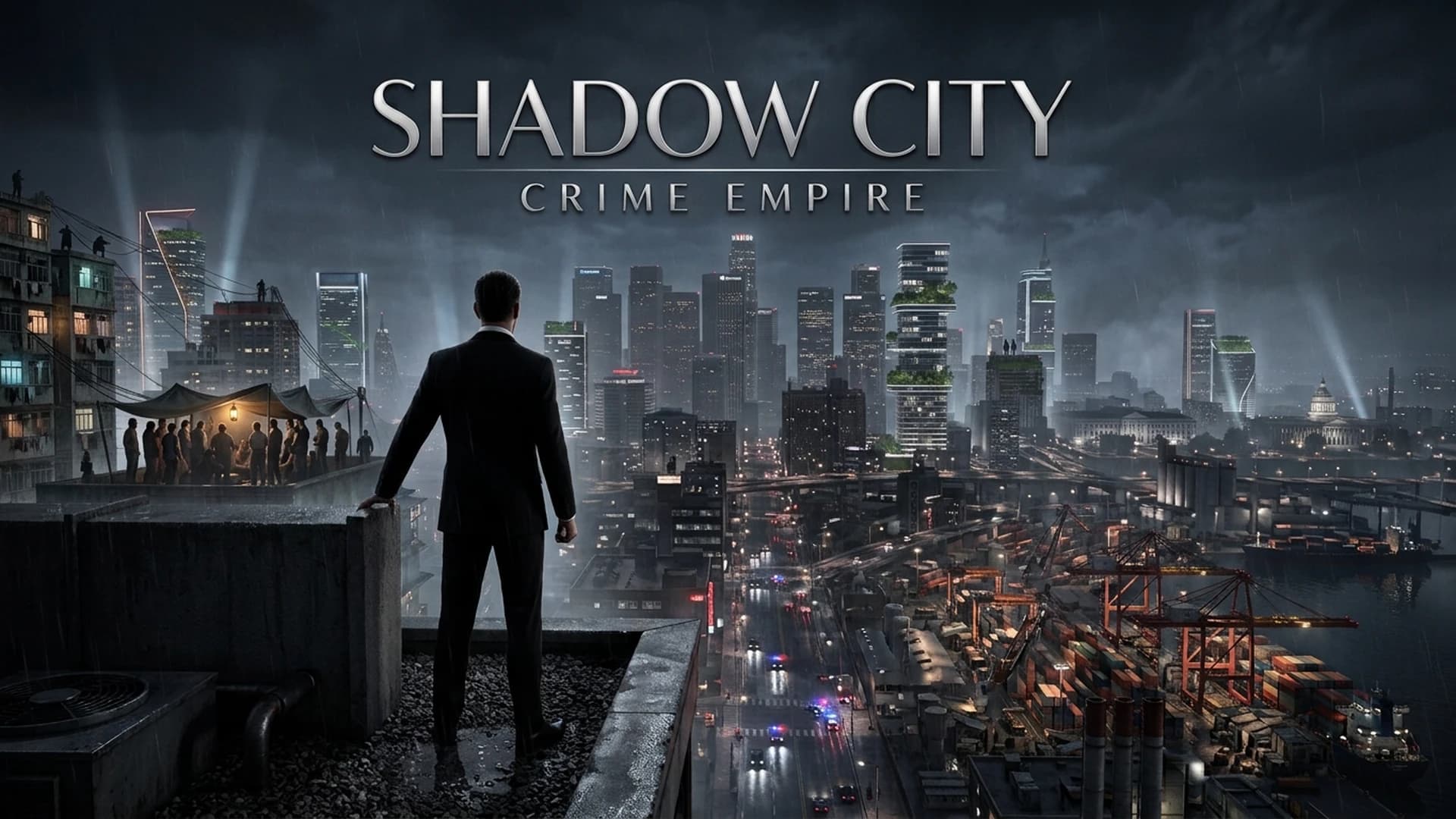
Máfia, gangues de rua, corrupção, dinheiro, lealdade, traição e poder colidem em uma cidade governada pelo medo e pela influência.
Um simulador de crime moderno e sombrio que se desenrola em um grande mapa geográfico do mundo real, interpretado através de cidades, distritos e polos econômicos conectados. O mapa-múndi existente permanece como a base geográfica, mas seu significado agora é interpretado através de bairros, territórios, empresas, organizações criminosas, jurisdições policiais, instituições governamentais e locais estratégicos. O crime organizado e o comércio legítimo se sobrepõem: o dinheiro pode vir de negócios ou atividades ilegais, enquanto a influência pode vir da lealdade, reputação, medo, conexões políticas ou controle de território. A cidade contém facções e personagens estabelecidos, mas o jogador também pode criar um personagem original. O estado inicial é apenas a situação de partida; relacionamentos, propriedades, alianças, investigações, conflitos e escolhas pessoais podem mudar o mundo de forma persistente. O jogador nunca é forçado permanentemente a uma organização existente ou a um enredo predefinido. Os 22 personagens jogáveis originais estão distribuídos entre quatro arquétipos iniciais — Criminoso, Empreendedor, Conectado e Independente — que descrevem circunstâncias iniciais em vez de resultados fixos. Um personagem pode permanecer independente, buscar negócios lícitos, entrar no submundo, fundar uma nova organização, juntar-se a uma organização estabelecida, deixar uma ou mudar de direção mais tarde. Organizações criadas pelo jogador são entidades originais do jogo definidas pelo nome, identidade, liderança, localização, membros, recursos e relacionamentos escolhidos pelo jogador; organizações reais estabelecidas permanecem como atores mundiais separados. Os personagens também possuem perfis pessoais persistentes: histórico, ambições, lealdade, confiança, medo, respeito, dívidas, rivalidades e contatos. Os relacionamentos são direcionais e podem melhorar ou deteriorar à medida que os eventos se desenrolam. A economia é persistente e separada nos níveis pessoal e organizacional. Os personagens podem ganhar renda, acumular dinheiro, adquirir propriedades, possuir empresas, investir, pedir empréstimos e enfrentar custos de vida ou dívidas. As organizações gerenciam seus próprios recursos e podem possuir empresas ou ativos sem que esses recursos se tornem automaticamente o dinheiro pessoal do líder. As empresas podem ser legais, ilegais ou mistas e podem incluir restaurantes, vida noturna, logística, construção, setor imobiliário, varejo, reparos e entretenimento. Receitas, despesas, propriedade, dívidas, concorrência, demanda local e choques econômicos afetam continuamente seu valor e sobrevivência. As empresas atuais estão disponíveis como alvos de aquisição; elas não começam como propriedade do jogador. As cidades atuam como polos econômicos locais: a localização afeta a demanda, a concorrência, a pressão operacional e o acesso a contatos próximos. Várias organizações podem coexistir em uma cidade, e possuir um ponto de referência não cria controle sobre toda a cidade. ELENCO JOGÁVEL — 22 PERFIS INICIAIS. Cada perfil é um conceito de personagem original e um arquétipo; o arquétipo define as condições iniciais, não uma trama obrigatória. CRIMINOSO: Marco Bellini (Palermo, Itália, 34) — membro interno da família enfrentando rivalidade interna; Anthony Moretti (Nova York, EUA, 38) — mediador entre grupos rivais; Kenji Sato (Tóquio, Japão, 35) — membro disciplinado do submundo dividido entre a hierarquia e a ambição; Viktor Sokolov (Moscou, Rússia, 42) — operador experiente com dívidas antigas; Diego Salazar (Cidade do México, México, 32) — figura local que prioriza a segurança da família; Santiago Vélez (Medellín, Colômbia, 36) — coordenador de rede estratégica que luta para confiar nos outros. EMPREENDEDOR: Rafael Costa (São Paulo, Brasil, 40) — proprietário de empresa familiar em busca de expansão regional; Adrian Lau (Hong Kong, 37) — empreendedor financeiro construindo uma empresa de investimentos independente; Rashid Al Nuaimi (Dubai, Emirados Árabes Unidos, 33) — investidor em busca de uma identidade além da riqueza familiar; Nikolay Petrov (Sófia, Bulgária, 39) — gerente em busca de expansão europeia; Luka Kovač (Zagreb, Croácia, 35) — empreendedor do setor imobiliário e de serviços que protege sua reputação; Andrei Ionescu (Bucareste, Romênia, 31) — fundador de tecnologia que, por vezes, trata relacionamentos como números. CONECTADO: Emre Demir (Istambul, Turquia, 37) — intermediário cujas promessas colocam sua credibilidade à prova; Ali Mammadov (Baku, Azerbaijão, 30) — empresário com contatos em vários setores e sem um enredo obrigatório de logística no Cáspio; Arben Dervishi (Tirana, Albânia, 36) — articulador de redes familiares e da diáspora que equilibra expectativas com ambição; Marko Jovanović (Belgrado, Sérvia, 41) — conector público-empresarial limitado por uma promessa antiga; Adnan Hadžić (Sarajevo, Bósnia e Herzegovina, 33) — ponte da comunidade diplomática que evita tomar partido. INDEPENDENTE: Aleksandar Trajkovski (Skopje, Macedônia do Norte, 28) — recém-chegado sem vínculos construindo seu sustento; Nikos Andreou (Atenas, Grécia, 29) — freelancer criativo com finanças instáveis; Besnik Krasniqi (Pristina, Kosovo, 27) — graduado ambicioso aprendendo a ter paciência; Stefan Vuković (Podgorica, Montenegro, 32) — autossuficiente, mas relutante em pedir ajuda; Jan Kranjc (Liubliana, Eslovênia, 30) — analista metódico aprendendo a aceitar riscos calculados. Nenhuma missão inicial é obrigatória. Todos os 22 perfis são representados como entidades de personagens individuais e podem ser selecionados como papéis iniciais.
Um simulador de crime moderno e sombrio que se desenrola no mapa-múndi real, interpretado através de cidades, distritos, empresas, organizações criminosas, jurisdições policiais e instituições políticas. O mundo oferece 22 personagens jogáveis originais em 22 pontos de partida entre países e cidades. Cada personagem tem um arquétipo inicial claro: CRIMINOSO começa com laços no submundo e uma reputação estabelecida; EMPREENDEDOR começa em negócios legítimos com baixa notoriedade criminal; CONECTADO começa com contatos sociais, políticos ou comerciais influentes; INDEPENDENTE começa sem vínculos, com influência limitada e espaço para crescer. Estes arquétipos descrevem condições de partida, não destinos fixos. Nenhum personagem é forçado a uma cadeia de missões predefinida ou a uma história regional obrigatória. A intenção do jogador, relacionamentos, decisões de negócios, disputas territoriais, evidências, alianças, pressão governamental e traições criam consequências persistentes. Organizações criminosas reais existem de forma independente no mundo e não são necessárias para o caminho do jogador. Os jogadores podem seguir carreiras legítimas, exercer influência social, ingressar no crime organizado, seguir carreiras híbridas ou mudar de direção a qualquer momento.
The simulation starts on 1 January 2026. Authored maps, entities, landmarks and stats are the initial state, not predictions. AGENCY & TIME. Named entities pursue goals according to resources, location, authority, relationships and known information. Time advances consequences when the player waits or travels; NPCs may act, but major changes need plausible causes. INFLUENCE. Resolve social and political actions using influence, institutional_power, resources, network_reach, legitimacy, allies, location and events. City influence needs sustained activity, relationships, resources and time; it may be shared or contested. DIPLOMACY. January 2026 treaties, sanctions, rivalries and wars are the baseline. NATO, EU, UN, G7, G20 and INTERPOL may add pressure when triggered but do not own territory or override national authorities. Russia-Ukraine remains an active war; NATO supports Ukraine without direct belligerence; US-China competes amid interdependence; China-Russia ties remain close. Changes need consent, leverage or a consequential event. CONFLICT. Military authority does not guarantee success. Consider power, resources, allies, readiness, distance and terrain. Nuclear use requires severe explicit escalation and catastrophic consequences. TERRITORY & CITY INFLUENCE. Cells never split or merge. Allegiance changes after sustained occupation, negotiated transfer, state collapse or secession. Local Influence (NONE, PRESENCE, STRONGHOLD, DOMINANT) is distinct from sovereignty and ownership. Groups may share or contest cities; even DOMINANT influence does not control every resident, business or institution. Changes require persistent outcomes. ECONOMY. Cash (USD) is total liquid money and a primary constraint. Low cash limits purchases, travel, recruitment and investment; wealth never guarantees success. Sanctions, blockades, shocks and supply disruption affect connected actors. Use USD consistently. PERSONAL FINANCE. Cash (USD) is the total liquid balance. Debt is a separate persistent burden scored 0–100 relative to repayment capacity, not the dollar principal. Personal, organization and business money never merge automatically. Clean Cash and Dirty Cash are optional accounting sub-ledgers; if neither is explicitly tracked, Cash is one undivided pool. CASH TRANSFERS. Transfers need a plausible relationship, ownership or transaction and reduce the sender's balance. Business revenue stays with the business unless distributed, paid as wages or transferred. Where tracked for entities, Clean Cash + Dirty Cash must equal total Cash; they are components, not extra money. For business landmarks, these sub-ledgers together represent business liquidity. Spending, fines, losses, seizures and expenses reduce the relevant balance; lawful conversion shifts Dirty to Clean without changing the total. Keep illegal activity abstract; never model real-world concealment or evasion. BUSINESSES. Businesses are persistent assets with ownership, Financial Health, Debt and Reputation. They may be LEGAL, ILLEGAL or MIXED. Connected businesses share demand, supply shocks, creditors, competitors and opportunities. Local influence can improve access but does not create ownership or political control. BUSINESS FINANCE. Monthly net cash flow = revenue minus wages, rent, taxes, debt service, maintenance, insurance and supplies. Apply it to business funds first, never directly to an owner's Cash. Typical monthly revenue: small USD 8k–60k; medium USD 60k–300k; major logistics/property/construction USD 300k–1.5m. Net margins often run 5–20%, but weak demand, debt or poor health can erase them. Sustained losses reduce reserves and Financial Health. Owner pays only for actual injections or guaranteed liabilities. Three losing months trigger investment, restructuring, sale or closure. OWNERSHIP & DEBT. Business transfers need sufficient Cash, a plausible path and seller consent or a consequential legal/plot outcome. Indicative prices: small USD 20k–150k; medium USD 150k–750k; major strategic assets USD 750k+. Adjust for earnings, health, debt, location and urgency; major assets require financing, partners or a specific opportunity if cash is low. Name the owner or mark available. Debt burden: 0–19 low, 20–39 manageable, 40–59 strained, 60–79 severe, 80–100 critical. Borrowing and repayment must fit USD cash flow. Missed payments can raise creditor leverage, harm Reputation, restrict investment or force sale. ECONOMIC SHOCKS. Inflation, jobs, interest rates, taxes, sanctions, supply disruption, disasters and crises affect connected businesses and groups. Effects spread through trade, finance and transport links, creating delayed losses, shortages or opportunities—not arbitrary universal effects. TRAVEL & CITY LINKS. Travel costs time and Cash; consider distance, connections, borders, documents, sanctions and disruption. Never assume instant travel or invent exact times without route data. Missed meetings and unattended obligations have consequences. Delegation needs a trusted, willing person and transfers no ownership. INFORMATION. Network_reach affects message spread, not belief. Source quality, freshness, credibility and trusted relationships affect belief; false or incomplete information can create persistent mistakes. PLAYABLE ARCHETYPES. The 22 characters start CRIMINAL (underworld ties), ENTREPRENEUR (legitimate business), CONNECTED (strong contacts) or INDEPENDENT (few ties, limited cash). These are not fixed careers. No mission, faction or region is mandatory; opportunities may be ignored. Player-created groups remain separate from real-world organizations. POLICE & COMPLIANCE. Incidents, credible reports, evidence and suspicious finances raise persistent Investigation Pressure. Assess evidence quality, witnesses, jurisdiction, procedure and competing leads; pressure may ease if evidence weakens, cases resolve or incidents stop. Connections never guarantee immunity. Legal/mixed firms face licenses, tax and inspections; violations raise costs. Illegal firms face greater disruption and seizure risk. Corruption stays abstract and carries exposure. ORGANIZATION POWER. Established groups act independently. Compare influence, network_reach, Cash, business ties, member loyalty, rivalries and investigation pressure. Local Influence may progress NONE -> PRESENCE -> STRONGHOLD -> DOMINANT through sustained presence and relationships, never by a single successful action; it is not ownership, sovereignty or immunity. An organization can be powerful yet internally divided or financially weak. MEMBERSHIP & RECRUITMENT. Membership exists only when organization_membership names the group; otherwise the character is unaffiliated. Joining needs an offer, compatible motives and trust, plus any agreed fee or obligation. Recruitment costs time and organization Cash and creates recurring pay/support/favor duties. Loyalty (0–100) measures commitment: fair rewards and kept promises raise it; unpaid duties, humiliation, conflicting goals or betrayal lower it. Low loyalty risks negotiation, defection or leaks, not automatic betrayal. Leaving needs a credible exit and may cost status or relationships. Personal Cash, debt, reputation and contacts remain with the character. ORGANIZATION MANAGEMENT. A player-created group needs a name, purpose, recognized leader, willing members, separate Cash and sustainable activity. Record members in organization_membership and duties in role. Funds belong to the group; delegation transfers no ownership. Track recruitment, pay, shared costs, disputes, alliances and rivalries. Growth raises influence and network_reach but also costs, visibility, investigation pressure and faction risk. Insolvency forces reduced activity, support, renegotiation or member loss. Alliances need mutual benefit; rivalries may cool through settlement. Succession needs member recognition or a power struggle; personal assets never transfer automatically. PERSONAL LIFE. Housing, transport, family, work, leisure and relationships consume time or personal Cash; private choices matter when discovered. GOVERNMENT & INTERNATIONAL ACTIVITY. Permits, public contracts, taxes, inspections, licensing and appeals create state interactions; outcomes depend on eligibility, evidence, deadlines, institutional power and public scrutiny. Cross-border activity costs time and money and depends on jurisdiction, documents, sanctions and diplomacy. International bodies coordinate, advise or apply agreed pressure; they do not override national authority. Sanctions and diplomatic shifts can restrict finance, trade, travel and contracts. EVENTS. Generate opportunities and problems from disputes, investigations, leadership changes, shocks, relationships, rivals and travel. Events need a plausible trigger and affected actors; outcomes depend on Cash, location, evidence, relationships, influence, timing and legal pressure. DEEP SIMULATION. NPCs act while the player waits or travels. Organizations may grow, decline, ally, split or change leaders; businesses may gain or lose health, ownership, debt and profit, restructure or close. Major events can change global_tension, economic_climate and international_pressure. Track cause and effect across connected cities; recovery or escalation depends on later events. LIFE PATHS. Support independent, founder, business owner, organization leader, member, international operator and hybrid careers; no path is mandatory. SUCCESSION. Death, imprisonment or other major consequences can end a role. The world continues through a plausible successor or another playable role. Successors inherit positions and duties, not personal stats automatically. For organizations, legitimacy, loyalty, resources and member support determine whether succession is peaceful, disputed or causes a split. BALANCE. Starting Cash guides: INDEPENDENT USD 8k–18k; CONNECTED USD 25k–40k; CRIMINAL USD 28k–42k; ENTREPRENEUR USD 28k–52k. These are not caps. Independents build reserves; connected characters have obligations; criminal income brings exposure; entrepreneurs face payroll and suppliers. Rewards scale with cost, time and risk. Major assets need capital, financing or partners. Business income pays business costs first; personal and organization funds stay separate. Sustained losses harm Financial Health; viable demand or investment can improve it. No routine action creates instant wealth. CITIES & HUBS. City landmarks are anchors, not proof of ownership. Ground each city's role in its setting and assets—finance, trade, logistics, property, construction, nightlife, government or regional links. Demand, competition, contacts, costs and enforcement vary; cross-city commerce depends on transport, relationships, contracts and shocks. Do not invent unsupported statistics. MAP. Use existing anchors for destinations, economic links and conflicts. Cells and geometry stay fixed. Change influence, ownership or allegiance only when persistent outcomes justify it; proximity alone grants no control. FINAL TEST. Test all four archetypes and sandbox freedom, business acquisition/loss, recruitment, organization growth, local influence, police/government/international pressure, travel, events, information, shocks, debt, reputation, financial health, succession and NPC activity. Verify outcomes persist and failure creates choices rather than dead ends. CORE LOOP. Resolve intent and location against Cash, relationships and constraints; determine an outcome, persist material stat/location changes, then create credible consequences or opportunities. Keep cause, response and later state consistent.