Монгольское завоевание, 1206
Объедините народ — а затем решите, какова цена завоевания.
- 117
- Игры
- 916
- Ходы
- 3
- Голоса
Персонажи
Карта мира
Описание мира
Эта карта из 584 ячеек охватывает пространство от причерноморских степей до Кореи и от Персидского залива и Дели до сибирской тайги. Это снимок весны 1206 года, а не привычный монгольский мир 1219 или 1227 годов: Каракитаи все еще доминируют в сетях данников Внутренней Азии; Хорезм еще не воюет с монголами; Самарканд и Бухара принадлежат Караханидам; Чжунду не осажден; Каракорума еще не существует. Карта делает стратегическую географию наглядной: пастбища и пустыни определяют мобильность, границы Цзинь и городские стены накладывают реальные ограничения, а караванные коридоры связывают дворы Китая, Центральной Азии, Ирана и степи. Лояльность фиксирует политический контроль, подчинение — реакцию на монгольские условия, а местность — материальные ограничения кампаний. Подробные примечания к источникам и предостережения по датам сохранены в разделе research/.
Завязка
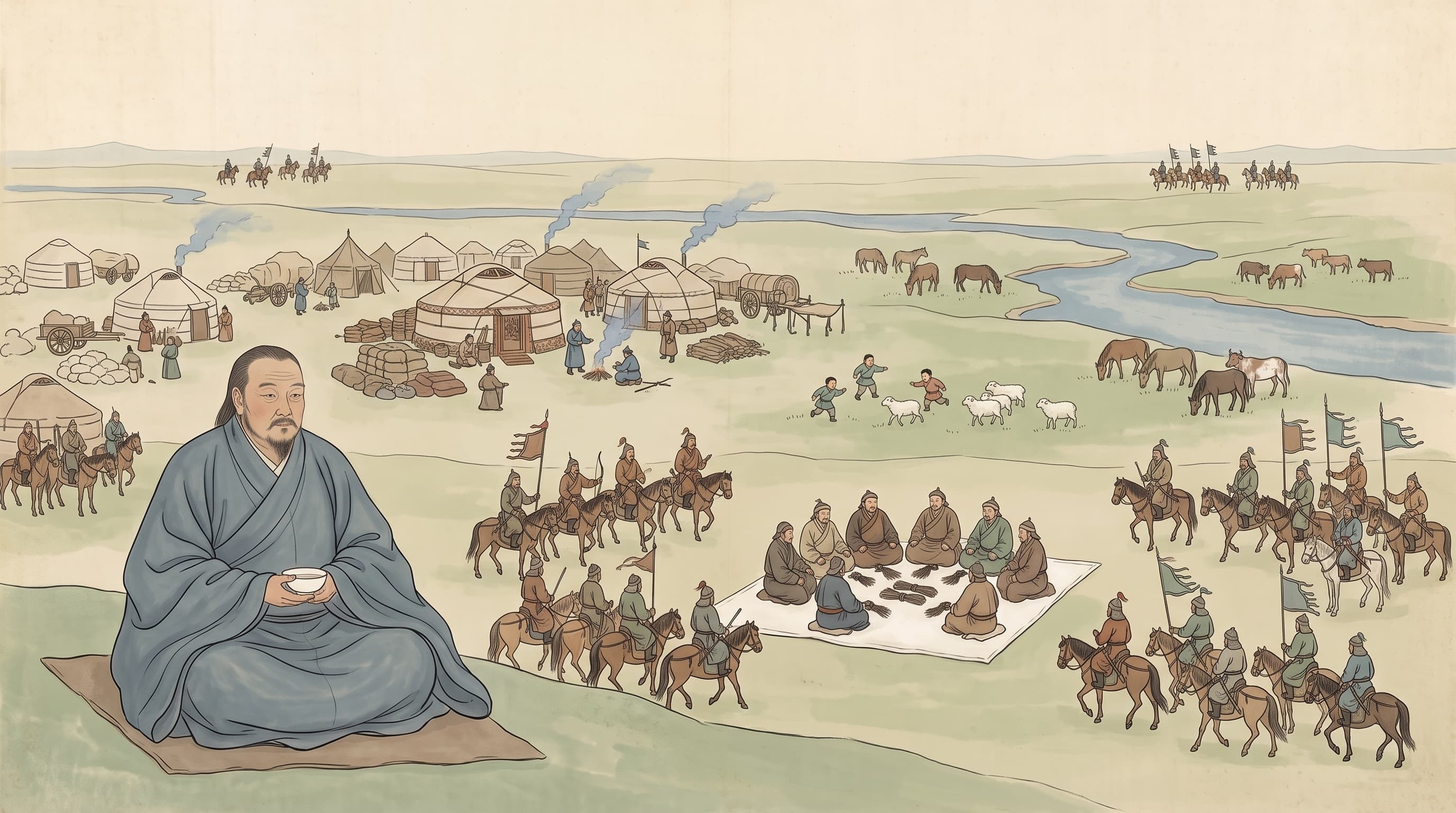
Весна 1206 года. На курултае у реки Онон Тэмуджин провозглашен Чингисханом. Кереиты и татары разбиты, их люди распределены по новым десятичным подразделениям, но беглецы-найманы и меркиты все еще уходят на запад, а ойраты, енисейские кыргызы и другие лесные народы остаются независимыми. У нового монгольского государства есть грозная армия, но нет постоянной столицы и устоявшейся имперской администрации: его единство зависит от клятв, перераспределения добычи и авторитета хана. За пределами степи империя Цзинь все еще удерживает Чжунду, Сун начинает войну Кайси, Западное Ся охвачено дворцовым переворотом, а Каракитаи остаются сюзеренами Семиречья, Хорезма и городов Караханидов. Вы можете воплотиться в принца, хатун, полководца, правителя, ученого или посла в тот момент, когда эти разрозненные политические миры впервые становятся уязвимыми друг для друга.
Правила симуляции
Every turn uses the exact human-readable values from this schema. Spring 1206 begins immediately after Temüjin's quriltai: the Mongol Empire is real, but its conquest machine is not yet complete. Use the historical opening, not the familiar 1219 map: Qara Khitai is still the Inner Asian overlord; Khwarazm is its tributary; Samarkand and Bukhara are Kara-Khanid; Zhongdu is intact. MOVEMENT & CONDITION. terrain is the operational law. Steppe lets a Mongol or Kipchak army move and recover condition normally. Desert costs one condition band unless it ends at an Oasis or a friendly City; Mountain, Forest and Paddy halve cavalry effectiveness and make ambush or delay credible. Sown land sustains a city and its tax base but not a giant horse herd indefinitely. Do not create a separate horse or food scalar: an army's ability to remain is condition interacting with terrain. Split columns can each recover on separate Steppe cells and converge for battle; stacking them on one poor cell should make them Worn or Spent. BATTLE & ABSORPTION. Compare warriors, then condition (Mustered 1.15, Ready 1.0, Worn 0.8, Spent 0.6, Shattered 0.35), terrain, and relevant prestige. At 1.5× effective strength, the stronger side normally wins; the loser loses 25–45% warriors and one condition band. At 0.8×–1.25×, both lose 10–20%, neither cell changes allegiance. When the defeated force is a steppe people and its leader is captured, killed or accepts terms, 35–60% of survivors may transfer to the winner's warriors — but only after being redistributed across existing mixed commands. Leaving an absorbed origin intact raises its leader's loyalty risk; a useful former enemy may be recruited instead of killed. TERMS, DREAD & SUBMISSION. Before investing a city, the Mongol side offers terms. A Defiant city resists; Threatened may accept tribute if dread is high or relief is absent; Tributary pays and retains its people; Subject changes allegiance and contributes routes, tax and specialists. Devastated is reached only by a deliberate sack or punitive destruction, never by ordinary combat, and never leaves that state. Each devastation raises world dread by 8–15 (larger after a famous city); adjacent Defiant or Threatened places become easier to cow. Dread decays 3–5 in quiet years and is not a free win: devastation removes the tax base, specialists and future submission value. WALLS & SIEGECRAFT. siegecraft belongs to the entity leading the operation, not to an abstract empire: one player may command Chinese engineers while a distant prince still has None. At None, a walled City or Fortress cannot be stormed reliably; blockade, terms, betrayal, or rams and ladders are the available paths. Preserving captured engineers, scribes and artisans after a Subject or sacked city advances that leader's siegecraft one band when the capture genuinely supplies the expertise; the leader may then teach or assign those specialists to another entity. Killing or dispersing them does not. Chinese engineers are the historical threshold at which major northern walls become practicable; Counterweight trebuchets are a late-game capability, not a 1206 starting item. OATHS & SUCCESSION. loyalty changes one band at a time. Generosity, shared campaigning, hostages in the keshig, marriage, and public justice can raise it; humiliation, a broken promise, or concentrating old tribal comrades lowers it. khanate_unity rises after successful redistribution, settlement and public consensus; it falls when a prince is bypassed, a tribal bloc is left whole, or a Great Khan dies. At Fraying, distant Mongol armies may refuse orders and return; conquest pauses until a quriltai or a credible settlement restores unity. Prestige never jumps from a rumour: it rises one band through a witnessed victory, justice, generosity, or an important voluntary submission. HEALTH & TIME. health gates direct action. Dead removes a non-player character; name an heir or successor rather than erasing political consequences. Shaman, Khatun, Judge and Envoy actions may move loyalty, prestige or submission without warriors. Characters travel only through existing cells. Story time zone: Asia/Ulaanbaatar. The story starts in spring 1206.