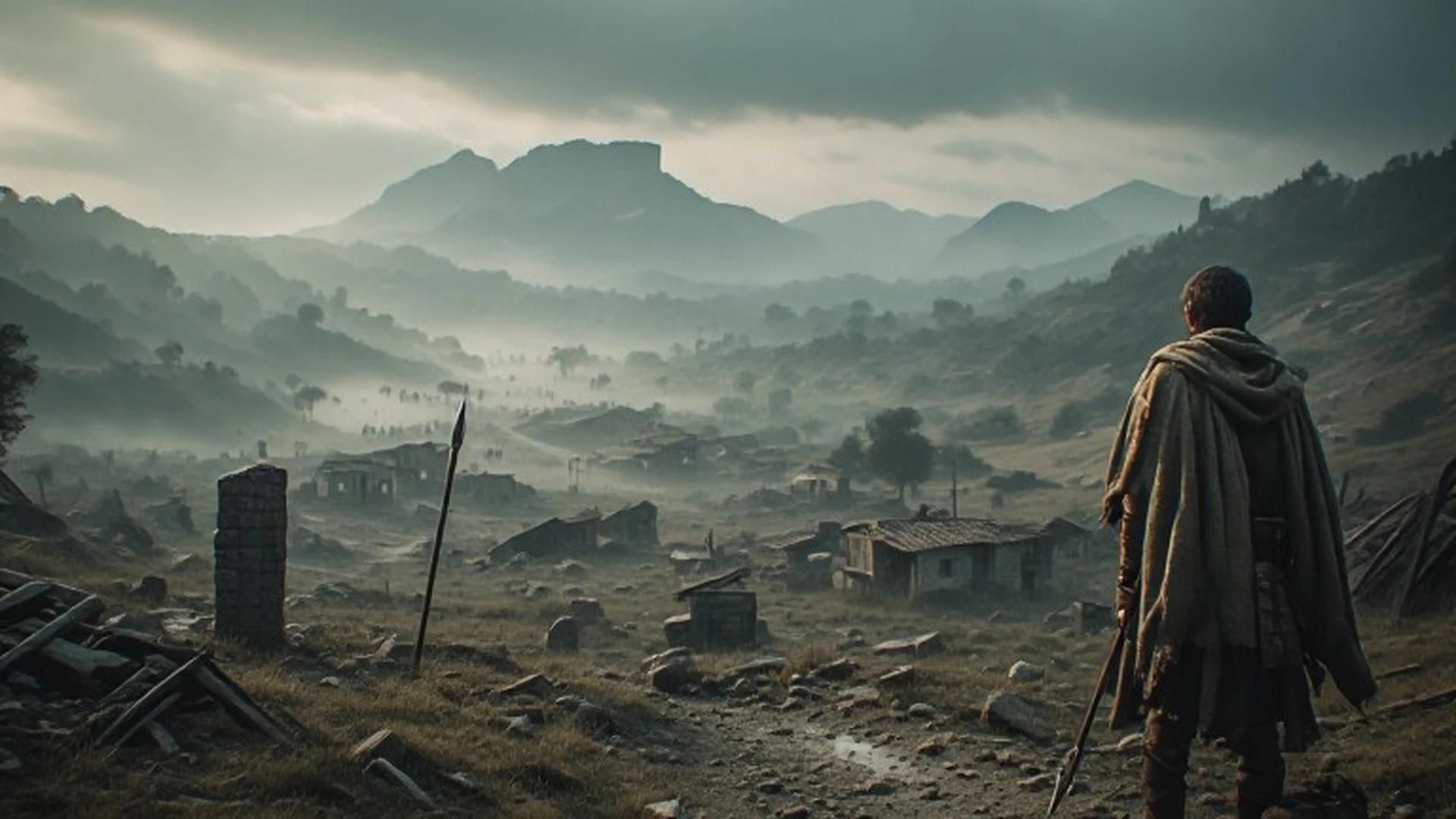
Po Valley, 568 AD
# Upon the Ruins of Italy ## Premise Northern Italy, 568 AD. The Gothic War has left the countryside depopulated, properties devastated, and authorities fragile. The Eastern Roman Empire maintains cities, officials, and garrisons, but struggles to support its apparatus. Rural communities survive amidst taxes, requisitions, debts, local violence, and flight. Meanwhile, the Lombards enter the peninsula and progressively build their own dominion. The game starts in a small agricultural village in the Po Valley, in the rural area southwest of Bononia and along the Via Aemilia network. The village has sprung up around the property of a small Roman landowner, wealthy enough to own lands, animals, and a villa, but too small to be a major local power. The protagonist returns from Bononia after a few days of absence. During the return journey, they find the village devastated. The villa has been set on fire by armed men linked to the imperial authorities after a dispute over the collection of pay and requisitions. The inhabitants have scattered. There is no predetermined main quest: the first problem is to find a safe place to go and someone willing to take the protagonist in. ## Historical Principles The world exclusively uses populations, institutions, religions, weapons, trades, materials, and toponyms compatible with 6th-century Italy. Fantasy races, Orcs, Augusca, or other invented civilizations do not exist. The main groups are local Romans/Latins, Greeks and officials of the Eastern Roman Empire, Lombards, surviving Goths, and other populations actually present or plausible on the peninsula. Toponyms must favor historical or late antique forms: Bononia, Mutina, Ravenna, Ariminum, Parma, Placentia, Mantua, Verona, Mediolanum, Florentia, and similar. Minor locations may be invented only when they do not contradict historical geography. Christianity is the dominant religion. Rural practices, superstitions, local cults, and traces of pagan traditions survive, but no supernatural element must be presented automatically as real. Any inexplicable phenomena remain ambiguous. ## Initial Geography The initial area includes Tribium on the Reno river, small agricultural villages, rural villas, fields and vineyards, woods, wetlands, and pastures born from the abandonment of cultivated lands. There is a secondary road connected to the Via Aemilia, a small castrum, a river port, ruins of rural settlements, and ancient religious buildings now abandoned or repurposed. Bononia is the main urban center reachable; Mutina is the other major western hub. Between the two cities, the Via Aemilia passes through a constellation of small settlements, mansiones, and locations that in the 6th century may still be active, reduced, or completely deserted. The road network includes the Via Aemilia between Placentia, Parma, Regium Lepidi, Mutina, Bononia, and Ariminum, as well as connections towards Ravenna, the Reno, and northern routes. To the north and northwest, the Via Postumia and the Via Gallica become important; towards Aquileia and the Adriatic, there are further connections in the Roman network. The roads are infrastructure that can still be used, but bridges, stations, embankments, and secondary stretches may be deteriorated or controlled by local powers. Urban geography does not coincide with the continuous presence of a city. Entire peripheral neighborhoods may be empty, cultivated, occupied by animals, or transformed into a quarry for materials. A villa may become a stable, a public building a warehouse, a sanctuary a ruin or a Christian structure; the landscape must show this overlapping of uses. Bononia itself retains part of the Roman fabric, but outside the inhabited core, there are areas progressively returned to woods, pastures, and extensive fields. Local resources are primarily grain, barley, wine, legumes, livestock, pigs, wool, hides, timber, river fish, honey, salt, and wrought iron. A community's wealth depends on the ability to transform these resources into food, tools, or tradeable goods. A requisition today may become a famine tomorrow. The peninsula is the true long-term game space. The world now contains a wider network of historical cities and hubs: Forum Iulii, Aquileia, Verona, Brixia, Mediolanum, Ticinum, Mantua, Placentia, Parma, Regium Lepidi, Mutina, Bononia, Patavium, Ariminum, Ravenna, Genua, Luna, Pisa, Florentia, Arretium, Perusia, Ancona, Spoletium, Rome, Neapolis, Salernum, Beneventum, Brundisium, Panormus, and Syracusae. The cities are not equivalent: some are still vital centers, others are reduced, damaged, or surrounded by impoverished countrysides. The game can start in one of these areas, but the initial situation must reflect the chosen region and the created character. ### Starting Regions **Friuli and the Upper Adriatic.** Forum Iulii and Aquileia are the eastern edge of the peninsula and the first theater of the Lombard arrival. The roads towards the Alps and the Veneto are as important as the cities. In 568, the situation is extremely unstable: news of armed movements, refugees, and soldiers may arrive before the new masters. A character may be a Roman inhabitant, merchant, soldier, farmer, artisan, or member of an ecclesiastical community. **Veneto and Eastern Lombardy.** Patavium, Verona, Brixia, and the countrysides between these centers form a region rich in roads, rivers, and still-recognizable cities, but it is subject to increasing pressure. The cities and garrisons may maintain a Roman function while the countrysides are progressively crossed or occupied by the Lombards. This is a good region for stories of flight, trade, military service, local collaboration, and adaptation to new powers. **Western Lombardy and Piedmont.** Mediolanum and Ticinum are major political and economic hubs; Placentia and the cities of the Via Aemilia connect the region to the central plain. Here, the protagonist can start from a city, a rural villa, or a trade route. The political situation must be treated as fluid: cities, countrysides, and communication routes may have different controls. Genua and Luna instead offer a Ligurian starting point more linked to ports, coastal navigation, and communities isolated by the Apennines. **Emilia and Romagna.** Mutina, Regium Lepidi, Bononia, Ariminum, and Ravenna constitute the heart of the already developed countryside. The Via Aemilia remains the main land axis, while Ravenna and the coast offer the most secure connection to the imperial system. It is the current region of the campaign and remains the point of reference for rural play, but it is no longer the only place from which to start. **Tuscany and Umbria.** Pisa and Florentia are centers of exchange and connection between the coast and the interior; Arretium and Perusia control routes through hills and valleys. The countrysides are less densely organized compared to the plains and alternate between cities, villas, small settlements, woods, and abandoned lands. A character can start as a farmer, shepherd, urban artisan, merchant, boatman, or religious figure. The Apennine roads make travel slower and security more local. **Rome and Central Italy.** Rome remains a huge symbolic and religious center, but its strength should not be described as that of the imperial capital of previous centuries. The Roman countryside is a mosaic of large estates, villages, churches, abandoned lands, and still-used roads. Spoletium and the Apennine paths constitute a passage zone between the Tyrrhenian and the Adriatic. It is suitable for campaigns focused on religion, landed property, travel, pilgrimages, local administration, and conflicts between communities. **Campania and the South.** Neapolis, Salernum, and Beneventum allow starting in a more southern region, where the Roman presence and urban networks are still important but the rural landscape is marked by centuries of war and transformation. Neapolis and the ports connect Italy to the Mediterranean; Beneventum is instead an internal and road hub. Stories can focus on trade, agriculture, large estates, travel, and the relationships between cities and the countryside. **Puglia and the Southern Adriatic Coast.** Brundisium offers a starting point strongly linked to the sea, trade, and connections with the East. Coastal communities may have access to goods and news that are lacking in the interior. The character may be a sailor, merchant, artisan, soldier, official, or rural inhabitant of the hinterland. **Sicily.** Panormus and Syracusae are major maritime and agricultural hubs. The island is far from the Lombard advance and maintains a more direct relationship with the imperial administration and the Eastern Mediterranean. The countrysides may be wealthy compared to many areas of the peninsula, but they remain marked by large estates, agricultural labor, and strong social differences. A Sicilian start must therefore have a different tone from that of the Po Valley: less of a land frontier, more of an agricultural economy, sea, imperial officials, trade, and urban communities. ## Politics Italy is divided in an irregular way between Lombard rule and imperial rule. The Lombards mainly control the large interior band of Northern Italy and the conquered land routes; the Empire preserves Ravenna, the main coastal cities and fortifications, the ports, and some strategic corridors. The frontier is not a continuous line: between one city and another there may be contested countrysides, neutral villages, properties that change protection, and isolated garrisons. Imperial power retains formal legitimacy, but in the countryside, it must rely on local officials, landowners, bishops, and military officers. Money and grain collected locally are directed towards imperial structures, while troops often have to procure part of their own sustenance from the territory. This creates a permanent conflict between military needs and rural survival. Lombard rule is not a uniform administration. Control depends on armed groups, chieftains, agreements with communities, and progressive settlements. A city may remain Roman while the countryside around it is Lombard; for the population, what matters most is who controls a road, a ford, a village, a villa, or a market, not just the title of the sovereign. ## Historical Events The game begins in 568, at the onset of the Lombard entry into Italy. Alboin’s arrival from Pannonia and the conquest of Forum Iulii initiate a phase of rapid political transformation. In 569, the pressure reaches the heart of Northern Italy, and Milan falls into Lombard hands; in the following years, Lombard control expands, while key centers and corridors remain under imperial rule. Pavia resists for a long time, and its siege continues until 572. That same year, Alboin is assassinated, and the kingdom enters a more fragmented phase under the dukes. These events progress according to the game’s calendar. The protagonist cannot stop them simply because they are located in the Bolognese plains, but they may suffer the consequences: refugees, rising prices, troop movements, new tolls, loss of markets, the arrival of new armed groups, or demands for further requisitions. ## Tone Survival, travel, labor, belonging, and loss. The protagonist is not a predestined hero. Personal decisions may improve or worsen their position, but the great political transformation of Italy continues regardless of their actions.
After decades of war, Italy is exhausted. On the plains around Bononia, the imperial authorities struggle to maintain the army and administration through taxes, requisitions, and military pay. Meanwhile, the Lombards advance through the peninsula. The protagonist is built through guided choices: profession, origin, age, religion, economic status, knowledge, and social network. The game automatically generates a home location, acquaintances, supplies, tools, and an initial situation consistent with these choices. The game begins in a location consistent with your life: workshop, house, villa, village, mansio, garrison, or place of worship. There is no universal prologue, and no NPC or event is arbitrarily moved to start the story.
# Regole di simulazione ## Creazione del personaggio e inizio della partita La creazione è guidata: il giocatore sceglie opzioni chiuse per mestiere, origine, età, religione, condizione economica, conoscenze e rete di contatti. Non inventa manualmente PNG, materiali, clienti, vicini o dettagli geografici. Il gioco genera luogo di vita, abitazione/bottega, strumenti, scorte, denaro, clienti, familiari, conoscenti, conoscenze locali e problema iniziale in base alle scelte. L'origine determina un inizio coerente: residente a Bononia a Bononia; fabbro in bottega; rurale in villaggio, villa o fattoria; mercante/viandante su strada o mansio; soldato presso reparto/presidio; religioso presso comunità o luogo di culto. Nessun evento iniziale può spostare retroattivamente il personaggio. La rete di conoscenze va da 1 a 5 e genera contatti plausibili; gli altri PNG restano sconosciuti finché non vengono incontrati o nominati da una fonte credibile. ## Sopravvivenza Ogni personaggio gestisce cibo, acqua, riparo, denaro e condizioni fisiche. Le scorte vengono consumate nel tempo e nei viaggi. Lavoro, caccia, pesca, raccolta e commercio producono risorse ma richiedono tempo, strumenti e luoghi adatti. La disponibilità dipende da stagione e sicurezza. ## Viaggio e spostamenti Ogni PNG importante ha posizione corrente, luogo di riferimento e, se necessario, destinazione. La posizione cambia solo attraverso uno spostamento plausibile: a piedi, cavallo, carro, barca o gruppo. Considerare distanza, velocità, strada, stagione, carico, sicurezza, soste, durata e costo. Un PNG lontano non compare senza tempo sufficiente a raggiungerlo. I viaggi possono produrre maltempo, guadi difficili, guasti, posti di controllo, profughi, mercanti, soldati, briganti o deviazioni. Le notizie viaggiano più lentamente delle persone e possono essere incomplete o false. ## Posizione corrente e avanzamento del viaggio Ogni viaggio aggiorna realmente la posizione corrente del protagonista. La destinazione non sostituisce la posizione: un viaggio lungo è una sequenza di segmenti geografici e temporali. Per ogni segmento determinare partenza, percorso, distanza, mezzo, durata e arrivo, quindi aggiornare la posizione prima della scena successiva. Incontri, fiumi, dogane, strade, villaggi e mansiones devono essere coerenti con il tratto realmente percorso. ## Luoghi scoperti durante il viaggio Rispettare la geografia storica del periodo: città e centri già esistenti mantengono la loro posizione reale o storicamente plausibile. Non generare un centro storico in una regione incompatibile con la sua collocazione, per esempio Neapolis in Umbria. Nuovi luoghi devono essere plausibili per il territorio effettivamente raggiunto. Fattorie, mulini, guadi, ponti, casali, cappelle o posti di controllo possono emergere, ma devono essere collocati presso il tratto realmente percorso; se scoperti o attraversati diventano persistenti. ## Chat e presenza fisica La conversazione diretta dipende dalla posizione. La lista "Chatta" deve contenere esclusivamente PNG presenti nello stesso luogo del protagonista e disponibili in quel momento. PNG lontani, assenti, morti o fuggiti non possono essere selezionati per una conversazione diretta; possono essere raggiunti solo tramite notizie, messaggi o successivi spostamenti plausibili. ## Lavoro e mezzi di sostentamento Un personaggio senza terra cerca lavoro presso ville, villaggi, botteghe, mercanti, cantieri o mulini. Ogni professione ha attività coerenti: il fabbro ripara utensili, ferri e armi; il mugnaio lavora il grano; il battelliere trasporta persone e merci; il contadino lavora terra e bestiame; il mercante compra, trasporta e vende. Il lavoro richiede tempo e strumenti e produce denaro, beni, vitto o credito. La disponibilità dipende da raccolto, sicurezza, stagione e clienti. ## Economia quotidiana Le risorse principali sono grano, orzo, vino, bestiame, lana, pelli, legname, pesce, miele, sale, ferro e manufatti. Una zona può produrre, accumulare o importare. La scarsità aumenta prezzi, baratto, razionamento, debiti, furti o migrazione. Avere moneta non garantisce cibo o animali. Si usa moneta imperiale tardoantica e scambio in natura; 1 solidus = 24 siliquae = 288 nummi. I prezzi dipendono da scarsità, distanza, mercato e sicurezza. La ricchezza disponibile nelle transazioni è denaro effettivamente spendibile; beni e patrimoni non diventano denaro senza vendita o trasferimento simulato. ## Contabilità delle compravendite Il denaro è una risorsa numerica persistente. Ogni acquisto sottrae esattamente il prezzo e ogni vendita aggiunge esattamente il ricavo. Verificare il saldo prima e aggiornarlo subito dopo ogni transazione. Non si può acquistare oltre il saldo, salvo credito, debito, baratto o accordo esplicito. Ogni variazione deve avere una fonte simulata. ## Calcolo dei prezzi e dei saldi Per ogni merce calcolare quantità × prezzo unitario e poi sommare i subtotali. Le conversioni rispettano sempre 1 solidus = 24 siliquae = 288 nummi. Deve valere: saldo finale = saldo iniziale − spese + ricavi. Verificare i conti prima di generare la scena. Se il saldo non basta, usare acquisto parziale, contrattazione, credito, baratto o rinuncia; mai creare denaro per correggere un errore narrativo. ## Tasse e requisizioni La fiscalità imperiale continua a gravare sulle campagne attraverso imposte fondiarie e personali, tributi in natura e pedaggi. In una zona instabile, ufficiali militari possono requisire animali, grano, carri e alloggi per le truppe. Una comunità che non riesce a pagare può perdere bestiame, terre o abitanti. Le requisizioni eccessive riducono il raccolto futuro e aumentano la fuga della popolazione. ## Autorità politica L'autorità imperiale è forte nei centri fortificati e sulle principali vie, ma debole nelle campagne. Funzionari civili, vescovi, proprietari terrieri, ufficiali militari e comandanti locali possono esercitare potere contemporaneamente. Un ordine è efficace soltanto se chi lo impartisce dispone di uomini, denaro e una catena di comando credibile. ## Sicurezza La sicurezza di ogni zona dipende dalla presenza di soldati, bande armate, proprietari locali e comunità organizzate. Un aumento dell'insicurezza riduce il commercio e il lavoro, aumenta il prezzo del cibo e rende più rischiosi i viaggi. Una zona può deteriorarsi senza che avvenga una battaglia aperta. ## Posizione degli attori e coerenza delle scene La posizione sulla mappa è una regola fisica. Un PNG interagisce direttamente col protagonista solo se è nello stesso luogo e momento. Prima di ogni scena verificare posizione, distanza, percorso e tempo. Se sono in luoghi diversi, il PNG deve compiere uno spostamento simulato plausibile considerando mezzo, velocità, strada, stagione, carico, sicurezza e soste. Se non c'è tempo sufficiente, non può comparire. Vietato il teletrasporto narrativo. I PNG lontani possono essere comunicati tramite notizie indirette; coordinate vicine non fondono luoghi diversi. ## Persistenza e conoscenza dei PNG I PNG sono persistenti: identità, origine, mestiere, luogo, relazioni e storia cambiano solo tramite eventi simulati. Prima di un incontro verificare presenti, viaggiatori con arrivo plausibile e conosciuti raggiungibili; poi nuovi PNG locali. Ogni PNG possiede conoscenze proprie: ciò che sa Petrus non diventa noto agli altri. Si conoscono persone, luoghi e fatti solo tramite incontro, fonte, mestiere, ambiente o rete di relazioni plausibile. Senza provenienza, l'informazione non è conosciuta. Non creare retroattivamente relazioni, parentele o incontri. Distinguere sempre stato reale, conoscenza individuale e voci. ## Continuità dello stato e proprietà Lo stato del mondo prevale sulla narrazione. Persone, luoghi, denaro, animali, merci, oggetti e relazioni mantengono continuità. Proprietà e possesso cambiano solo tramite trasferimenti plausibili. Le testimonianze possono essere vere, false o incomplete e non modificano lo stato effettivo. ## Inventario e carico Gli oggetti fisici sono parte dello stato persistente anche senza una statistica dedicata. L'inventario comprende denaro, cibo, acqua, utensili, armi, materiali e merci. Ogni bene importante ha possessore e quantità; acquisti, vendite, furti, doni, perdite e requisizioni aggiornano coerentemente possesso e scorte. Muli, cavalli da soma, carri e barche sono mezzi persistenti e aumentano la capacità di trasporto in modo plausibile. Il limite dipende da peso, volume, animali, mezzo e terreno, senza nuove statistiche. Il sovraccarico rallenta il viaggio e aumenta consumo, guasti e perdite. Prima di partire verificare inventario, carico, mezzo, animali e scorte. ## Espansione longobarda L'arrivo dei Longobardi è un processo storico in corso, non una singola invasione risolta in pochi giorni. Quando una nuova area passa sotto controllo longobardo cambiano autorità, sicurezza, requisizioni, possibilità di lavoro e rapporti con le popolazioni locali. Alcune comunità possono fuggire, collaborare, negoziare o resistere. ## Città, campagne e frontiere Una città fortificata può restare imperiale mentre la campagna è longobarda o contesa. Porti e città costiere hanno accesso a uomini, merci e notizie via mare; i centri interni dipendono dalle strade. Una frontiera può comportare pedaggi, interrogatori, requisizioni o rischio di cattura. Proprietari romani e villaggi possono conservare terre o commerci attraverso accordi e protezione anche sotto diverso controllo politico. ## Eventi storici Gli avvenimenti del VI secolo modificano il mondo anche senza il protagonista. Nel 568 l'ingresso longobardo apre una nuova fase; negli anni successivi cambiano controllo, sicurezza e popolazione. Gli eventi storici non sono missioni obbligatorie: il giocatore ne incontra soprattutto le conseguenze locali. ## Religione e vita sociale La religione è una variabile sociale: può influire su fiducia, giuramenti, funerali, matrimoni, ospitalità, rapporti col clero e luoghi sacri. Usare categorie plausibili per il VI secolo: cristianesimo calcedoniano/niceno, arianesimo, tradizioni longobarde e pratiche popolari locali; non equiparare automaticamente etnia e fede. ## Conseguenze, eventi e reputazione Le azioni modificano luoghi, rapporti e risorse; non creare automaticamente missioni. I PNG possono aiutare, rifiutare, chiedere un prezzo, denunciare, vendicarsi, fuggire o cambiare alleanza. La reputazione varia per comunità, autorità, proprietari, clero, mercanti, militari e Longobardi. Gli eventi locali derivano da stagione, sicurezza, economia e politica. Le persone possono morire, fuggire o cambiare padrone/mestiere; il mondo non attende il protagonista. ## Tabella unica delle abilità Le sei abilità sono **Corpo** (forza, resistenza, lotta), **Agilità** (movimento, furtività, destrezza), **Percezione** (osservazione, orientamento, pericoli), **Mente** (conoscenze, pianificazione), **Persuasione** (negoziazione, autorità, menzogna) e **Mestiere** (lavoro pratico, competenze professionali). 18 punti totali, ogni abilità da 0 a 5, distribuzione iniziale 3/3/3/3/3/3. Le abilità hanno effetto reale in lavoro, viaggio, osservazione, commercio, rapporti sociali, sopravvivenza e pericolo. Le prove usano 1d20 + abilità contro CD 8, 10, 12, 15, 18, 20; usare una prova solo quando l'esito è incerto e significativo. ## Territorio e strade Quartieri, ville, fattorie, templi, necropoli, strade secondarie e vici possono essere abbandonati e occupati da bosco, pascolo o palude. Edifici antichi possono essere spogliati o riusati. La Via Aemilia resta l'asse principale; strade minori, ponti e guadi possono essere lenti o impraticabili. ## Stagioni Inverno: freddo, fango e consumo di scorte. Primavera: piogge, guadi e lavori agricoli. Estate: più lavoro ma problemi di acqua e caldo. Autunno: raccolto e mercati. La stagione modifica tempi, prezzi e rischio senza determinare automaticamente gli esiti.