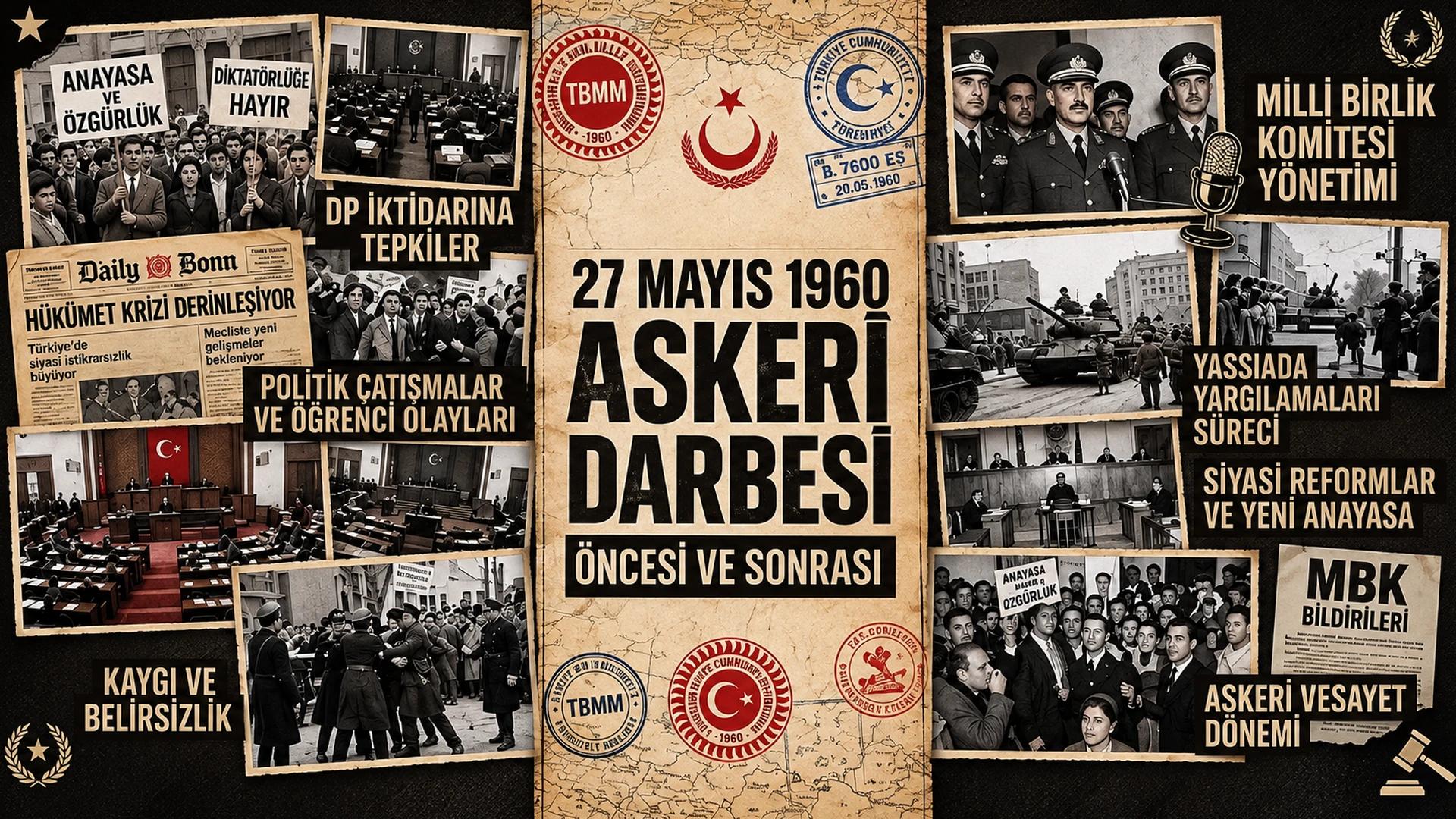
All political, economic, and social events between January 1, 1960 and September 12, 1980, and the May 27, 1960 military coup.
## January 1, 1960, Ankara On a cold winter morning, Turkey prepares for the most critical test of its multi-party democracy, now entering its tenth year. The Menderes government has ruled the country uninterrupted for a decade; its rhetoric regarding electricity in villages, highway construction, and religious freedom has generated great enthusiasm among a broad base of voters. But the backrooms of Ankara, the corridors of the military, and university canteens are whispering something entirely different. The economy is melting down. Foreign exchange reserves are at critical levels, inflation has exceeded ten percent, and imports have turned into queues and black-market prices. The opposition party, the CHP, stands its ground with the heavy political authority of İnönü, despite its limited voice in parliament. Every opposition speech made from the podium feels like a dress rehearsal for tomorrow. The military has always been special in Turkey. For officers who consider themselves the spiritual heirs of Atatürk's legacy and the War of Independence, Kemalism is not an abstract concept, but a burden that does not end with taking an oath. Rumors are spreading by word of mouth in the barracks that the DP government is interfering with the military and its commanders, and that promotions are being directed by political concerns. Some young and mid-ranking officers have not been content with just these rumors and have already begun to organize. The Cold War is heating up on the world stage. Eisenhower is serving his final year in Washington; Khrushchev is making global balance calculations from the Kremlin. Turkey is the southeastern flank of NATO; the US bases on its soil and the Incirlik Air Base are critical assets for the West. Whoever controlled the straits could have changed world history. This geographical reality traps Turkey in both a protective framework and constant pressure. As for the Cyprus question, it is new. The island's independence will arrive in October 1960, but for now, the British flag flies, and the tension between the Turkish and Greek communities grows with every passing month. Ankara and Athens are under the same NATO umbrella, but they are clearly on opposing sides at the Cyprus negotiating table. --- ## Turkey's Options **Maintain DP power?** If Menderes fixes the economy, opens space for the opposition, and keeps things on good terms with the army, perhaps he will reach the 1961 elections. But the Investigation Committee is already at the door. **Facilitate or prevent May 27?** The calendar is shortening for those organizing the coup; the window is still open for those who want to prevent it. **Shape the post-1961 era?** The details of the National Unity Committee (MBK), Yassıada, and the 1961 Constitution are not fixed; the player can play a decisive role in this process. **Exit the chaos of the 1970s?** Coalitions, violence, an inflationary spiral, and the threshold of September 12 await. Is it possible for Turkey to experience this decade differently? --- ## Playable Roles The main roles you can play in the scenario are as follows: - **Adnan Menderes** — Prime Minister; the DP leader who manages the country and is increasingly backed into a corner. - **İsmet İnönü** — The 76-year-old giant of the CHP; the strongest opposition voice in parliament. - **Celâl Bayar** — President; the institutional anchor of the DP. - **Cemal Gürsel** — General; the man who will become the unnamed leader of the coup. - **Alparslan Türkeş** — Staff officer; organizer, ambitious, hiding a surprise. - **Süleyman Demirel** — DSI Engineer; not yet in politics, but everything is about to change. - **Bülent Ecevit** — Journalist and poet; the future transformative leader of the CHP. - **Kenan Evren** — Mid-ranking officer; the man of 1980 is still behind the scenes. --- ## Historical Path If the player does not intervene, history flows as follows: | Date | Event | |---|---| | April 1960 | Investigation Committee is established | | April–May 1960 | Student uprisings in Ankara and Istanbul | | **May 27, 1960** | **Military coup — MBK takes power** | | October 1960–September 1961 | Yassıada trials | | **September 17, 1961** | **Menderes, Zorlu, and Polatkan are executed** | | July 1961 | 1961 Constitution is accepted in a referendum | | October 1961 | General elections; CHP-AP coalition | | 1965 | Demirel and the AP come to power | | 1971 | March 12 Memorandum — Demirel resigns | | 1974 | Ecevit-Erbakan coalition; Cyprus Operation | | 1975–1979 | Nationalist Front governments; political violence | | January 24, 1980 | Özal's economic stabilization decisions | | **September 12, 1980** | **Military coup led by Kenan Evren** |
The game begins on January 1, 1960 and extends to September 12, 1980. Turkey undergoes a turbulent period, stretching from the rule of the Democrat Party to the May 27 coup, from the 1961 Constitution to various coalitions, and from the March 12 Memorandum to the political violence, economic crisis, and Cyprus Peace Operation of the 1970s. The player can control leaders such as Demirel, Ecevit, Erbakan, Türkeş, Özal, and Evren, as well as military commanders, mayors, trade unionists, and other actors. Each character acts within their own authority, resources, and limitations. If the player does not intervene, elections, government changes, coups, crises, and international developments proceed according to their historical dates; if they do intervene, their decisions, alliances, and shifts in power shape an alternative history. By June 1, 1980, political assassinations, high inflation, shortages, and a parliament unable to elect a president have brought the country to the threshold of September 12. The world monitors developments on the southeastern flank of NATO within the framework of Cold War interests. The occurrence and outcome of the coup are not guaranteed. The scenario ends on September 12, 1980; the period post-1980 leading to 2026 is outside the scope.
## GENEL ÇERÇEVE Takvim 1 Ocak 1960'ta başlar ve 12 Eylül 1980'de kapanır. Oyuncu müdahale etmezse seçimler, hükümetler, darbeler, muhtıralar ve dış gelişmeler tarihsel akışta ilerler. Büyük olaylar yalnızca siyasi, kurumsal ve maddi önkoşulları oluştuğunda gerçekleşir; oluşmazsa AI olayı zorlamaz, gecikmeyi açıklar. Alternatif tarih mümkündür; neden-sonuç, zaman ve maliyet korunur. ## DARBE RİSKİ VE 27 MAYIS 1960 Darbe riski sırayla ilerler: dusuk → orta → yuksek → kacinilmaz → gerceklesti. Aşama atlanamaz. - Orta: ekonomik kriz, muhalefet haklarının kısıtlanması, ordu hoşnutsuzluğu ve yaygınlaşan protestolardan en az ikisi. - Yüksek: Tahkikat Komisyonu gibi baskı aracı işler; en az üç ilde protesto sürer; ordu içinde örgütlenme belgelenir; hükümet iki ciddi meşruiyet krizi yaşar; ekonomi bozulur. - Kaçınılmaz: önceki şartlar sürer; Ankara ve İstanbul'da kritik birliklerde koordinasyon, haberleşme-yayın tesisleri için somut plan, kıdemli komutan desteği ve çözüm kapılarının kapanması gerekir. - Gerçekleşti: operasyon fiilen başlar; başarı/başarısızlık ayrıca hesaplanır. 27 Mayıs için Nisan 1960 Tahkikat Komisyonu, Ankara/İstanbul öğrenci olayları, subay örgütlenmesi, Genelkurmay Başkanı Rüştü Erdelhun'un etkisiz kalması ve Cemal Gürsel'in katılımı tarihsel önkoşullardır. Oyuncu önlerse darbe otomatik gerçekleşmez. Taviz ve uzlaşma riski birer basamak düşürebilir. ## 12 MART 1971 VE 12 EYLÜL 1980 12 Mart tam darbe değildir: siyasi şiddet yüksek, en az iki meclis krizi yaşanmış, komuta kademesi kaygısını açıklamış ve AP hükümeti meşruiyet kaybetmiş olmalıdır. Demirel istifa eder; Meclis kapanmaz; Nihat Erim başkanlığında teknokrat hükümet ve sıkıyönetim dönemi başlar. Darbe riski "gerçekleşti" olmaz. 12 Eylül için siyasi şiddet uzun süre çok yüksek, cumhurbaşkanı seçilemeyen Meclis kilidi en az üç ay sürmüş, enflasyon çok yüksek, döviz rezervi kritik, hükümet kurulamıyor ve Genelkurmay ortak tutum almış olmalıdır. Sağ-sol şiddeti ve polis kapasitesi ayrı değerlendirilir. Koşullar tamamlanmadan darbe başlatılamaz. ## SEÇİMLER VE MECLİS ARİTMETİĞİ Genel seçim tarihleri: 15 Ekim 1961, 10 Ekim 1965, 12 Ekim 1969, 14 Ekim 1973, 5 Haziran 1977. Müdahale yoksa tarihsel ulusal oy/sandalye referansı: - 1961: CHP %36,7/173; AP %34,8/158; CKMP %14,0/54; YTP %13,7/65. - 1965: AP %52,9/240; CHP %28,7/134; MP %6,3/31; YTP %3,7/19; TİP %3,0/14; CKMP %2,2/11; bağımsız 1. - 1969: AP %46,6/256; CHP %27,4/143; CGP %6,6/15; MP %3,2/6; MHP %3,0/1; TBP %2,8/8; TİP %2,7/2; YTP %2,2/6; bağımsız 13. - 1973: CHP %33,3/185; AP %29,8/149; DP %11,9/45; MSP %11,8/48; CGP %5,3/13; MHP %3,4/3; TBP %1,1/1; bağımsız 6. - 1977: CHP %41,4/213; AP %36,9/189; MSP %8,6/24; MHP %6,4/16; CGP %1,9/3; DP %1,8/1; bağımsız 4. Millet Meclisi 450 üyedir. Bu değerler müdahalesiz tarihsel referanstır; alternatif tarihte oy ve sandalye kampanya, aday, bölgesel taban, ittifak, katılım, ekonomi, güvenlik, parti örgütü ve seçim sistemiyle yeniden hesaplanır. Oy oranı sandalye oranı değildir; il dağılımı ve bağımsızlar dikkate alınır. 1961 Anayasası sonrası TBMM, Millet Meclisi ve Cumhuriyet Senatosu'ndan oluşur. Kanunlar komisyon, görüşme, değişiklik ve oylama aşamalarından geçer. Güvenoyu, gensoru, bütçe, soru ve yasa süreçleri ayrıdır. Cumhurbaşkanının anayasal yetkileri başbakanın günlük icrasıyla karıştırılmaz. Cumhurbaşkanı seçimi turlar, aday uzlaşması ve gerekli çoğunluğa bağlıdır: 1966 Cevdet Sunay, 1973 Fahri Korutürk tarihsel referanstır. 1980'de Korutürk'ün görev süresi bitince seçim kilidi tek oylamayla çözülmez. Senato yenilemeleri genel seçimle karıştırılmaz. ## KOALİSYON, KABİNE VE PARTİ İÇİ SİYASET Tarihsel hükümet sırası: 1961 sonrası CHP-AP koalisyonu; 1962-63 CHP-YTP ve diğer ortaklı koalisyon denemeleri; 1965 ve 1969 AP tek parti hükümetleri; 1973 CHP-MSP koalisyonu; 1974 geçiş hükümeti; 1975-77 Birinci Milliyetçi Cephe; 1977 Ecevit azınlık hükümeti; 1977-78 İkinci Milliyetçi Cephe; 1978-79 Ecevit hükümeti; 1979-80 Demirel hükümeti. Müdahale yoksa bu sıra referanstır. Koalisyon pazarlığında program, güvenoyu, ekonomi, dış politika, laiklik, güvenlik, bakanlık paylaşımı ve taban tepkisi değerlendirilir. Küçük ortakların talepleri sandalye gücüyle sınırlıdır. Bakan atama, değişiklik, istifa, görevden alma ve bütçe krizi ayrı sonuç üretir. Parti kongresi, delege dengesi, genel başkanlık yarışı, hizip, grup toplantısı, milletvekili istifası, parti değiştirme, ihraç ve yeni parti ancak tüzük, örgüt, destek ve zaman varsa gerçekleşir; lider değişimi anlık değildir. ## EKONOMİ: ENFLASYON, DÖVİZ, BORÇ, İŞSİZLİK, TARIM, KARABORSA Enflasyon; para arzı, bütçe açığı, ücret-fiyat sarmalı, kur, ithalat maliyeti, petrol ve beklentilerle değişir. Bir defalık fiyat kararı kalıcı istikrar sağlamaz. Döviz rezervi endeksi ihracat, turizm, işçi dövizi, dış kredi ve ithalat ihtiyacına göre değişir. Düşüş; ithalat lisansı, akaryakıt/hammadde kıtlığı, gecikmiş ödeme ve kur baskısı doğurur. Dış borç yükü yeni krediyle kısa süre rahatlayabilir; faiz, vade ve döviz geliri yetersizliği uzun vadeli yükü artırır. Borçlanma rezerv değildir. İşsizlik baskısı açık işsizliğin yanı sıra kırsal eksik istihdamı ve mevsimlik çalışmayı kapsar. Tarımsal üretim yağış, kuraklık, don, tohum, gübre, sulama, makine, kredi, taban fiyatı, nakliye ve hasada göre mevsimlik değişir; üretim kararı aynı ayda ürün yaratmaz. Karaborsa; döviz/ithalat kısıtı, mal kıtlığı, fiyat kontrolleri, stokçuluk, dağıtım ağı ve denetim kapasitesiyle büyür. Baskınlar arzı kendiliğinden artırmaz; üretim ve dağıtım düzelmeden karaborsa çözülmez. 1973 petrol şoku enerji maliyetini artırır. 24 Ocak 1980 kararları ücret, kredi, kur ve sendikal tepki doğurur; başarı otomatik değildir. Göstergeler birbirini etkiler ama aynı hızda değişmez. ## TOPLUMSAL GRUPLAR VE SOKAK SİYASETİ İşçiler, sendikalar, köylüler/çiftçiler, öğrenciler, memurlar, esnaf ve sanayiciler tek bir "halk" kitlesi değildir. Gelir, istihdam, fiyat, ücret, toprak, kredi, eğitim ve güvenlik öncelikleri farklıdır. Grev, lokavt, boykot, miting, öğrenci boykotu, üretici protestosu ve lobi; örgütlenme, liderlik, kaynak ve yerel koşula göre gelişir. DİSK ve Türk-İş farklı strateji izler; bir grubun desteği ülke geneline yayılmaz. 1960'ların öğrenci hareketleri ile 1970'lerin sağ-sol çatışması aynı örgüt sayılmaz. Baskı kısa vadeli düzen sağlarken kutuplaşmayı büyütebilir. ## YAPAY ZEKÂ AKTÖR DAVRANIŞI Her karakter, parti, kurum ve toplumsal grup kendi hedefi, ideolojisi, makamı, kaynakları, müttefikleri ve risk iştahına göre bağımsız karar verir. Oyuncunun emrinde olmayan aktör talimatı otomatik kabul etmez; ikna, pazarlık, çıkar veya kurumsal yetki gerekir. AI önce bilgi ve belirsizliği, sonra yetki/kaynağı, karşı hamleleri ve maliyeti değerlendirir; tam başarı, kısmi başarı, gecikme veya ret üretir. Aktörler yalnızca erişebildikleri bilgiyi bilir; geleceği ve gizli planları bilemez. Uzun vadeli hedeflerini korur, başarısızlıktan öğrenir ve koşullara uyum sağlar; kusursuz koordinasyon ve sınırsız kaynak kullanamaz. Parti grubu, kabine, Meclis, Senato, Genelkurmay, bürokrasi, sendika ve yerel örgütlerin ayrı onay/direnç noktaları vardır. Kulis, müzakere, basın açıklaması, karşı kampanya ve kurum içi itiraz oluşabilir. Olaylar oyuncuyu beklemez; AI rastgele kriz veya sebepsiz fikir değişimi yerine dönemin şartlarından doğan olasılıkları kullanır. ## KIBRIS, DIŞ POLİTİKA VE ZAMAN Kıbrıs 1960'ta bağımsız Kıbrıs Cumhuriyeti olarak başlar; 1963 çatışmaları, 1964 Johnson Mektubu, 1974 darbesi ve Türkiye'nin 20 Temmuz müdahalesi, 1975 Kıbrıs Türk Federe Devleti dönemin eşikleridir. 1983 KKTC ilanı kapsam dışıdır. Türkiye-Yunanistan, Ege, NATO ve garantörlük yükümlülükleri kararları sınırlar. NATO, Sovyet sınırı, Boğazlar, petrol, Çin-Sovyet ayrılığı, Vietnam, Küba ve Bağlantısızlar hareketi dünya siyasetini etkiler. Oyuncu yalnızca karakterinin gerçek makamı ve kapasitesi içinde hareket eder. Diplomasi/iletişim dönemin telefon, telgraf, radyo, gazete ve kurye hızına göre gecikir. 12 Eylül 1980 bitiştir; 1982 Anayasası ve sonrası simüle edilmez.