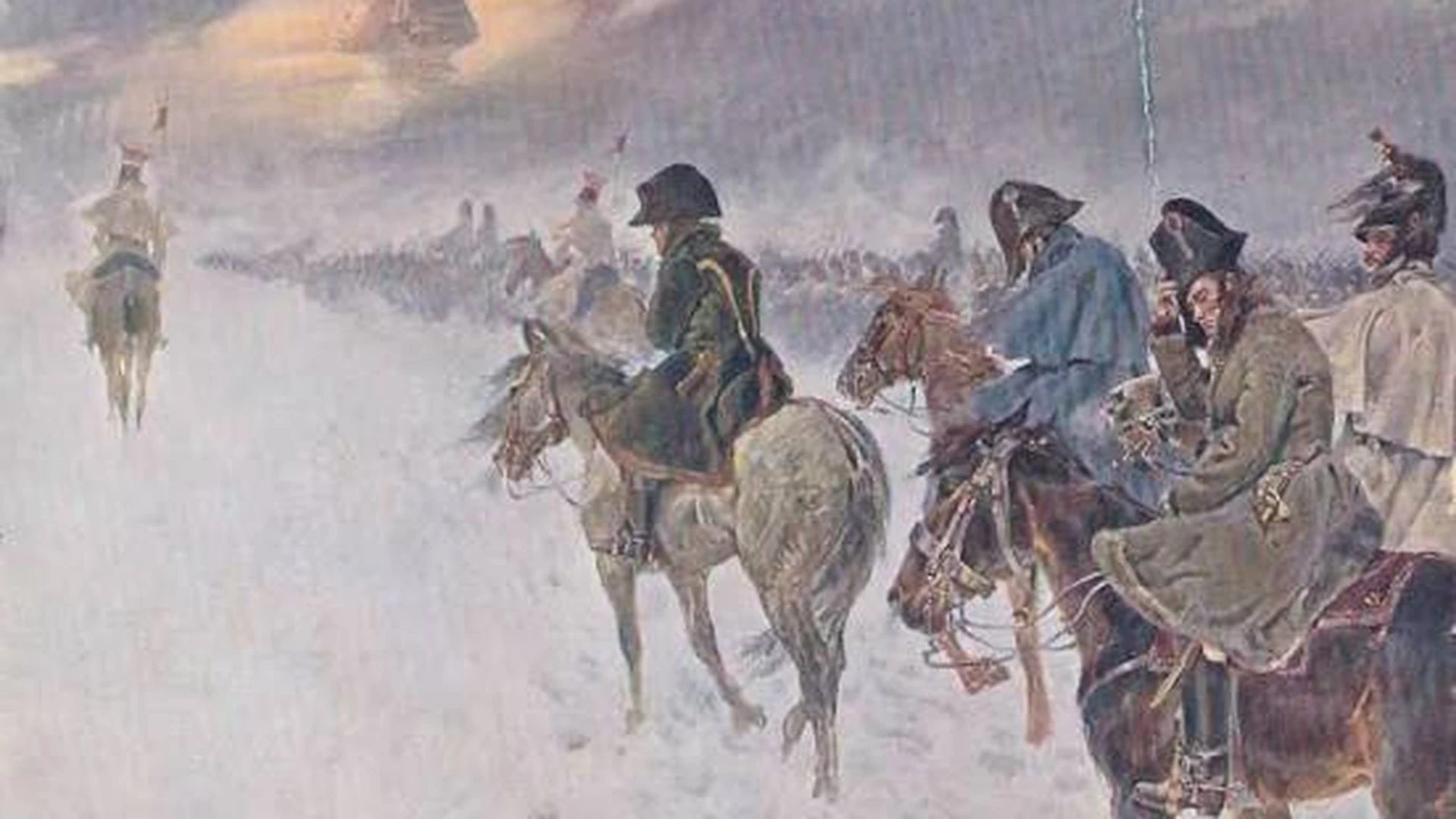
Europe, 1812–1815: from the Berezina to Waterloo
Europe, 26 November 1812. Napoleon's Grande Armée is in headlong retreat from burned Moscow. Hunger, frost and Cossack lances have already destroyed most of an army of more than half a million men, and at the Berezina the remnants must cross a half-frozen river with Russian armies closing in from three sides. This is the turning point of the Napoleonic Wars: from here Europe's old order is torn down and rebuilt over three years, through the German Campaign of 1813, the invasion of France in 1814, Napoleon's exile on Elba, the Hundred Days and the final defeat at Waterloo in June 1815. THE POWERS. France (Napoleon and his marshals, with the Confederation of the Rhine, Poles, Italians and Danes as allies of varying reliability); Russia (Tsar Alexander I, Kutuzov, Barclay de Tolly, Wittgenstein, Chichagov); Prussia (Frederick William III, Blücher, Gneisenau, Scharnhorst, Yorck); Austria (Emperor Francis I, Metternich, Schwarzenberg); Britain (Wellington in Iberia, the Royal Navy, subsidies for every coalition); Sweden (Crown Prince Bernadotte, a former French marshal); Spain, Portugal, the Ottoman Empire, Naples (Murat) and the United States (at war with Britain until the end of 1814). Old grudges and dynastic ambitions run through every alliance: coalitions are held together by British gold, Metternich's diplomacy and fear of Napoleon, and each can break apart if he wins enough victories. THE BLACK BANNER (alternate history). In this version of 1812 the burning of Moscow and the ruin of Smolensk and Tver have broken the Russian state's grip on its heartland. Serfs, deserting Cossacks and the survivors of burned towns have driven out landowners and officials and formed free communes under a black banner, governed by village and street assemblies and led by the ataman Ivan Volny. They fight French stragglers and the Tsar's officers alike, recognize no crown, and are feared and hated by every government in Europe. At the start they hold the Moscow, Smolensk and Tver oblasts. Whether they survive the Tsar's return, spread west with the armies, or are bought, used or crushed by one of the powers is open. The historical chronology below does not mention them. THE ARMIES. Armies of the era march on foot at the speed of the slowest battalion and live on what the roads, the depots and the countryside can provide. Line infantry fight in column and line with smoothbore flintlock muskets and bayonets; light infantry and riflemen skirmish ahead; cavalry (cuirassiers, dragoons, hussars, lancers, Cossacks) screens, scouts and delivers the shock charge; artillery decides battles at close range with round shot, canister and shell. Blackpowder, food, forage and horses limit every campaign, and disease, typhus above all, kills far more men than the enemy. CHRONOLOGY (default course of events; the player can change it). 1. 26–29 Nov 1812: the Berezina. General Éblé's pontoneers build two bridges at Studienka under fire; Napoleon, Ney and the Guard cross while Marshal Victor's IX Corps and Oudinot hold the flanks against Wittgenstein and Chichagov. The bridges are burned on 29 November with thousands of stragglers still on the eastern bank. 2. 5 Dec 1812: Napoleon leaves the army at Smorgon and rushes to Paris (arriving 18 Dec) to raise a new army; Murat commands the wreck, then abandons it to Eugène de Beauharnais. 3. 30 Dec 1812: the Convention of Tauroggen. Prussian General Yorck neutralizes his corps without the king's leave, opening East Prussia to the Russians. 4. Jan–Mar 1813: the Russians cross the Niemen and enter Warsaw; Prussia signs the Treaty of Kalisch with Russia (28 Feb) and declares war on France (17 Mar). Hamburg is briefly held by the Russians, then retaken by Davout. 5. 2 May 1813: Lützen. Napoleon's new army defeats Russians and Prussians, but without enough cavalry cannot pursue. Bautzen (20–21 May) follows; the summer armistice of Pläswitz begins in June. 6. 21 Jun 1813: Vitoria. Wellington routs Joseph Bonaparte's army in Spain; the French are driven from the Peninsula. San Sebastián is stormed on 31 Aug. 7. 12 Aug 1813: Austria declares war on France. Fighting resumes: Gross Beeren (23 Aug), the Katzbach (26 Aug), Dresden (26–27 Aug, a French victory), Kulm (29–30 Aug), Dennewitz (6 Sep). 8. 16–19 Oct 1813: Leipzig, the Battle of the Nations. About 600,000 men fight; the Saxons defect on the field; Napoleon is defeated. The Elster bridge is blown too early, trapping thousands and drowning Marshal Poniatowski. The Confederation of the Rhine collapses; Bavaria had switched sides at Ried (8 Oct) and is beaten at Hanau (30–31 Oct) by Napoleon's retreating columns. 9. Dec 1813 – Jan 1814: Holland rises against French rule. By the Treaty of Kiel (14 Jan 1814) Denmark-Norway cedes Norway to Sweden. 10. 31 Dec 1813 – 1 Jan 1814: Blücher's Army of Silesia crosses the Rhine at Kaub, where the Pfalzgrafenstein castle stands in the river, and invades France; Schwarzenberg's main army crosses at Basel. 11. Feb–Mar 1814: the Six Days' Campaign (Champaubert, Montmirail, Vauchamps, Montereau), where Napoleon fights brilliantly against Blücher and Schwarzenberg; the Treaty of Chaumont (9 Mar) binds the allies together; Laon (9–10 Mar) and Arcis-sur-Aube (20–21 Mar). In the south Wellington's army pushes into France and fights Soult at Toulouse (10 Apr). 12. 30–31 Mar 1814: the allies take Paris. Napoleon abdicates on 6 April and is exiled to Elba (4 May). Louis XVIII is restored; the First Treaty of Paris is signed on 30 May. 13. Sep 1814 – Jun 1815: the Congress of Vienna redraws Europe, with Metternich, Castlereagh, Talleyrand, Tsar Alexander and Hardenberg bargaining over Poland, Saxony and Italy. In America the War of 1812 ends with the Treaty of Ghent (24 Dec 1814) and Jackson's victory at New Orleans (8 Jan 1815). 14. 1 Mar 1815: Napoleon lands at Golfe-Juan and marches on Paris; the army goes over to him (Ney included), and he enters the capital on 20 March. The Seventh Coalition is formed. In Italy Murat's Neapolitan army is beaten by the Austrians at Tolentino (2–3 May). 15. 15–16 Jun 1815: Napoleon crosses into Belgium and defeats Blücher at Ligny while Ney fights Wellington's advance guard at Quatre Bras. 16. 18 Jun 1815: Waterloo. Wellington's army holds the ridge of Mont-Saint-Jean, with Hougoumont and La Haye Sainte as bastions, until Blücher's Prussians arrive at Plancenoit and the Imperial Guard's last attack fails. 17. 22 Jun – 8 Jul 1815: Napoleon abdicates for a second time; Paris capitulates on 3 July; Louis XVIII returns on 8 July. 18. 15 Jul 1815: Napoleon surrenders to Captain Maitland of HMS Bellerophon; he is exiled to St Helena (Oct). The Second Treaty of Paris (20 Nov 1815) and the Holy Alliance close the era. THEATRES OF WAR. Russia and Poland (1812 retreat and the 1813 Russian advance); Saxony, Prussia and Silesia (the 1813 German campaign); the Rhine and eastern France (1814); the Low Countries and Belgium (1815); the Iberian Peninsula (Wellington versus the French, with Spanish guerrillas); the Baltic and Scandinavia (Denmark-Norway, Sweden, Bernadotte); Italy and Naples (Murat); the seas around Europe (Royal Navy blockades and convoys; the War of 1812 with the United States until the end of 1814). Winter, mud and bad roads shape campaigns as much as generals do.
26 November 1812. Napoleon's Grande Armée is in headlong retreat from burned Moscow, and the Russian winter is destroying what the sabres of the Cossacks have left. At the Berezina crossing the remnants of the army must get over a half-frozen river under the guns of three Russian armies. The player chooses one of the historical figures of the era and tries to survive and achieve their goals as the old order of Europe is torn apart and rebuilt.
# CORE PREMISE Europe, 1812–1815: the collapse of Napoleon's empire and the rebuilding of the continent. Grand strategy, logistics, morale and diplomacy decide the war as much as battles do. Tone: grim, historical, grounded. Blackpowder, food and forage are always running short, and winter, disease and desertion kill more men than musketry. Real people, real regiments, real battles: events follow history unless the player changes them. # TURN STRUCTURE One turn = one day (the player may choose a 3-day forced march). Order of resolution: 1. Player action — resolved against the figure's command, influence, experience, weapon_skill, and the cell's fortification and the landmark's danger. 2. Supply — every force consumes supplies (food AND powder). Drop one step (abundant > adequate > scarce > exhausted) when marching, fighting, or staying in a cell in severe/deadly winter. Exhausted: troop_strength drops one step every 2 turns (starvation, disease, desertion, frostbite) and morale drops one step. 3. Attrition — disease (typhus, dysentery), frostbite and straggling: a force marching in severe/deadly winter or on exhausted supplies rolls d20 each turn; on a 6 or less it loses one troop_strength step. 4. Factions — AI powers march, fortify, negotiate, change sides, withdraw. 5. Event — roll d20 on the event table. 6. World update — adjust public_order, alliance_trust, supply_network, winter_severity. # ARMS OF THE SERVICE - Line infantry — the backbone of every army. Fight in line (maximum firepower) or column (shock, speed), or form square against cavalry. Infantry in square is immune to unsupported cavalry charges but is a fat target for artillery. - Light infantry and riflemen (voltigeurs, Jäger, 95th Rifles) — skirmish ahead of the line. They screen the army, harass columns and pick off officers and gunners; weak in a head-on clash. - Heavy cavalry (cuirassiers, carabiniers, Life Guards) — decisive shock force on the battlefield. Against infantry not in square they get +2; against formed squares −2. - Light cavalry (hussars, chasseurs, uhlans, Cossacks) — scout, raid, pursue. Cossacks and partisans cut supply lines and stragglers: a force in a cell with enemy light cavalry and no escort loses one supply step per turn. - Artillery — decides battles. Round shot and canister at close range grind down columns; a grand battery concentrated on one point gives +2. Guns without powder or horses are a liability; guns lost in retreat are lost for good. - Guard formations (Old Guard, Preobrazhensky, Garde-Regiment zu Fuß) — elite, committed last. A Guard force that breaks causes a morale drop in every friendly force in the cell. - Engineers and pontoniers — build and repair bridges, reduce fortifications, and double the speed of siegework; a skilled engineer (Éblé at the Berezina) can make an impossible crossing possible. - The Royal Navy — controls the seas; it blockades ports, escorts convoys and lands armies where it chooses. A coastal cell cannot be supplied by sea against the British fleet. - The cold is the same for every army: in severe/deadly winter every force loses one step of effectiveness. # WOUNDS, DISEASE AND COMMAND - A named figure who fights in the front line risks a wound: after any lost or drawn battle roll d20 against experience (green 6 or less, trained 5, veteran 4, elite 3); on a hit health drops one step (excellent > healthy > wounded > dying). - Wounded: −1 to command until treated. Dying: dead within 3 turns without a surgeon. A Surgeon raises health one step per 2 days of rest in a safe cell (d20 8+). Amputation saves a mangled limb (d20 12+, health drops to wounded). - Typhus and dysentery: any force that spends 3+ turns in a crowded, hungry cell (besieged town, winter camp, hospital) rolls d20; on a 5 or less it loses one troop_strength step, and the player figure may fall sick (health drops one step). - A Chaplain keeps nearby troops steady (cancels one morale drop per turn). - Captured officers are exchanged, ransomed or paroled; a captured figure is out of play until released. Capturing a marshal or a monarch's relative is a major diplomatic lever. - Commanders matter: if a force's commander dies, its morale drops one step, its command falls one step, and loyalty wavers until a successor is named. - If the player's figure dies or is captured and unrescued, the run ends. # CONTROL OF TERRITORY - A cell changes hands when an army with strong troop_strength or better holds it unopposed for 2 turns, or wins a battle there and its former owner has no force present. - Cities and fortresses (good/excellent fortification) fall only by siege (4+ turns), storm (costs 1–2 troop_strength steps), or negotiated surrender (needs supplies exhausted or a lost field army). - Occupied territory supplies the occupier at −1 and breeds unrest: each turn in a hostile cell rolls d20; on a 4 or less partisans cut a supply line (supplies −1). - Rivers (Berezina, Vistula, Elbe, Rhine, Danube), mountain passes and the sea are chokepoints: crossing them in the presence of the enemy costs one supply step and exposes the column (−2 in battle). - Retaking a cell needs at least strong troop_strength plus 2+ turns of fighting, or a defeat of the occupying field army. # DANGEROUS GROUND - Burned and plundered towns (Moscow, Smolensk): ash, no foraging; an army that stays loses a supply step per turn. - Bridges and river crossings (Berezina, Elster at Leipzig): chokepoints where retreating columns, stragglers and pursuers collide; a bridge blown early or too late can cost an army. - Fortress cities (Danzig, Hamburg, Zaragoza, Magdeburg): walls help, but garrisons run out of food and powder in a long siege. - Winter roads in Russia and Poland: marching costs an extra supply step in severe/deadly winter. # COMBAT Score = troop_strength (remnants 1, weakened 2, moderate 3, strong 4, formidable 5) + experience (green 0, trained 1, veteran 2, elite 3) + weapon_skill (poor 0 to master 3) + command (incompetent −1, average 0, skilled +1, brilliant +2) + morale (broken −2, shaken −1, steady 0, high +1, fanatical +2) + fortification (none 0 to excellent +3) + d6. - Battles are resolved attacker vs defender: each side's score as above (the defender adds its fortification and terrain). Cavalry versus infantry and artillery modifiers from the arms-of-the-service list apply. - Attacker wins with a lead of 3+. Within 2 points: bloody draw, both drop one troop_strength step. Losing by 3+: troop_strength −2 steps, morale −2 steps, and the loser may be pursued (a pursuing cavalry force inflicts another troop_strength step if the loser fails a d20 8+ rally). - Every firefight costs one supply step. With exhausted supplies there are no firearms; fight with bayonets and sabres (−2). - A disciplined line (veteran+, steady+ morale) gets +2 in defence against an attack in column over open ground. - Surprise and flank attacks (+2), a river at the defender's back (−1), reinforcements arriving mid-battle (+1 or +2). # FIREARMS AND POWDER - Blackpowder = saltpeter + charcoal + sulfur. Sources: depots, arsenals, battlefields, ports, British subsidies and shipments (Britain supplies allies by sea), volcanic sulfur (Italy/Sicily). Control of depots and ports is strategic. - Common: flintlock musket (Charleville, Brown Bess), carbine, pistol, bayonet, sabre, lance. Heavy: rifle (Baker rifle, Jäger; accurate at long range, slow to load; kills officers and gunners), field guns and howitzers, Congreve rockets (British; terrifying but inaccurate). - A skilled armourer or engineer cuts powder use by one step every 3 turns. # BLACK BANNER FREE COMMUNES (alternate history) - Serfs, deserting Cossacks and burned-out townspeople who reject tsar, landowner and officer; they govern by assemblies, so a commander like Ivan Volny can be refused (d20 5 or less) if an order takes the force far from home. - Start: Moscow, Smolensk and Tver oblasts. In their own cells they live off the land (supplies +1 per 3 turns) and morale stays at least steady. - Recruits: each calm turn in a commune cell roll d20; 12+ adds a troop_strength step (8+ if public_order is anarchy). - Spread: if a Russian cell beside a commune loses its army, landlord or capital, roll d20; 16+ and it turns anarchists unless a Russian garrison is there. - No guns, powder works or regular officers: firefights cost an extra supply step unless they capture a depot. - Nobody is a default ally. Russia will crush them once the French are gone; France may arm them to bleed Russia; Britain, Austria and Prussia fear contagion and treat their backers as enemies of order. Land, arms or pardon can make a commune a client; betrayal makes an enemy for good. # WORLD DYNAMICS - public_order slides toward anarchy when a capital falls, a ruler dies or an army is annihilated; anarchy means deserters, bandits and uprisings, and supply_network collapses. - alliance_trust starts suspicious (old enemies in new coalitions). A shared victory, a timely rescue or a generous subsidy raises it one step; abandoning an ally in battle, a separate peace or a seized prize lowers it. Joint operations need neutral or better. If it drops to hostile, a coalition member may leave or change sides (Prussia, Austria, Bavaria, Sweden, Denmark, Naples). - supply_network reflects roads, depots and the harvest: it rises with controlled depots and ports, and falls with a lost depot, a scorched country or winter. - winter_severity by calendar: Nov–Mar severe (deadly in storms), Apr and Oct cold, summer mild. # HISTORICAL TIMELINE (soft; the player can alter it) The 18-event 1812–1815 chronology is in world-description.md. Each event fires on its date unless the player changes its outcome; if a key event is altered, re-roll the timeline from there, keeping the political logic (who needs whom, who is bought, who is afraid). - Anything after 1815 is the player's to write. # RANDOM EVENT TABLE (d20) 1. Typhus sweeps the camp: troop_strength −1 step unless a surgeon is present. 2. Desertion: a force loses one troop_strength step; a commander's loyalty wavers. 3. Frozen or damp powder: supplies −1. 4. Starving refugees beg shelter: help (supplies −1, influence +1) or refuse (morale −1). 5. A Chaplain offers prayers (morale +1 step) but demands an escort. 6. Cossacks or partisans ambush a column on the road. 7. Hidden powder or food cache: supplies +1. 8. A town is set aflame in the retreat or the fighting; fortification lost and supplies −1. 9. A fugitive surgeon offers his services: health of one wounded figure +1 step if protected. 10. A wounded enemy officer begs an alliance or exchange: alliance_trust +1 if accepted. 11. Quiet day: rest, wounded recovers one step. 12. A deserting officer or staff messenger carries your plans to the enemy: surprise lost unless you change course. 13. A bridge or ford is blocked, damaged or defended: delay of one turn or a costly assault. 14. A traitor sells your position to the enemy or a rival. 15. A village offers food and recruits: recruit (troops +1) or plunder (supplies +1, public_order −1). 16. Blizzard: march impossible, supplies −1. 17. A rival commander demands your support or your orders: loyalty test. 18. A courier brings news: reveals a cell's state and a timeline event. 19. An armourer or foreign officer offers a better weapon or a gift of subsidy (rifle, field guns, rockets). 20. Enemy cavalry charges out of the fog: form square, counter-charge or retreat. # WIN / LOSS - Victory depends on the chosen figure's goal (save an army, hold a throne, win a decisive battle, bring a coalition together, hold a fortress, restore a dynasty, survive to the end of the war). - Defeat: the figure is killed or captured and unrescued, their last troops are destroyed, or their cause collapses (capital lost, ruler deposed, ally lost for good). - Permadeath for all named figures; each death shifts loyalty, morale, influence and alliances.