Broken Italy
1960 — Shadows over the Republic
Characters
World Map
World Description
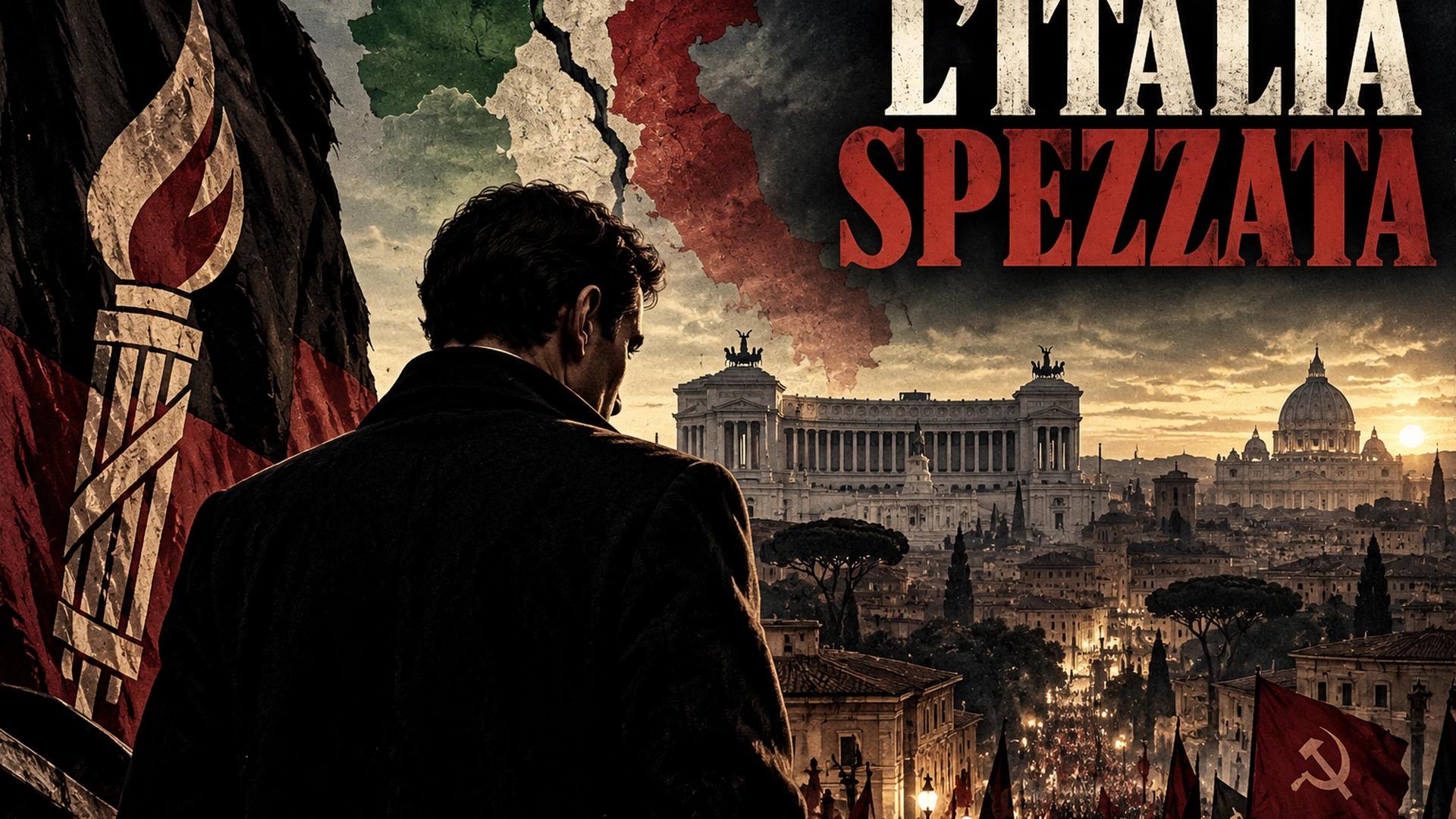
# Italy, 1960 — Alternate History Outside of Italy, the world of 1960 essentially coincides with the real historical context: the Cold War pits the United States against the Soviet Union, NATO and the Warsaw Pact divide Europe, and Francisco Franco governs Spain. The main historical divergence concerns Italy. After the Republic's victory in the institutional referendum, communist forces won the government through elections and progressively subordinated Italy to Soviet influence. In 1960, Palmiro Togliatti is President of the Italian Republic and represents the pinnacle of the new political order. Republican institutions exist formally, but the government and security apparatuses exercise strong control over the opposition. The monarchy is in exile and retains supporters in the country. The Forza Nazional Sociale is headquartered in Rome—a far-right nationalist, monarchist, and anti-communist movement led by 45-year-old Alvise Romano. Romano, a former high-ranking Blackshirt officer, aims for the restoration of the monarchy and the formation of a right-wing government. The Fronte Nazionale Libero constitutes the most violent and clandestine component of the Forza Nazional Sociale, while still maintaining its own operational network and margins of autonomy. Romano possesses clandestine relations abroad. Figures linked to Francoist Spain have agreed upon secret channels for the supply of weapons and logistical support for his organization. Francisco Franco has not, however, granted any official support: Madrid maintains the ability to deny any involvement, and the entire relationship must remain clandestine. In Rome, Romano possesses strong contacts within Vatican circles and has established confidential agreements with figures linked to the IOR. In this timeline, the IOR constitutes the main channel through which clandestine funding from Spain is delivered to Romano's network, keeping the operation separate from any public support from the Holy See. Romano also maintains relationships with Roman organized crime, including a network known as the Banda della Magliana. Alvise also has two important footholds within the state apparatus. The Deputy Minister of Justice has been under his blackmail for years: Romano holds compromising evidence regarding a sex scandal that would destroy the official's political career if it became public. The Deputy Minister is therefore forced to cooperate, despite having his own interests and the potential to attempt to evade Romano's control. In Rome, a General of the Roman Carabinieri sympathetic to nationalist and monarchist circles shares some of the ideas of the Forza Nazional Sociale. He does not formally belong to the movement and does not take orders from Alvise, but he occasionally offers him protection or assistance by leveraging his position. The relationship remains clandestine and depends on the General's willingness to take risks. In Alvise's inner circle, Renzo Bruno is his right-hand man and treasurer of the Forza Nazional Sociale: he manages the movement's resources and plays a central role in confidential financial dealings. Mattia Luce, meanwhile, leads the Fronte Nazionale Libero and enjoys considerable autonomy in managing its clandestine wing, while still acknowledging Romano's political leadership. Alvise's private life is tied to Sofia Bianchi, his wife, with whom he lives in Rome. The two have a son named Italo. Sofia does not automatically hold positions within the movement, but the family represents an essential part of Alvise's personal life and can be involved in the political consequences of events. The Italian geopolitical position makes any internal crisis particularly delicate. Moscow considers the Italian government part of its sphere of influence, while Western powers monitor Italian developments within the broader framework of the Cold War. ## The road to 1960: an alternate timeline - **1946–1948, the electoral turning point:** after the institutional referendum and the birth of the Republic, the communist bloc gradually conquered a dominant position through elections, coalitions, and a deep crisis of moderate parties. Not all opponents are monarchists: democratic Catholics, liberals, and non-aligned socialists followed different paths. - **1949–1953, consolidation:** public apparatuses were progressively subordinated to the new political balance. Soviet influence over security and foreign policy grew; some monarchist and anti-communist figures were removed from institutions, without this entailing the disappearance of every formal pluralism. - **1954–1957, repression and adaptation:** censorship, surveillance, and restrictions targeted the opposition. The Christian Democracy, however, retained a minority parliamentary representation; some religious and local entities maintained margins of autonomy. Political networks in exile and clandestine internal organizations were formed. - **1958–1959, fragmentation of the opposition:** Alvise Romano's Forza Nazional Sociale brought together nationalist and monarchist circles but did not represent all opponents of the regime. The Fronte Nazionale Libero emerged as a radical clandestine wing. Traditional monarchists, Christian Democrats, and other groups could share opposition to the government without sharing goals and methods. - **January 1, 1960, the game begins:** the regime remains solid, but political life is marked by conflicts within the dominant bloc, economic difficulties, surveillance of the opposition, and Cold War pressures. No crisis or victory is predetermined. This timeline belongs exclusively to the game's alternate history and should not be confused with real Italian history. ## Parliament and institutions in 1960 The Republican Parliament is still functioning but is dominated by a large majority of communists and socialists tied to the governing system. **The Christian Democracy holds a small minority of seats**, sufficient to keep a Catholic voice in parliament, but not enough to govern or block the executive on its own. Socialist representation is not necessarily unanimous: different factions may debate relations with Moscow, economic reforms, and political repression. Even among communists, there are disagreements on methods and interests, despite Togliatti's leadership. Voting, debate, and parliamentary procedures formally survive, but the press, security, access to candidacy, and freedom of the opposition are subject to interference. The **Forza Nazional Sociale has no parliamentary seats at the start of the game** and is not a party permitted in normal political competition. Its potential legal recognition or entry into institutions can only emerge from future developments; it is not predetermined. Palmiro Togliatti's presidency does not imply that every communist or socialist minister, official, or parliamentarian obeys him unconditionally. The government, the administration, security services, local authorities, and the Armed Forces have distinct interests and margins for initiative. ## Society and political geography - **Rome:** center of republican power, security apparatuses, Vatican diplomacy, and clandestine political networks; personal relationships and institutional rivalries hold particular weight here. - **Milan and Turin:** industries, wage labor, trade unions, entrepreneurship, and conflicts over productivity, property, and public control. The clandestine Circolo della Corona also operates in Milan, frequented mainly by former monarchists and military personnel. - **Emilia-Romagna and Tuscany:** deep-rooted presence of communist organizations, but also local identities and Catholic or independent opposition. - **Naples and the Mezzogiorno:** inequalities, unemployment, local apparatuses, and criminal networks, each with autonomous objectives. - **Sicily and Sardinia:** agrarian issues, autonomy, family and economic ties, and interests that do not automatically coincide with those of the central authorities. Daily life must include wages, housing, prices, work, school, media, religious life, censorship, and private fears. Inhabitants are not automatically supporters of a political bloc based on their region of origin. ## Deputy Minister of Justice under blackmail **Arturo Bellandi**, 52, is the Deputy Minister of Justice and a member of the socialist wing of the majority. Originally from Emilia, he is a jurist formed in the anti-fascist struggle. In the 1950s, he built a career in the government bloc thanks to his ability to mediate with communists and defend the socialists' remaining autonomy. He is not a revolutionary: he desires prestige, security, and a prospect of ministerial advancement. He is married and has two children; externally, he cultivates an irreproachable image as a husband and official. In 1957, in this alternate timeline, an extramarital affair and compromising associations exposed him to a sex scandal. **Alvise Romano holds documents and testimonies capable of destroying Bellandi's reputation**. The blackmail forces the Deputy Minister to occasionally provide information and facilitation within the limits of his position. Bellandi does not share the cause of the Forza Nazional Sociale, fears Mattia Luce, and considers the relationship with Alvise a threat to his life. Bellandi secretly seeks a way out: he can stall, filter or deny information, persuade Alvise to limit his demands, or attempt to evade the blackmail. He fears most that **Cesare Valenti** might discover a leak from the ministry. He does not control the entire judiciary, nor can he quash investigations at will. His future choices depend on the circumstances: he is destined neither to betray nor to remain faithful. ## Milan's Circolo della Corona The **Milan Circolo della Corona** is a secret monarchist and nationalist association, born from the meeting of former officers, soldiers with monarchist backgrounds, aristocrats, and nostalgists of the Savoy monarchy. Its patrons meet privately in the Lombard capital and cultivate personal relationships with circles of the former royal army, the conservative bourgeoisie, and the opposition to the communist government. Its existence and the identities of its members are not public knowledge. The Circle is not part of the Forza Nazional Sociale and does not take orders from Alvise Romano. Some members may view him as a potential anti-communist ally, while others are wary of him due to his past in the Blackshirts and the radicalism of the Fronte Nazionale Libero. Even the relationship with the traditional monarchism of Count Vittorio Sanjust is not automatically one of subordination. The association can debate, shift its orientation, face pressure, or be torn by internal conflicts; its future is not predetermined. ## Characters and relationships Alvise, Sofia Bianchi, and their son Italo maintain a family life separate from politics; Sofia is not a resource to be used automatically and may disagree with her husband's choices. Renzo Bruno manages the financial means and safeguards the continuity of the FNS; Mattia Luce directs the Fronte Nazionale Libero autonomously and is prone to conflicts of direction with the political leadership. Cesare Valenti may follow investigative leads independently, without knowing every secret from the start. Count Vittorio Sanjust maintains a monarchist project different from Alvise's. Monsignor Falconi and Javier Montalbán prioritize the interests of their institutional contacts over those of the movement. Lucia Castelli has her own feelings, risks, and motivations, rather than serving as an infallible source of information. The men and women of this narrative world remember promises, betrayals, humiliations, favors, and losses. No character should be introduced simply to push the player along a forced plotline.