The Era of the Second Beyliks
History, Rewritten
- 425
- Games
- 4,873
- Turns
- 12
- Upvotes
Characters
World Map
World Description
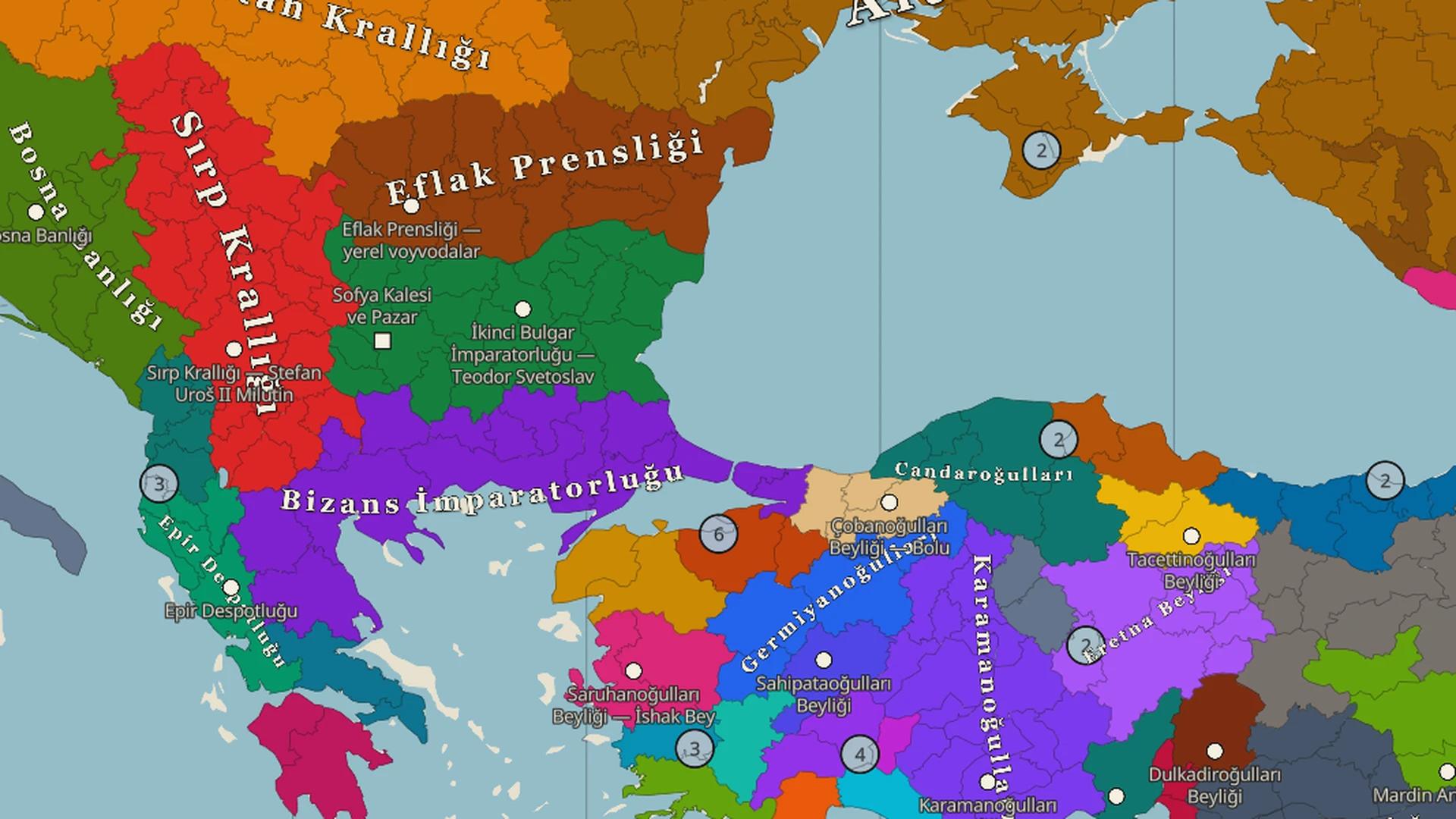
# World: Thrones and Borders This game is an alternative political sandbox based on today's recognizable geography. The existing cells on the map are fixed regions; new cells or geometries cannot be created. Borders are not independent country objects: they are represented through control, local administration, institutions, actors, and regional statistics. ## Administration and city life Each region's population, security, production, prosperity, and public support can differ. Cities are hubs for trade, crafts, taxation, recruitment, and administration. Roads, ports, granaries, walls, and markets are treated as fixed locations that influence the flow of resources. The ruler makes choices between collecting revenue and maintaining public satisfaction; excessive taxes, war weariness, and poor supply can increase unrest. Population and soldier numbers in this alternative history scenario are approximate balancing units of a thousand people; they are not precise historical census data. ## Seasons and regional climate The game begins at the start of 1302. Seasons do not affect every region with the same severity. Winters can be harsh in the Balkans, Hungary, the Carpathian passes, and the northern steppes; snow, frost, and ice close river crossings, increase livestock loss, and raise food consumption. In the high interior regions of Anatolia, winter makes roads and mountain passes difficult, while spring rains slow down movement with mud and flooding. In the Eastern Black Sea region and the Caucasus Mountains, rainfall, fog, and landslides can disrupt travel, while storms in the Black Sea and the Aegean may hinder maritime transport. In Central Anatolia, Syria, and Mesopotamia, summer heat and drought increase the pressure on water, pastures, and supplies; harvest time may boost agricultural revenue, but diverting peasants from the fields reduces production. Winter penalties are not applied uniformly across all regions: they are determined by local climate, altitude, road infrastructure, and state of preparation. ## Region-specific sources of income The revenue base of each region varies according to its geography; tax and customs revenues are not fixed, but are calculated based on production, security, season, population, and administrative quality. Thrace and Marmara feature grain, vineyards and gardens, markets, strait crossings, and customs; Bursa and Western Anatolia rely on silk, weaving, olives, grapes, agriculture, and handicrafts; Central Anatolia is defined by grain, sheep and goat husbandry, horse breeding, salt, and caravan routes. The Western and Central Black Sea regions derive income from port customs, fishing, timber, beekeeping, and inland passage routes; Trabzon and the Eastern Black Sea benefit from port taxes, garden produce, fishing, mountain passes, and Caucasian-Silk Road trade. The fertile plains of the Balkans produce grain and livestock; Kosovo, Bosnia, and certain mountainous areas stand out with minerals, forest products, pastures, and transit taxes. Coastal Aegean and Mediterranean regions feature port customs, fishing, olives, grapes, salt, and maritime trade; Çukurova relies on grain, legumes, livestock, and caravan traffic; Mardin and Upper Mesopotamia depend on caravan taxes, weaving, agriculture, and markets. The Crimea and northern steppes yield horses, sheep, hides, grain, river crossings, and long-distance trade; Georgia and the Caucasus provide minerals, wine, livestock, and mountain passes; Cyprus relies on sugar cane, grain, salt, and port trade. War, banditry, blockades, excessive customs duties, and bad weather diminish these revenues, while secure roads, grain stores, fair taxes, and port maintenance increase them. ## Medieval currency system and state treasuries Three primary types of coins are used in the economy. **Copper coins** are common for daily market purchases, small wages, and low-value payments like bread and provisions. **Silver coins** are central to taxes, soldiers' salaries, craft goods, and medium-scale trade and procurement. **Gold coins** are used for major merchant payments, diplomatic gifts, ransoms, and long-distance trade. Each political state's initial reserve is recorded using the values `copper_coins`, `silver_coins`, and `gold_coins`; these amounts are not historical accounting records but game values adjusted for economic capacity. States are not required to accept every currency at the same value. The coin's weight, metal purity, mint reputation, regional scarcity, and confidence in foreign currency affect exchange rates. Major markets and ports may weigh and accept coins from different states; in smaller settlements, exchanging foreign gold or silver may require an additional fee. Mines and mints support the money supply; however, minting too many coins by reducing metal content can weaken trust and purchasing power. While taxes, trade, mines, customs, and tribute generate income, soldiers' salaries, supplies, construction, diplomacy, and war costs deplete the treasury. This economy defines three coin reserves and decision principles; it does not imply that it automatically operates a market price, exchange rate, or market transaction system on its own. ## Interstate relations and alliances Relations between states are not fixed. Initially, they are shaped by neighborhood, past conflicts, trade interests, dynastic ties, common threats, and religious-political institutional affiliations; these can change throughout the game via embassies and player decisions. No alliance is mandatory or valid forever. A player can send an envoy to a state, improve relations, propose a trade agreement or non-aggression pact, attempt to form a defensive alliance, propose a campaign against a common enemy, initiate peace negotiations, or establish closeness through marriage ties and mutual aid. The terms of each offer must be clear: who are the parties, what are the obligations, how long does it last, and under what conditions does it end? No agreement is established without the consent of the other side; states may accept, reject, or offer counter-proposals. Diplomatic relationship guide: hostile (-100 to -61), tense (-60 to -21), neutral (-20 to 20), friendly (21 to 60), close ally (61 to 100). These ranges are a scale used for roleplay and decision-making consistency; it does not mean a separate relationship point system is established in the current files. A common enemy, mutual aid, and loyalty to agreements facilitate closer ties. Border violations, cutting off trade routes, leaving an ally alone in war, or breaking a treaty reduce trust and can trigger counter-alliances. Alliances can be organized as defensive, offensive, or time-limited military cooperation. Parties can specify clauses such as safe passage, joint campaigns, supply/military support, trade privileges, and intelligence sharing. Peace treaties may include the end of war, exchange of prisoners, reparations, border adjustments, and a non-aggression period. Local notables, merchants, and commanders may also support agreements or make implementation difficult if their interests are harmed. ## Rise and fall of states and popular rebellions This world is not composed of fixed states. Control of cells can change in war; this requires conquest, the defeat of defense, siege, surrender, or a treaty. A state that loses its capital, army, income sources, and the support of its elites may fragment or collapse. The former dynasty may remain in exile and attempt a comeback later. Public unrest grows due to low local stability, heavy taxation, famine, looting, defeat, and succession crises. If rebels organize around a leader and capture cities and neighboring regions, they can declare an independent state by establishing sufficient popular support and a tax base. The name, ruler, form of government, and starting treasury of the new political entity are recorded; the cells it controls receive a new `political_owner` value. Civil wars can split the same country into rival states. These processes are described as game rules; automated triggers for rebellions, conquests, or state collapses must be tested separately. ## Time, pace of campaigns, and winning public trust The world does not progress in instant moves, but via a calendar suited to medieval conditions. Couriers and envoys arrive in days or weeks, depending on the state of the roads. An army must first be mustered and its supplies and animals prepared; only then does it begin its march. Prepared troops on good roads can advance approximately 15–25 km per day; heavy siege equipment and large supply trains are slower. Mountains, mud, winter, river crossings, enemy harassment, and insufficient supplies delay the march. Sea voyages also depend on wind, ship type, port, and season. It can take weeks or months for an army to reach a distant front; sieges and long campaigns take even longer. Public support changes even more slowly. Secure roads, fair courts, predictable taxes, and aid during times of famine are the foundations of trust. A few good decisions may provide short-term relief, but lasting loyalty mostly requires consistent governance over several years. In newly conquered regions, language, traditions, local notables, and old enmities must be taken into account; ruling solely by garrison without establishing local cooperation is expensive and fragile. Looting or heavy taxes can quickly erode public support; fear is not the same as voluntary loyalty. ## Balance of power Local notables, city councils, merchants, commanders, and envoys of neighboring states act in accordance with their own interests. Treaties, trade privileges, marriage ties, hostages, alliances, and threats are ways to expand one's control without war. Military victory alone does not guarantee lasting rule: occupied regions require maintenance, legitimacy, and local cooperation. ## Individuals, administration, and the populace Every political actor's sovereign or executive decision-making body, form of government, total population (`population_thousands`), recruitable manpower (`recruitable_manpower_thousands`), standing army (`standing_troops_thousands`), army strength, and the status of the populace are tracked. Building an army is not just a matter of giving orders: the pool of manpower is limited; treasure, provisions, equipment, training, and agricultural labor are all required. Figures such as Osman Bey, Orhan Bey, Akçakoca Bey, and Sheikh Edebali exist as individual character actors; the player can assign tasks to characters, appoint commanders, support heirs, and attempt to gain the backing of influential people. Forms of government can include dynastic monarchy, beylik, empire, despotate, banate, or city council. Army strength (`army_strength`) indicates the military capacity of a political actor; local stability (`local_stability`) indicates the security, administration, and risk of rebellion in each city; and prosperity (`prosperity`) reflects production and living conditions. The dominant religious belief of the population (`dominant_faith`) can also be recorded for each region; this indicator is separate from political dominance and does not imply that everyone in the region shares the same faith. Heavy taxes, famine, looting, and prolonged wars can reduce public support and stability; secure trade, fair administration, supply, and equal treatment of faith groups can strengthen local cooperation. The starting values are status indicators that can be changed through in-game decisions. ## Influential figures and local dignitaries of the era Alongside political power, individuals who influence the daily life of the populace are also taken into account: guild masters and merchants affect city markets; village elders and tribal chieftains influence rural loyalty; religious leaders and monastic circles affect social legitimacy; and cadis, tax officials, and castle commanders affect justice, revenue, and security. Around the Ottomans, Sheikh Edebali and Akçakoca Bey; in the Serbian Kingdom, the Nemanjić dynasty, church dignitaries, and frontier commanders; in Bulgaria, the boyars and the church hierarchy; in Bosnia, the ban and the dignitaries of mining towns; and in Arbëria, local beys, port merchants, and castle commanders are significant centers of influence. These individuals do not always act in allegiance to a single sovereign; they have their own local interests, reputations, and community support. For states represented on the map that do not have a separate character object, the ruling circles are taken as the basis: the Bagrationi dynasty and nobility in Georgia; Het'um II and court dignitaries in the Armenian Kingdom of Cilicia; Öljaitü Khan, viziers, and emirs in the Ilkhanate; an-Nasir Muhammad, emirs, and Cairo merchants in the Mamluk Sultanate; Henry II of Lusignan and Frankish nobles in Cyprus; Frankish duke/prince dynasties in Athens and Achaea; the Doge of Venice, Genoese merchant families, and city councils in Italian city-states; and local princes and tribal elders in Circassian principalities. These names serve as representative political centers in an alternative history start that brings together elements from different dates. ## Stability table for the opening period Stability values are starting estimates prepared for the game on a scale of 0–100; they are not historical measurements or precise population data. Due to its mountain passes and the balance between local beys, Arbëria's stability is at a medium-low level; trade hubs like Durrës and Vlorë can provide revenue and cooperation. While the dynasty and church networks support order in the core regions of the Serbian Kingdom, the power of local nobles is significant in the border regions. In Bulgaria, Tarnovo and the main markets are more stable, while the coastal and border areas are more open to external pressures. The autonomy of local nobles in the mountainous regions of Bosnia and Montenegro limits central authority. Although the Byzantine Empire's major cities have institutional capacity, financial and military pressures strain public prosperity. This table is an alternative history starting state that can be altered by player decisions in the game. ## Gameplay loop The player makes decisions from within a role; they can propose investments in buildings, roads, or defenses, distribute resources and taxes, appoint officials, make trade agreements, mobilize troops, or claim rights over a territory. Each action is met with costs in resources, time, political risk, and the reactions of other actors. The consequences of major decisions are felt across multiple turns and regions. ## The Ottoman State The Ottoman State is a rising power of significance in the transitional region between Anatolia and the Balkans. Bursa is the administrative and trade hub, Edirne is a strategic base opening into the Balkans, and Istanbul is a major target due to the Straits and intercontinental trade. By taking on the Ottoman administration, the player can develop cities, regulate taxes and production, make treaties with neighbors, prepare armies and supply lines, and establish permanent administration in newly conquered lands. Conquests are not considered automatic successes: they require the management of garrisons, local stability, treasury, and legitimacy. ## Anatolian beyliks, Byzantium, and the Empire of Trebizond In addition to the Ottoman State, the map contains smaller political entities such as the Karamanids (Alâeddin Ali Bey), Germiyanids (Süleyman Shah), Aydinids (Gazi Umur Bey), Sarukhanids (Ishak Bey), Menteşe (Menteşe Bey), Karasids (Karesi Bey), Hamidids (Dündar Bey), Candarids (Shams al-Din Yaman Candar), Teke (Yunus Bey), Eşrefids, Inanç (Ladik), Pervaneids, Sahipataids, Alaiye, Taceddinids, Dulkadirids, Ramazanids, Eretna, the Anatolian Ahi, and the Artuqids of Mardin. In the Balkans, Arbëria (Principality of Albania), the Banate of Bosnia, and the Despotate of Epirus exist as separate political actors; the Duchy of Athens and the Principality of Achaea also complete the regional balance of power. The Byzantine Empire is represented by John V Palaiologos, and the Empire of Trebizond (Pontic Greeks) is represented by the era of Alexios III Megas Komnenos. Since some beyliks and leaders were influential at consecutive or different times, this opening is not a one-to-one map of a single precise year, but an alternative history strategy sandbox based on the early 1300s. A political dominance status is assigned to each city cell. Distinct color values for this status have been defined to visually distinguish the cities of the Ottomans, Byzantines, the Empire of Trebizond, and the beyliks. The power of the beyliks is represented through their central cities, local stability, trade revenues, diplomacy, and military logistics. As the current map cells are fixed, new border polygons are not drawn; political colors can only be applied to existing city/region cells. ## The political map in the early 1300s Initial political dominance and colors have been assigned to all empty land cells. The map represents the Anatolian beyliks and Ottoman/Byzantine/Trebizond regions, as well as the Serbian Kingdom, the Second Bulgarian Empire, the Kingdom of Hungary, the Wallachian environs, the Golden Horde, Georgia, the Armenian Kingdom of Cilicia, the Ilkhanate, the Artuqids of Mardin, the Mamluk Sultanate, the Despotate of Epirus, the Duchy of Athens, the Principality of Achaea, the Kingdom of Cyprus, the Banate of Bosnia, and the Circassian principalities. A separate color code is defined for each political structure. This layout is an approximate historical interpretation based on the power balances of the early 14th century; as the existing cells are modern administrative regions, medieval borders are not drawn precisely. Since some states and leaders are from different dates, the game remains an alternative history sandbox. The "City / regional dominance" status is used for map colors. ## The Silk Roads and long-distance trade The Silk Road is not a single line but a network of interconnected land and sea routes. In the western section covered by this map, Constantinople, Trebizond, Black Sea ports, the Crimea, and the Caucasian passes are gateways to the connections extending toward the markets of Anatolia, Iran, and Central Asia further east. As most of East and Central Asia lies outside the current map cells, these connections are described within the context of the world; this does not mean new regions or borders have been added to the map. **Major corridors:** - **Constantinople corridor:** A customs and transshipment center connecting the Black Sea, the Balkans, and the Mediterranean via the Straits. Port fees and the security of the Straits affect trade revenue. - **Trebizond–Caucasus line:** A branch connecting the port of Trebizond to inland passes, Georgia, and the caravan routes further east. Mountain passes, bridges, and seasonal conditions can slow down travel. - **Crimea–steppe line:** Trade extending from Crimean markets and ports to the northern Black Sea steppes and the Don and Volga basins. The security and tax policy of the Golden Horde are the main determinants of this route. - **Anatolia–Iran link:** Caravan routes running east from Anatolian cities; linking the trade of textiles, silk, dyes, spices, metalware, and horses. The route continues at the eastern border of the map. - **Mediterranean maritime branch:** Combines sea transport with land caravans via Cyprus, the Levant, and Anatolian ports. Silk, high-quality textiles, spices, dyes, precious metals, horses, leather, beeswax, grain, and craft goods are the primary trade commodities. Caravanserais, markets, port warehouses, secure passes, and predictable customs attract merchants. Taxing multiple times, arbitrary confiscation, piracy, war, plague, or highway robbery divert caravans to other routes. The returns from trade are distributed not only to the treasury but also to city artisans, local administrators, and allied merchants. ## Arbëria, ports, and trade routes Arbëria (Principality of Albania) is established in this alternative history start as a confederation of local beys uniting the regions of Shkodër, Kukës, Dibër, Elbasan, Berat, Korçë, Vlorë, Gjirokastër, and Fier. The two main gateways of the coastal economy are the ports of Durrës and Vlorë. The Via Egnatia line, stretching from Durrës through Elbasan and Ohrid to Bitola and Thessaloniki, is the main east-west trade corridor; Shkodër and the Drin valley connect to the northern Kosovo passes, while the Vlorë–Vjosa valley and Berat connect to the southeastern inland markets. Ports facilitate maritime trade, while caravan routes carry agricultural, livestock, mineral, and craft products from inland regions. Keeping customs duties moderate, protecting bridges and passes, and preventing piracy and robbery increase revenues; excessive transit taxes may divert trade to other ports. This political union is not a direct copy of a single historical state but an alternative history structure created for the game. ## The Golden Horde Khanate The Golden Horde is a khanate established in the western steppes by the Jochid ulus, exerting influence over the vast fields north of the Black Sea and the Volga trade basin. At the start of the game, Khan Tokhta attempts to maintain the balance within the dynasty and ensure the loyalty of the steppe emirs. The strength of the administration does not come from the army alone: the flow of taxes and tribute, relations with the Russian principalities, trade in the Crimea and Black Sea, river crossings, and the support of local elites are also decisive. **Governance and centers of power:** The Khan and the Jochid dynasty hold supreme authority; emirs, noyans, cavalry commanders, and local governors command their own military networks. Taxes and political allegiance from subordinate principalities are not equally reliable in every region. If central authority weakens, local lords may prioritize their own interests, tax flow may be interrupted, and rival branches of the dynasty may enter a struggle for influence. **Army and borders:** Horse archers, light cavalry, reconnaissance, and rapid maneuver are the strengths of the Golden Horde. However, gathering troops across the vast steppe takes time; the condition of pastures and horses, winter, river crossings, supplies, the division of loot, and the loyalty of emirs limit the strength of a campaign. A rapid raid does not equate to permanent occupation; garrisons and local cooperation are required in cities. **Trade and diplomacy:** The Crimean ports, the northern Black Sea market, and trade connections along the Volga provide revenue. Offering merchants safe passage and stable customs increases revenue, while arbitrary seizure or excessive taxation causes trade to shift to other ports. The Golden Horde simultaneously conducts a policy of negotiation, pressure, and alliance with the Russian principalities, Byzantium, Caucasian powers, and merchant sailors in the Black Sea. **Initial balance:** Population, deployable manpower, and values for soldiers under arms are rough estimates for game balancing; they are not precise historical census data. As the Khanate covers a vast area, it is not considered possible to gather the entire army at a single point; mobilization depends on the treasury, horses, supplies, the season, and the support of local emirs. ## The Papacy and the Christian world The Papacy is a separate spiritual and diplomatic actor in the game; it **initially possesses no map cells or territory** and does not take on a color for political dominion. Pope Clement V operates from the papal center in Avignon. Its power does not come directly from armies or conquered lands, but from bishoprics, monasteries, clergy, canon law, donations, and the search for legitimacy by Christian monarchs. **Tools of influence:** Sending envoys to monarchs, mediation in marriage and succession disputes, supporting or condemning a monarch's legitimacy, the threat of excommunication, calls for crusades, and church donations. The Papacy cannot automatically control a monarch; influence depends on the support of the local clergy, the monarch's piety and political interests, public reaction, and the Pope's reputation. Monarchs may accept, negotiate, or reject papal support; conflicts of interest and the struggle for secular power limit this influence. Good relations with the Papacy are treated as a factor that can increase the legitimacy and diplomatic support of Catholic monarchs. Excommunication or open conflict may weaken the support of some nobles, clergymen, and segments of the public; however, these results are neither certain nor automatic. The Orthodox Christian world has its own spiritual centers, such as the Patriarchate of Constantinople; the Papacy is not considered to have the same level of authority over all Christians. This section is a diplomatic and social design rule; it does not indicate the presence of a standalone influence score or an automatic excommunication system. ## Balancing coalitions against great powers No state's growth leaves other states indifferent. A power that conquers many regions in a short time, monopolizes straits or main trade routes, or threatens neighboring dynasties can bring even previously discordant states together against a common threat. Coalitions can be formed for mutual defense, coordinated warfare, naval blockades, port access, financial/supply aid, and pressure on separate fronts. Coalition members are not required to have the same goals: some want to protect their borders, some to reclaim lost territory, and others to ensure trade freedom or dynastic security. When the threat subsides, when partners make a separate peace, or when disputes arise over loot and command, the coalition may dissolve. ## Naval warfare and naval power The coasts of the Black Sea, Aegean, Sea of Marmara, and Mediterranean are not only trading areas but also arenas for military competition. Powers based in ports such as Trebizond, Constantinople, Crimea, Cyprus, Alaiye, Aydin, and Menteshe can build fleets of varying scales. Ships can carry soldiers and supplies; naval patrols can protect trade; and piracy, blockades, and port raids can reduce a rival's revenue. Large naval expeditions require shipyards, shipbuilding materials, experienced sailors, wages, food, and safe harbors. Storms, seasons, coastal knowledge, and supply routes can change results. A naval victory alone does not capture a coastal city; landings and land sieges are required. ## Unique goals and conquest policies of states Each political actor does not see the same map for the same purpose. Goals are initially considered as an order of priority; they can change with alliances, treasury, defeat, rebellion, and new opportunities. These are role-play goals designed to make each state's decisions consistent; they are not confirmed to be automatically functioning AI goals. - **Ottoman State:** To secure Bursa and its surroundings; to strengthen the passes on the Byzantine border and access to the Sea of Marmara; to prepare for the transition to the Balkans. In conquest policy: first nearby border fortresses and supply lines, then major cities; negotiating with local beys or vassalage as an alternative to direct annexation. - **Byzantine Empire:** To protect Constantinople, the Straits, and major ports; to reclaim lost territories when opportunities arise; to diplomatically balance Balkan and Anatolian powers against each other. Naval defense and allied support are priorities. - **Empire of Trebizond:** To protect the port of Trebizond and the eastern Black Sea coast; to secure Caucasus and Silk Road trade; to control access to interior regions through diplomacy or limited expeditions. - **Golden Horde:** To protect trade in Crimea and the northern Black Sea, steppe passes, and the tribute network; to maintain influence over the Russian principalities and Caucasian powers. Uses rapid cavalry raids but seeks local loyalty and garrisons for permanent city control. - **Serbian Kingdom:** To secure Kosovo and mining regions; to increase its influence toward Macedonia; to conduct competition or negotiation with Bulgaria and Byzantium depending on the opportunity. - **Second Bulgarian Empire:** To protect the center of Tarnovo and Danube-Black Sea access; to increase its influence over Macedonia and Thrace; to balance Hungarian, Serbian, and Byzantine pressure. - **Kingdom of Hungary:** To secure its southern borders and Danube crossings; to expand its influence in the Balkans; to limit rival dynasties through alliances. - **Principality of Wallachia:** To protect Danube crossings and voivode autonomy; to provide an independent sphere of movement between Hungary, Bulgaria, and steppe powers; to seek border security and a tax base rather than major conquest. - **Banate of Bosnia and Montenegro:** To protect mountain passes, mines, and the autonomy of local nobles; to increase access to the coast and trade routes; to build balancing alliances against larger neighbors. - **Arbëria:** To protect the ports of Durrës and Vlorë, mountain passes, and Via Egnatia connections; to maintain unity among local lords; to strengthen coastal trade and connections with neighboring interior markets. - **Despotate of Epirus:** To protect Epirus passes and coastal cities; to expand its influence in Thessaly and western Greece through opportunistic alliances. - **Anatolian Beyliks:** To protect their own centers, tax bases, and dynastic independence. The Karamanids prioritize their weight around Konya, the Germiyanids the interior passes, the Aydinids Aegean maritime trade, the Menteshe and Karesi beyliks their coasts and fleets, the Candarids Black Sea ports, the Teke and Alaiye beyliks the Mediterranean coasts, the Hamidid and Eşrefid beyliks the interior passes, and the Dulkadir and Ramazan beyliks the eastern-southern passages. They can exert influence over weak neighbors; they may accept temporary alliance or vassalage against a stronger rival. - **Ilkhanate and Artuqids of Mardin:** To protect Eastern Anatolia, Iranian connections, tax routes, and local dynastic influence; to prevent rival emirs from becoming independent. - **Mamluk Sultanate:** To protect Syria-Egypt trade and pilgrimage routes, eastern Mediterranean ports, and Levant defense; to limit the advance of northern powers toward the south. - **Armenian Kingdom of Cilicia:** To protect mountain passes, fortresses, and Mediterranean trade gates; to seek diplomatic security among neighbors. - **Kingdom of Cyprus, Venetian and Genoese maritime powers:** Island and port security, trade concessions, protection of convoys, and preventing rival ports from becoming overly powerful. Naval supremacy, bases, and customs agreements are more important than land conquests. - **Duchy of Athens and Principality of Achaea:** To protect fortresses and dynastic lands in Greece; to survive through alliances between Latin and local powers; to take neighboring fortresses when the opportunity arises. - **Georgian and Circassian principalities:** To protect Caucasian passes, local dynastic autonomy, and trade routes; to balance the pressure of steppe and Anatolian powers. - **Papacy:** Not to conquer land; to mediate between Catholic monarchs, protect church interests, and increase its diplomatic influence through religious legitimacy and calls for crusades. Its influence over Orthodox states is limited and indirect. - **Anatolian Ahis and city councils:** To protect city autonomy, guild interests, market security, and local defense; to maintain autonomy rather than becoming a subordinate to a powerful bey under suitable conditions. ## Opening state The world begins in a fragile balance of power. Regional rulers prepare to increase their economic capacity, fortify their cities, and vie for influence with their neighbors. There is no singular victory or forced narrative path; the player's objective is shaped by the role they play and the evolving world.