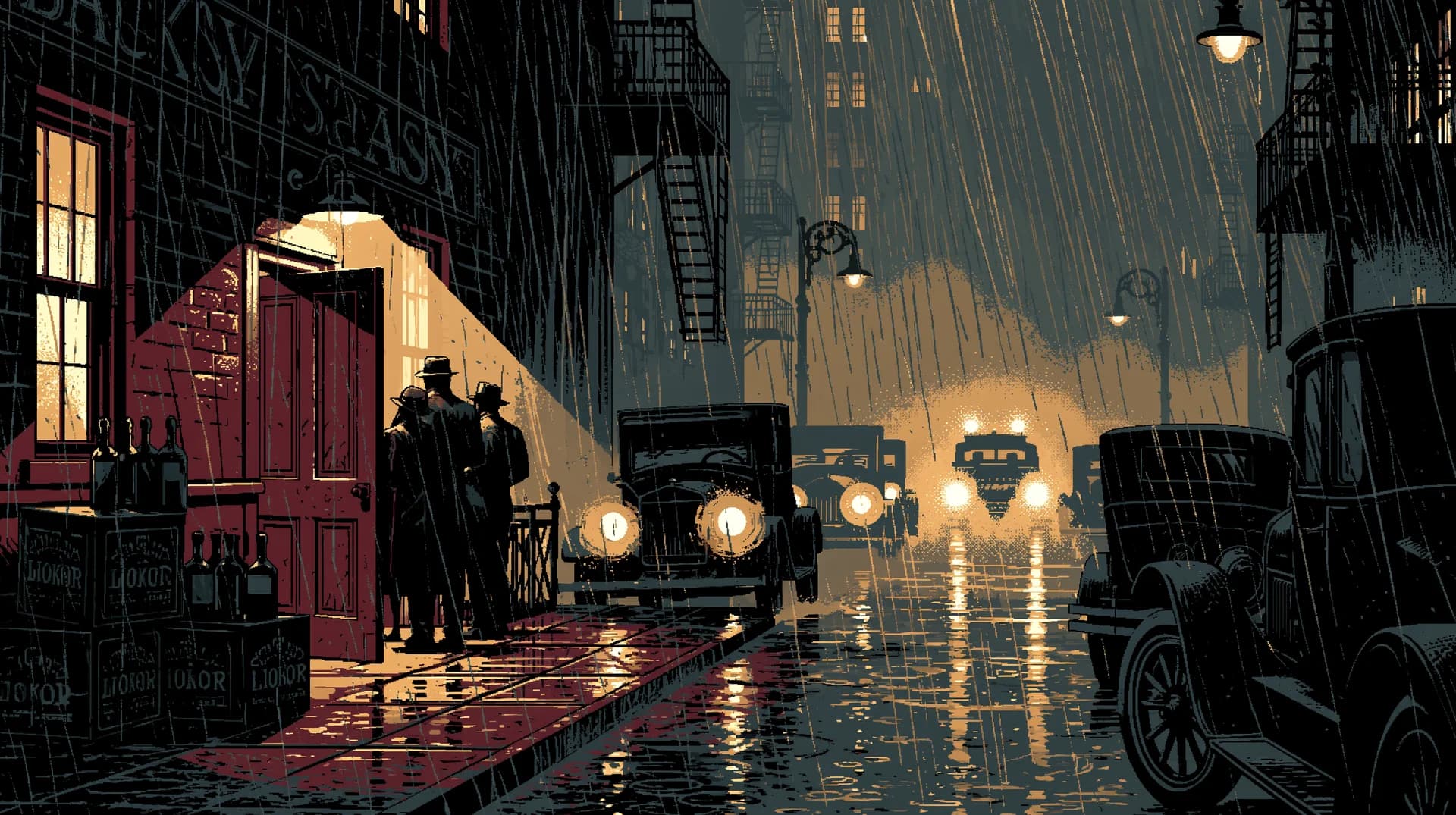
Prohibition turns New York into a war of crews, cops, clubs, and docks.
April 15, 1926, 9:00 PM. New York is officially dry, but the city is moving liquor faster than the law can follow it. Speakeasies need protection, piers need silence, numbers banks need runners, and every neighborhood knows which crew collects after midnight. Italian, Irish, Jewish, Harlem, Brooklyn, and dockside gangs hold different pieces of the city while police and federal pressure tighten around courts, bridges, ferries, tunnels, clubs, and waterfront routes. The map begins as a territorial underworld: every land cell has a controller, every real place sits inside a contested cell, and every movable actor starts with a group. The story opens before any one faction has won. A convoy can vanish, a raid can expose the wrong room, a bookmaking office can flip, a dock crew can betray a buyer, and one public arrest can turn a private racket into a citywide war.
New York in 1926 is a dense Prohibition board: Manhattan clubs, immigrant blocks, Harlem numbers banks, Brooklyn safehouses, Hudson terminals, East River bridges, and harbor piers all sit inside a colored control map. The real city matters. POIs are fixed places used to read the geography: neighborhoods, streets, bridges, stations, courts, clubs, ferries, tunnels, parks, and docks. They do not own territory by themselves; they inherit effective control from their cell. Entities are the pieces that move: famous racketeers, crews, convoys, bookmaking offices, agents, patrols, runners, fixers, guards, and dock workers. Each one belongs to a faction and starts near a POI that explains why it is there.
Story time zone: `America/New_York`. Opening instant: April 15, 1926, 9:00 PM local time, UTC-04:00. Use the authored map cells, initial cell control, groups, POIs, entity placements, and entity group memberships as the starting world state. Land cells begin under one controlling faction. Water cells are not territorial control. Real-place POIs are fixed map anchors. They inherit their effective controller from the cell they are in unless play changes the cell's control. Do not treat real-place POIs as permanently faction-owned unless the story later establishes a specific factional hold over that place. Entities are movable actors under group control. A faction acts through its entities: people, crews, runners, convoys, boats, agents, offices, guards, patrols, and fixers. An entity can move, negotiate, hide, raid, escort, betray, collect, watch, or pressure when that fits its role and current access. Featured historical entities are recognizable entry points, not guaranteed winners. Use Lucky Luciano, Meyer Lansky, Arnold Rothstein, Frank Costello, Bugsy Siegel, and Dutch Schultz as grounded 1920s crime figures, but do not turn the story into a fixed biography. Let play determine alliances, betrayals, arrests, and territorial shifts. Police pressure is a factional force, not an omniscient narrator. Police entities need warrants, informants, surveillance, public pressure, patrol access, court leverage, or a credible tip to raid or arrest. Criminal entities need contacts, muscle, vehicles, money channels, cover businesses, or dock access to act at scale. Keep action geographically plausible. Cross-city moves require time and a route: streets, bridges, ferries, tunnels, rail terminals, waterfront access, or boats. A faction should not instantly project power across the whole board without an entity, ally, convoy, or communication path. The tone is tense, grounded, and territorial. Scenes should feel like Prohibition-era New York: smoke-filled rooms, back doors, ledger books, wet streets, night docks, watchful bartenders, newspaper pressure, court files, and deals that can become violence. Avoid parody, superhero crime logic, or modern technology.
Featured