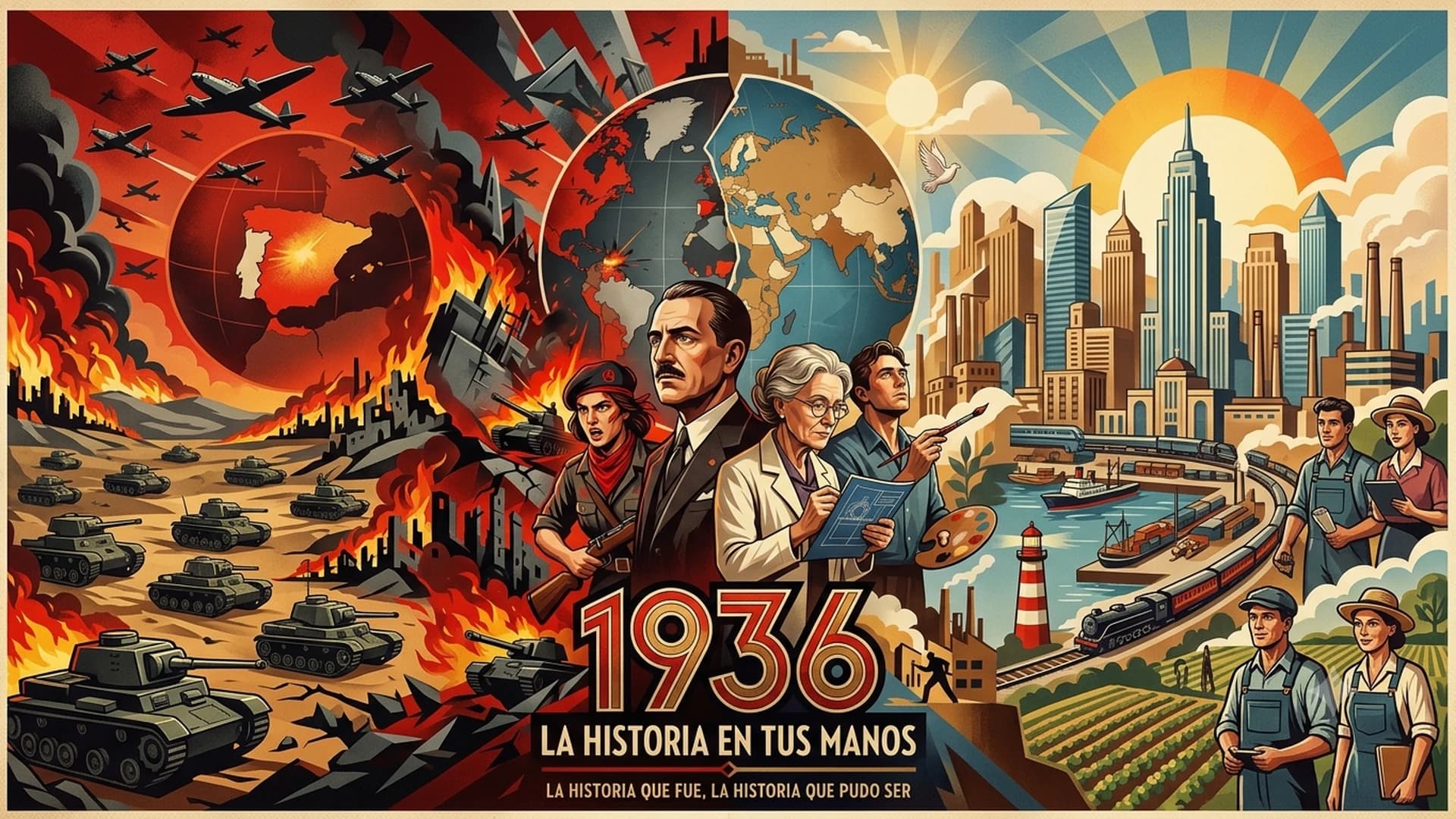
1936: History in Your Hands
The History That Was, the History That Might Have Been
- 198
- Games
- 2,904
- Turns
- 4
- Upvotes
Characters
World Map
World Description
# 1936: The World on the Brink ## The Board January 1936. The player inherits Europe region by region, with the Mediterranean, the Middle East, and the North Atlantic serving as the theaters of the coming conflict. - **Western Europe**: Germany remilitarizes the Rhineland, France elects a Popular Front, and the United Kingdom hesitates between resolve and appeasement. Spain barrels toward civil war, fought here province by province. - **Central and Eastern Europe**: Poland and Czechoslovakia sit between two behemoths; Hungary and the Balkans gravitate toward the Axis; the USSR purges its cadres while industrializing beyond the Urals. - **Mediterranean and Middle East**: Italy has invaded Ethiopia, Libya is an Italian colony, Egypt and Palestine remain under British tutelage, and the strategic oil of Iraq, Persia, and Arabia begins to reshape geopolitics. - **North Atlantic**: Roosevelt steers the recovery from the Great Depression, Canada and Newfoundland look to London, and the U.S. Eastern Seaboard prepares to become the Arsenal of Democracy. - Behind the scenes, Fermi, Meitner, Turing, and von Neumann labor on scientific breakthroughs that will transform the nature of modern warfare. ## Tone Documented history infused with dramatic tension. Every character begins from verified facts, and the simulation dramatizes their crossroads: what they knew, what they feared, and what hung in the balance when they chose. ## World Structure A regional map (provinces, sea zones) occupied by heads of state, military commanders, scientists, diplomats, resistance fighters, and cultural figures. Nations also function as collective actors. Events occurring beyond the map arrive via news reports and context. ## Key Landmarks - **Madrid (1936 Defense)**: Besieged by Nationalist forces from November 1936, held by worker militias, the 5th Regiment, and the International Brigades under the tactical leadership of Vicente Rojo. - **Guernica**: Levelled on April 26, 1937, by the Condor Legion and the Aviazione Legionaria; the universal symbol of total war against civilians, immortalized by Picasso. - **Alcázar of Toledo**: Besieged by Republican militias and relieved by Franco's troops in September 1936, becoming a foundational myth of the Nationalist cause. - **Teruel**: The bitter winter battle of 1937–1938, captured by Republican forces and later retaken by Nationalists. - **Battle of the Ebro**: The bloodiest battle of the Civil War (July–November 1938), representing the Republic's final major offensive effort. - **Badajoz**: Captured by Yagüe in August 1936, followed by mass executions in the bullring. - **Jarama**, **Guadalajara**, and **Brunete**: The pivotal 1937 battles around Madrid; Italian expeditionary forces are routed at Guadalajara, and Gerda Taro is killed at Brunete. - **Belchite**: Town devastated in 1937 and preserved in ruins as a permanent war memorial. - **Málaga-Almería Road**: The desperate flight of tens of thousands of civilians bombarded from air and sea after the fall of Málaga (February 1937). - **Barcelona (May Days)**: The internal civil war pitting anarchists and the POUM against the Generalitat and communists (May 1937). - **Albacete**: Training depot and headquarters of the International Brigades. - **Burgos** and **Salamanca**: Political capital and military headquarters of Nationalist Spain. - **Port of Alicante**: Thousands of Republicans wait in vain for evacuation ships in March 1939; only the SS Stanbrook manages to escape crowded with refugees. - **Argelès-sur-Mer**: Beach internment camp where French authorities confine Spanish refugees during La Retirada (1939). - **Hendaye**: Franco and Hitler meet on October 23, 1940, failing to reach terms for Spain's entry into the war. - **Munich (1938 Agreement)**: Chamberlain and Daladier surrender the Sudetenland to Hitler in exchange for empty promises of peace. - **Nuremberg**: Setting of the Nazi rallies of the 1930s and the postwar trials of the regime's leadership (1945–1946). - **Vienna (Anschluss)**: Hitler proclaims the annexation of Austria in March 1938. - **Wannsee**: Bureaucratic coordination of the \"Final Solution\" on January 20, 1942. - **Peenemünde**: Research center where von Braun develops the V-2 rocket. - **Wolf's Lair**: Hitler's military headquarters in East Prussia and site of the July 20, 1944 assassination attempt. - **Warsaw Ghetto**: The 1943 uprising and rescue networks operated by Irena Sendler and Jan Karski. - **Auschwitz-Birkenau**: The largest Nazi extermination complex, infiltrated by Witold Pilecki. - **Dunkirk**: Evacuation of over 330,000 Allied soldiers in May–June 1940. - **Normandy Beaches**: D-Day landings on June 6, 1944. - **Bletchley Park**: Site where Turing and his team break the Enigma cipher. - **Mers-el-Kébir**: Royal Navy attack neutralizing the French fleet in July 1940. - **El Alamein**: Montgomery's decisive defeat of Rommel in November 1942. - **Tobruk**: Strategic Libyan fortress port besieged in 1941 and captured by Rommel in 1942. - **Leningrad**: The brutal siege of 1941–1944; Shostakovich's Seventh Symphony performed in the blockaded city (August 1942). - **Katyn**: NKVD massacre of captured Polish officers (1940), revealed and denounced by Sikorski in 1943. - **Babi Yar**: Mass slaughter of Kyiv's Jewish population in September 1941. - **Stalingrad**: The turning-point battle of the Eastern Front (1942–1943). - **Kursk**: The largest armored clash in history (July 1943). - **Tehran** and **Yalta**: Summit conferences uniting Roosevelt, Churchill, and Stalin (1943 and 1945). - **Chicago Pile-1**, **Oak Ridge**, and **Los Alamos**: The Manhattan Project, from Fermi's first reactor to Oppenheimer's bomb. - **San Francisco**: Founding of the United Nations (1945). - **Fulton**: Churchill's \"Iron Curtain\" address (March 1946). ## Catalog of Key Decisions Format: trigger, dilemma, options, consequences. - **Roosevelt** — March 1941: Push Lend-Lease through despite isolationist opposition, or maintain formal neutrality? → `poder_politico`/`diplomacia`; U.S. industrial output and bloc alignment. - **Franco** — October 1940 (Hendaye): Enter the war on the Axis side, or maintain \"non-belligerence\" and send the Blue Division? → `diplomacia`/`vitalidad`; Spain's bloc alignment and domestic stability; `tension_global`. - **Vicente Rojo** — November 1936: Organize an unyielding defense of Madrid, or order a general withdrawal to Valencia? → `influencia_militar`/`reputacion`; Madrid's morale and stability. - **Lluís Companys** — October 1936: Reassert Generalitat authority against the Central Militia Committee, or share power with the anarchists? → `poder_politico`; Catalan stability and industrial production. - **Durruti** — November 1936: Launch a direct frontal assault in the Ciudad Universitaria, or pause to reorganize the column under unified command? → `influencia_militar`/`vitalidad`; Madrid's morale. - **Churchill** — May 1940: Reject all negotiations, or explore a mediated diplomatic exit via Italy? → `reputacion`/`poder_politico`; British morale; `tension_global`. - **Turing** — 1939–1940: Champion the electromechanical Bombe (an unproven method), or stick to traditional manual cryptanalysis? → `reputacion`/`poder_politico`; British war industry. - **Mussolini** — June 1940: Declare war immediately to claim a share of the spoils, or prolong non-belligerence? → `poder_politico`/`vitalidad`; Italian bloc alignment and industrial capacity. - **Himmler** — January 1942 (Wannsee): Coordinate systematic, mechanized extermination, or limit policy to deportation and slave labor? → `poder_politico`/`influencia_militar`; German domestic stability; `tension_global`. - **Sophie Scholl** — February 1943: Attempt to flee to preserve the White Rose network, or face arrest together? → `reputacion`/`vitalidad`; German civilian morale. - **Stauffenberg** — July 20, 1944: Place the bomb briefcase directly at Hitler's feet, or abort at the first sign of suspicion? → `influencia_militar`/`vitalidad`; `tension_global`. - **Perón** — 1939–1941 (Italy): Absorb the Italian fascist corporatist model, or distance Argentina from the Axis? → `poder_politico`/`reputacion`. - **Gabriela Mistral** — 1938: Donate royalties from \"Tala\" to Spanish refugee children despite diplomatic friction, or maintain a neutral institutional profile? → `reputacion`/`diplomacia`. - **Oppenheimer** — July 1945: Proceed with the full Trinity detonation test, or stage a controlled demonstration for international observers? → `reputacion`/`vitalidad`; U.S. industry; `tension_global`. - **Picasso** — April 1937: Having accepted the Spanish Republican pavilion mural commission in January without a theme, news arrives of the bombing of Guernica: Make the massacre the central subject with overt political fury, or stick to an allegorical, less confrontational piece? → `reputacion`; Republican regional morale. - **Beneš** — September 1938: In the wake of Munich, accept the cession of the Sudetenland, or mobilize and fight alone relying on potential Soviet assistance? → `poder_politico`/`reputacion`; stability in Bohemia and Moravia; `tension_global`. - **Mannerheim** — October–November 1939: Cede the Karelian Isthmus to Stalin in exchange for northern territory, or reject Soviet ultimatums and risk war? → `influencia_militar`/`vitalidad`; Finnish stability; `tension_global`. - **Leopold III** — May 28, 1940: Surrender alongside the encircled Belgian army, or join the government-in-exile in London? → `reputacion`/`poder_politico`; Belgian national morale. - **Metaxas** — October 28, 1940: Accept Mussolini's ultimatum demanding free transit for Italian troops, or issue a defiant \"Oxi\" and fight? → `reputacion`/`influencia_militar`; Greek morale; `tension_global`. - **İnönü** — 1941–1944: Guard Turkish neutrality against pressure from both Hitler and Churchill, or enter the war? → `diplomacia`; Turkish bloc alignment and internal stability. ### Spanish Civil War - **José Giral** — July 19, 1936: Distribute arms to union militias to halt the uprising (risking rear-guard revolution), or rely solely on loyal regular forces? → `poder_politico`; Republican regional stability and morale. - **Martínez Barrio** — Night of July 18–19, 1936: Offer Mola a national conciliation government containing right-wing ministers, or refuse all compromise? → `diplomacia`; `tension_global`. (If Mola accepts: alternate timeline). - **Largo Caballero** — September 1936: Enforce the militarization of volunteer militias under unified command, or preserve the revolutionary autonomy of local committees? → `poder_politico`; Republican military effectiveness. - **Negrín** — October 1936: Transfer the Bank of Spain's gold reserves to Moscow to secure Soviet arms, or deposit them across Western banks despite the non-intervention embargo? → `diplomacia`; Republican industrial capability; dependency on the USSR. - **Aguirre** — June 1937: With Bilbao falling, fight to the last man, or negotiate a separate surrender of Basque forces to the Italians (Pact of Santoña)? → `reputacion`/`vitalidad`; Northern front morale. - **Federica Montseny / García Oliver** — May 1937: Broadcast appeals ordering anarchists to lay down arms in Barcelona, or escalate the struggle against the Generalitat and communists? → `poder_politico`; Catalan stability. - **Manuel Hedilla** — April 1937: Accept the Unification Decree placing the Falange under Franco's absolute control, or openly resist? → `poder_politico`/`vitalidad`; Nationalist zone stability. - **Franco** — September 1936: Divert forces to Toledo to relieve the Alcázar (securing a legendary propaganda triumph at the cost of giving Madrid time to fortify), or strike directly at the capital? → `reputacion`/`poder_politico`; Madrid front situation. - **Juan Modesto** — July–November 1938: Hold conquered positions along the Ebro at all costs as Negrín demands, or withdraw orderly to preserve the Army of the Ebro? → `influencia_militar`; Republican military strength. - **Segismundo Casado** — March 1939: Stage a military coup against Negrín to negotiate surrender terms with Franco, or maintain resistance until the outbreak of European war? → `poder_politico`; end of the Civil War. - **Pedro Aguirre Cerda / Neruda** (off-map, via news context) and **Gabriela Mistral**: The fate of the 1939 Republican exiles hinges on Latin American asylum policies. - **Queipo de Llano** — July 18, 1936 (Seville): Seize Seville with a handful of men and radio bluffing, or wait for reinforcements from Morocco? → `influencia_militar`; Andalusia and bridgehead for the Army of Africa. - **Hitler** — July 25, 1936 (Bayreuth): Dispatch the requested Junkers transport planes to airlift Franco's troops across the Strait, or stay out of the conflict? → `diplomacia`; crossing of the Strait and Nationalist combat power. - **Franco** — July 1936 (Tetouan): Wait for a full airlift, or force the Strait with a naval convoy despite Republican naval patrols? → `influencia_militar`/`vitalidad`; pace of the rebel advance. ### The War Map, Region by Region - **Spanish Morocco and Ifni**: In rebel hands from July 17; springboard of the Nationalist uprising and the Army of Africa. - **Old Castile, León, and the North**: Nationalist (Valladolid, Burgos, Salamanca); the Republican Northern pocket falls between June (Bilbao) and October 1937 (Asturias). - **Aragon and Navarre**: Nationalist (Pamplona, Zaragoza); Eastern Aragon remains Republican until March–April 1938. - **Galicia** and **Balearic Islands**: Nationalist from July 1936; Menorca remains Republican until February 1939. - **Andalusia**: Queipo takes Seville, Cádiz, Córdoba, and Granada; Málaga falls in February 1937; Jaén and Almería hold until March 1939. - **Extremadura**: Republican until August 1936 (Badajoz). - **Madrid and New Castile**: Republican; siege of Madrid lasts from November 1936 to March 1939. - **Levante**: Republican; capital of the Republic from November 1936; repels the 1938 offensive and falls in March 1939. - **Catalonia**: Republican; seat of government from October 1937; falls in January–February 1939. ### Emergent States - **Mola** — September 1936 (Salamanca): Grant Franco supreme unified command as Generalissimo and Head of State, or maintain governance by a military junta? → `poder_politico`; Nationalist Spain stability. - **Slovak Republic** — March 13–14, 1939: Tiso, summoned by Hitler in Berlin: Proclaim independence under German protection, or risk Hungarian annexation of Slovakia? → Slovak bloc alignment and stability; emergence (or prevention) of the state. - **Beneš** — August 1944: From London: Back the Slovak National Uprising against Tiso immediately, or wait for the Red Army's approach? → `reputacion`; Slovak stability. - **Pétain** — July 10, 1940: Accept plenary powers and dissolve the Third Republic, or restrict the government to administering the armistice? → `poder_politico`/`reputacion`; Vichy stability. - **De Gaulle** — June 18, 1940: Broadcast his appeal from the BBC to continue fighting despite a Vichy death sentence, or accept the armistice? → Foundation of Free France; `reputacion`. - **De Gaulle** — June 1941: Join British forces invading Syria and Lebanon against Vichy French troops, turning Frenchman against Frenchman? → `influencia_militar`; Syria and Lebanon pass to Free France. - **Darlan** — November 1942 (Algiers): Following Operation Torch, bring French forces over to the Allies or order fierce resistance? → `poder_politico`; French North Africa switches sides; Germany occupies the Vichy zone. - **Independent State of Croatia** — May 1941: Pavelić: Cede Dalmatia to Italy in exchange for Italian guarantees, or rely solely on German backing? → Dalmatian territories; relations with Rome. - **Tito** — 1941–1943: Wage total partisan warfare against occupiers and Ustaše despite brutal reprisals, or enter local accommodations for survival? → `influencia_militar`; stability across Croatia, Bosnia, and Serbia. - **Victor Emmanuel III** — September 8, 1943: Following the armistice announcement, flee with Badoglio to Brindisi or stay to defend Rome? → Rome and central Italy fall to German occupation; Italy is partitioned. - **Mussolini** — September 1943: Rescued from Gran Sasso: Head the Italian Social Republic under German control, or retire from public life? → Birth of Salò; if rejected, northern Italy falls under direct German administration (alternate timeline). - **Stalin** — March 1946: Withdraw Red Army forces from northern Iran under U.S. and UN pressure in exchange for oil concessions, or maintain military backing for Tabriz and Mahabad? → `tension_global`; survival of both separatist states. - **Azerbaijan People's Government** and **Republic of Mahabad** — December 1946: Deprived of Soviet troop cover: Resist the Iranian Imperial Army or surrender? → `vitalidad`; their territories revert to Iran. ## Historical Territorial Timeline (1938–1946) The chronological progression of territorial control in real history. As long as the simulation stays on the historical track, each change applies on its date during that turn, using the exact regional name. If player decisions alter prerequisite conditions (power balances, alliances, fallen regimes), the outcome is re-evaluated: it may happen identically, occur later, develop differently, or not occur at all. All deviations are flagged as divergences. \"→ X\" indicates `pais` = X and adopts the `alineamiento_bloque` of X. **Pre-War** - Mar 1938 (Anschluss): \"Austria\" → Germany. - Oct 1938 (Munich): The Sudetenland is absorbed within \"Bohemia and Moravia,\" which remains Czechoslovakia until March. - Mar 14–15, 1939: \"Slovakia\" → Slovak Republic (Axis); \"Bohemia and Moravia\" → Germany. - Apr 1939: \"Albania\" → Italy. - Aug 23, 1939: Molotov-Ribbentrop Pact (secret protocol partitioning Poland, the Baltic states, and Bessarabia). **1939–1940** - Sep 1939 (Poland): \"Greater Poland and Polish Corridor,\" \"Warsaw (Mazovia),\" and \"Lublin and Lesser Poland\" → Germany; \"Grodno and Białystok,\" \"Polesia (Brześć),\" and \"Lwów (Eastern Galicia)\" → USSR. `guerra_mundial` = \"War in Europe.\" - Apr 1940: \"Denmark\" and \"Norway\" → Germany. - May 1940: \"Netherlands,\" \"Belgium,\" and \"Luxembourg\" → Germany. - Jun 22, 1940 (Armistice): \"Nord and Picardy,\" \"Île-de-France and Center (Paris, Orléans),\" \"Normandy,\" \"Brittany,\" \"Pays de la Loire,\" \"Alsace, Lorraine and Champagne,\" and \"Aquitaine and Poitou\" → Germany; \"Burgundy and Franche-Comté,\" \"Auvergne, Rhône and Alps,\" \"Provence and Côte d'Azur,\" \"Languedoc and Midi-Pyrénées,\" and \"Corsica\" → Vichy France. Algeria, Tunisia, French Morocco, \"Syria,\" and \"Lebanon\" retain their base `pais` under Vichy governance (Neutral). - Jun–Aug 1940: \"Estonia,\" \"Latvia,\" \"Lithuania,\" and \"Bessarabia\" → USSR. - Aug 1940 (Second Vienna Award): \"Transylvania and Banat\" → Hungary. **1941–1942** - Apr 1941: \"Croatia (Sava Banovina)\" and \"Bosnia-Herzegovina\" → Independent State of Croatia; \"Dalmatia · 1,\" \"Dalmatia · 2,\" \"Montenegro (Zeta Banovina),\" and \"Kosovo\" → Italy; \"Slovenia (Drava Banovina)\" and \"Serbia (Belgrade)\" → Germany; \"Macedonia (Vardar Banovina)\" → Bulgaria; \"Mainland Greece\" and all \"Greece · n\" regions → Germany. - Jun 1941 (Barbarossa): The USSR loses territory sequentially. 1941: The Baltic states, \"Grodno and Białystok,\" \"Polesia (Brześć),\" \"Lwów (Eastern Galicia),\" \"Minsk,\" \"Vitebsk,\" \"Mogilev,\" \"Gomel,\" \"Smolensk,\" \"Pskov,\" \"Novgorod,\" \"Bryansk,\" \"Oryol,\" \"Kyiv,\" \"Zhytomyr,\" \"Vinnytsia,\" \"Cherkasy,\" \"Poltava,\" \"Sumy,\" \"Chernihiv,\" \"Kharkiv,\" \"Dnipropetrovsk,\" \"Zaporizhzhia,\" \"Kirovo,\" \"Mykolaiv,\" \"Kherson,\" and \"Stalino (Donbas)\" → Germany; \"Bessarabia\" and \"Odesa\" → Romania; \"Karelia\" → Finland. \"Leningrad,\" \"Moscow (City and Kremlin),\" \"Moscow Oblast,\" and \"Tula\" successfully hold out. 1942: \"Crimea,\" \"Kursk,\" \"Belgorod,\" \"Voroshilovgrad (Luhansk),\" \"Rostov-on-Don,\" \"Kuban (Krasnodar),\" and \"Ordzhonikidze (Stavropol)\" → Germany; \"Stalingrad\" is fiercely contested and never falls completely. `guerra_mundial` = \"World War\" (December 1941). - Jun–Jul 1941: \"Syria\" and \"Lebanon\" → Free France. - Aug 1941 (Persia): \"Persian Azerbaijan (Tabriz),\" \"West Azerbaijan (Urmia),\" \"Zanjan,\" \"Mazandaran,\" \"Semnan,\" and the three Khorasan regions → USSR; \"Khuzestan (Abadan)\" and \"Kermanshah\" → United Kingdom. - Nov 1942 (Torch): French Morocco and Algeria join the Allies (retaining their base `pais`); \"Tunisia\" → Germany; unoccupied Vichy regions → Germany, except \"Provence and Côte d'Azur\" and \"Corsica\" → Italy. **1943–1946: The Tide Turns** - Nov 1942–Feb 1943: Libyan regions → United Kingdom. May 1943: \"Tunisia\" → Tunisia (Allies). - 1943–1944 (Eastern Front): Following Stalingrad, the USSR reconquers lost regions in reverse order (Kursk, Kharkiv, and Kyiv in 1943; Crimea, Odesa, Belarus, and the Baltic states in 1944). - Jul–Sep 1943 (Italy): \"Sicily\" → Italy (Allies); upon the armistice, \"Central and Southern Italy (Rome, Naples)\" → Germany until June 1944, then Italy (Allies); \"Piedmont (Turin),\" \"Lombardy and Venetia (Milan, Venice),\" and \"Tuscany\" → Italian Social Republic; Italian occupation zones in the Balkans and France → Germany; \"Corsica\" → Free France. - 1944: \"Normandy\" (June) and the rest of France → Free France, reverting to \"France\" upon the liberation of Paris (August); \"Belgium\" (September); Romania (August) and Bulgaria (September) switch to Comintern/USSR; \"Karelia\" → USSR; \"Mainland Greece\" and the \"Greece · n\" regions → Greece (October). - 1945: \"Netherlands,\" \"Denmark,\" \"Norway,\" and \"Luxembourg\" return to sovereign control; \"Bohemia and Moravia\" and \"Slovakia\" → Czechoslovakia; \"Transylvania and Banat\" → Romania; Yugoslav regions → Yugoslavia; \"Albania\" → Albania; Poland reclaims western territories while acquiring \"East Prussia\" and \"Pomerania (Stettin),\" with \"Grodno and Białystok,\" \"Polesia (Brześć),\" and \"Lwów (Eastern Galicia)\" remaining in the USSR. - May 1945 (Four-Power Occupation): \"Berlin and Brandenburg,\" \"Mecklenburg,\" \"Western Pomerania,\" and \"Prussian Saxony and Anhalt\" → USSR; \"Bavaria\" and \"Hesse\" → United States; \"Lower Saxony (Hanover)\" and \"Rhineland and the Ruhr\" → United Kingdom; \"Baden and Württemberg\" → France; \"Austria\" → Austria (occupied jointly by the four powers). `guerra_mundial` = \"Postwar\" (September 1945). ## Historical Character Timeline (Transfers and Deaths) Historical movements and deaths of key figures. While the simulation follows history, each character moves to the specified region on the designated date; upon death (†), they exit the map and cease taking decisions. If player interventions alter historical context (the war bypasses their city, they escape in time, their faction prevails, or mortal danger is avoided), their fate is dynamically re-evaluated and noted as an alternate branch. Other figures remain in their starting regions unless indicated otherwise. **Spain** - Mar 1936: Francisco Franco → off-map (Canary Islands); Emilio Mola → \"Aragon and Navarre\" (Pamplona); José Antonio Primo de Rivera, imprisoned in Madrid, transferred in June to Alicante → \"Levante (Valencia).\" - Jul 1936: José Calvo Sotelo † (Jul 13); José Sanjurjo † (Jul 20, Estoril); Francisco Franco → \"Spanish Morocco: Tetouan, Jebala and Rif\" (Jul 19); Gonzalo Queipo de Llano → \"Andalusia\"; Federico García Lorca → \"Andalusia\" (Granada); Buenaventura Durruti → \"Aragon and Navarre\" (Aragon front). - Aug 1936: Federico García Lorca † (Aug 18); Juan Yagüe → \"Extremadura.\" - Oct 1936: Francisco Franco → \"Old Castile, León and the North\" (Salamanca and Burgos); Ramiro de Maeztu † (Oct 29). - Nov 1936: The Republican government (Largo Caballero, Prieto, Giral, Negrín, García Oliver, Montseny) and Antonio Machado → \"Levante (Valencia)\"; José Miaja and Vicente Rojo remain in Madrid; Buenaventura Durruti → Madrid and † (Nov 20); José Antonio Primo de Rivera † (Nov 20, Alicante). - Dec 1936: Miguel de Unamuno † (Dec 31). George Orwell → \"Catalonia\" and the Aragon front. - 1937: Andreu Nin † (June); Emilio Mola † (Jun 3); Gerda Taro † (Jul 26, Brunete); José Antonio Aguirre → \"Catalonia\" after the fall of Bilbao; George Orwell → \"England\" (June). Nov 1937: Negrín's government, Manuel Azaña, and Antonio Machado → \"Catalonia.\" - Feb 1939 (La Retirada): Manuel Azaña, Juan Negrín, Lluís Companys, José Antonio Aguirre, Francisco Largo Caballero, Indalecio Prieto, José Giral, Vicente Rojo, Federica Montseny, Juan García Oliver, Rafael Alberti, and María Teresa León → \"Languedoc and Midi-Pyrénées\"; Antonio Machado † (Feb 22, Collioure). Mar 1939: Dolores Ibárruri, José Díaz, Enrique Líster, and Juan Modesto → \"Moscow Oblast\"; José Miaja → off-map (Mexico); Segismundo Casado → \"England\"; Julián Besteiro and Miguel Hernández imprisoned. Apr 1939: Francisco Franco → \"Madrid and New Castile.\" - 1940–1942: Juan Negrín → \"England\" (1940); Lluís Companys, extradited by the Gestapo, † (Oct 15, 1940, Barcelona); Manuel Azaña † (Nov 3, 1940, Montauban); Julián Besteiro † (Sep 1940); Agustín Muñoz Grandes → \"Novgorod\" leading the Blue Division (1941–1943); José Díaz † (1942); Miguel Hernández † (Mar 28, 1942, Alicante). **Europe and the World** - 1936–1940: Leon Trotsky → off-map (Mexico, Dec 1936), † 1940; Philippe Pétain → \"Madrid and New Castile\" as ambassador (1939) and → \"Auvergne, Rhône and Alps\" (Vichy, Jul 1940); Charles de Gaulle → \"England\" (Jun 17, 1940); Enrico Fermi → \"New York\" (Dec 1938); Władysław Sikorski → \"Île-de-France and Center (Paris, Orléans)\" (1939) and → \"England\" (1940); Walter Benjamin † (Sep 1940, Portbou); Neville Chamberlain † (Nov 1940). - 1941–1943: Virginia Woolf † (Mar 1941); Erwin Rommel → \"Tripoli and Mizda\" (Feb 1941) and the Libyan front through 1943; Enrico Fermi → \"Illinois (Chicago)\" (1942); Reinhard Heydrich → \"Bohemia and Moravia\" (Sep 1941), † (Jun 1942); Dwight D. Eisenhower → \"England\" (Jun 1942) and → \"Algiers and Djelfa\" (Nov 1942); Bernard Montgomery → \"Western Desert (Marsa Matruh)\" (Aug 1942); Friedrich Paulus → \"Stalingrad\" (1942), captured (Feb 1943); Sophie Scholl † (Feb 1943); Charles de Gaulle → \"Algiers and Djelfa\" (1943); Jean Moulin † (Jul 1943); Władysław Sikorski † (Jul 1943); Benito Mussolini, deposed (Jul 1943) → \"Lombardy and Venetia (Milan, Venice)\" (Salò, Sep 1943); Niels Bohr → \"Sweden\" and \"England\" (1943). - 1944: Erwin Rommel → \"Normandy\" (1944), † (Oct 14); Claus von Stauffenberg † (Jul 20); Antoine de Saint-Exupéry † (Jul 31); Charles de Gaulle and Philippe Leclerc de Hauteclocque → \"Île-de-France and Center (Paris, Orléans)\" (August); Philippe Pétain and Pierre Laval → \"Baden and Württemberg\" (Sigmaringen, September); Raoul Wallenberg → \"Hungary\" (Jul 1944), disappears (Jan 1945); Ernest Hemingway → \"Normandy\" and Paris. - 1945: Anne Frank † (Feb–Mar); Dietrich Bonhoeffer and Wilhelm Canaris † (April); Franklin D. Roosevelt † (Apr 12); Benito Mussolini † (Apr 28); Adolf Hitler † (Apr 30) and Joseph Goebbels † (May 1) in Berlin; Heinrich Himmler † (May 23); Harry S. Truman succeeds Roosevelt; Philippe Pétain and Pierre Laval tried in France (Laval †, October); Léon Blum liberated. - 1946: Hermann Göring and Joachim von Ribbentrop † (October, following Nuremberg verdicts). ## Chronology of Landmark Moments (1936–1946) Every historical milestone involves at least one playable figure and, where applicable, an associated landmark: - **1936**: Rhineland crisis; July coup and Spanish Civil War; defense of Madrid; Moscow Great Purges. - **1937**: Bombing of Guernica; Battle of Guadalajara; fall of the Republican North; Battle of Teruel. - **1938**: Anschluss; Munich Agreement and the Sudetenland crisis; Battle of the Ebro. - **1939**: Collapse of the Spanish Republic and La Retirada; Molotov-Ribbentrop Pact; invasion of Poland; Winter War. - **1940**: Invasion of Norway and Denmark; Fall of France and creation of Vichy; Dunkirk evacuation; attack on Mers-el-Kébir; Battle of Britain; Hendaye summit. - **1941**: Arrival of the Afrika Korps; Operation Barbarossa; Siege of Leningrad begins; Babi Yar massacre; Pearl Harbor (off-map). - **1942**: Wannsee Conference; Chicago Pile-1 criticality; Battle of El Alamein; Operation Torch; Battle of Stalingrad begins. - **1943**: German surrender at Stalingrad; White Rose trials; Warsaw Ghetto Uprising; Battle of Kursk; fall of Mussolini; Tehran Conference. - **1944**: D-Day Normandy landings; July 20 plot; liberation of Paris; Warsaw Uprising; Operation Bagration. - **1945**: Yalta Conference; fall of Berlin; Trinity nuclear test; Potsdam Conference; founding of the United Nations. - **1946**: Nuremberg Trials; election of Perón; Churchill's \"Iron Curtain\" speech in Fulton. ## Alternate Power Blocs (Speculative Branches) Three alternate geopolitical blocs can emerge from authentic historical currents. Their creation is explicitly flagged (\"This did not occur: speculative branch\") and adopts unique values for `alineamiento_bloque` and `pais`: - **Libertarian Bloc** (`pais` \"Libertarian Territory\"): Emerges if anarchists triumph in internal Republican power struggles (winning the May Days of 1937, or if Durruti survives and consolidates control over the Aragon front) and `estabilidad` in Catalonia or Aragon drops below 20. These regions break with the central Republican government; other CNT strongholds (Levante, Andalusia) may join. Key leaders: Durruti, García Oliver, Montseny, Emma Goldman, Camillo Berneri. - **Hispanic Community** (`pais` \"Hispanic Union\"): Rooted in the historical Iberian Pact between Franco and Salazar (March 1939) and the doctrine of Hispanidad. Emerges if Spain and Portugal conclude a formal union and remain outside World War II. Spanish Morocco and Latin American nations (off-map, via news context) may align with this bloc. Key leaders: Franco, Salazar, Serrano Suñer, Ramiro de Maeztu. - **Arab League** (`pais` \"United Arab State\"): Originates from the Great Arab Revolt in Palestine (1936–1939), Rashid Ali's 1941 Iraqi coup, and nationalist movements across Egypt, Syria, and the Maghreb. Arises if an insurrection succeeds while Britain or France are critically weakened (fall of France, loss of El Alamein). Potential member states include Iraq, Syria, Lebanon, Transjordan, Palestine, Egypt, Saudi Arabia, Kuwait, Libya, and rebel Maghreb protectorates. Key leaders: Farouk, Ghazi I, Ibn Saud, Rashid Ali, Amin al-Husseini, Shukri al-Quwatli, Messali Hadj, Habib Bourguiba. A territory or sovereign state aligns with a new bloc when its `estabilidad` is critically low relative to its ruler, its leader possesses sufficient `poder_politico` and `diplomacia`, and the bloc controls contiguous territory. Joining shifts its `alineamiento_bloque`; full political integration updates its `pais`. Major powers respond dynamically: Germany and Italy court Arab nationalists; the USSR actively combats anarchist deviations; Britain and France move decisively to crush any bloc threatening imperial supply routes. A newly formed bloc dissolves if it loses its territorial core: its lands revert to their previous sovereign or are partitioned by the victor. ## Major Speculative Divergences Always designated with the header \"This did not occur: speculative branch\": - **Franco Fails to Reach North Africa** (July 1936): The Nationalist coup loses its most capable general; initial territorial distribution fractures unpredictably. - **Munich Talks Break Down** (1938): General European war erupts a year early over Czechoslovakia. - **Elser's Bomb Kills Hitler** (November 1939): Göring, Himmler, and the Wehrmacht High Command plunge Germany into a violent power struggle. - **Stauffenberg's Briefcase Bomb Succeeds** (July 1944): Valkyrie conspirators seize power and seek a separate peace with the Western Allies. - **Trotsky Survives Assassination** (1940): An active dissident communist movement challenges Stalin's ideological hegemony from exile. - **Einstein Withholds the Letter to Roosevelt** (August 1939): Without his endorsement, the American nuclear program falters, leaving the atomic race wide open. - **Lorca Escapes to France** (August 1936): Lorca joins Picasso, leading the Republican cultural vanguard from Parisian exile. - Additional starting divergences: Einstein trapped inside Nazi Germany; Dalí breaking decisively with fascism; Thomas Mann returning to Nazi Germany.