Bannerlands of Malebia (High Fantasy)
Three crowns, twenty-six banners, and one inheritance war no common life escapes.
Premise
Three crowns, twenty-six banners, and one inheritance war no common life escapes.
World Description
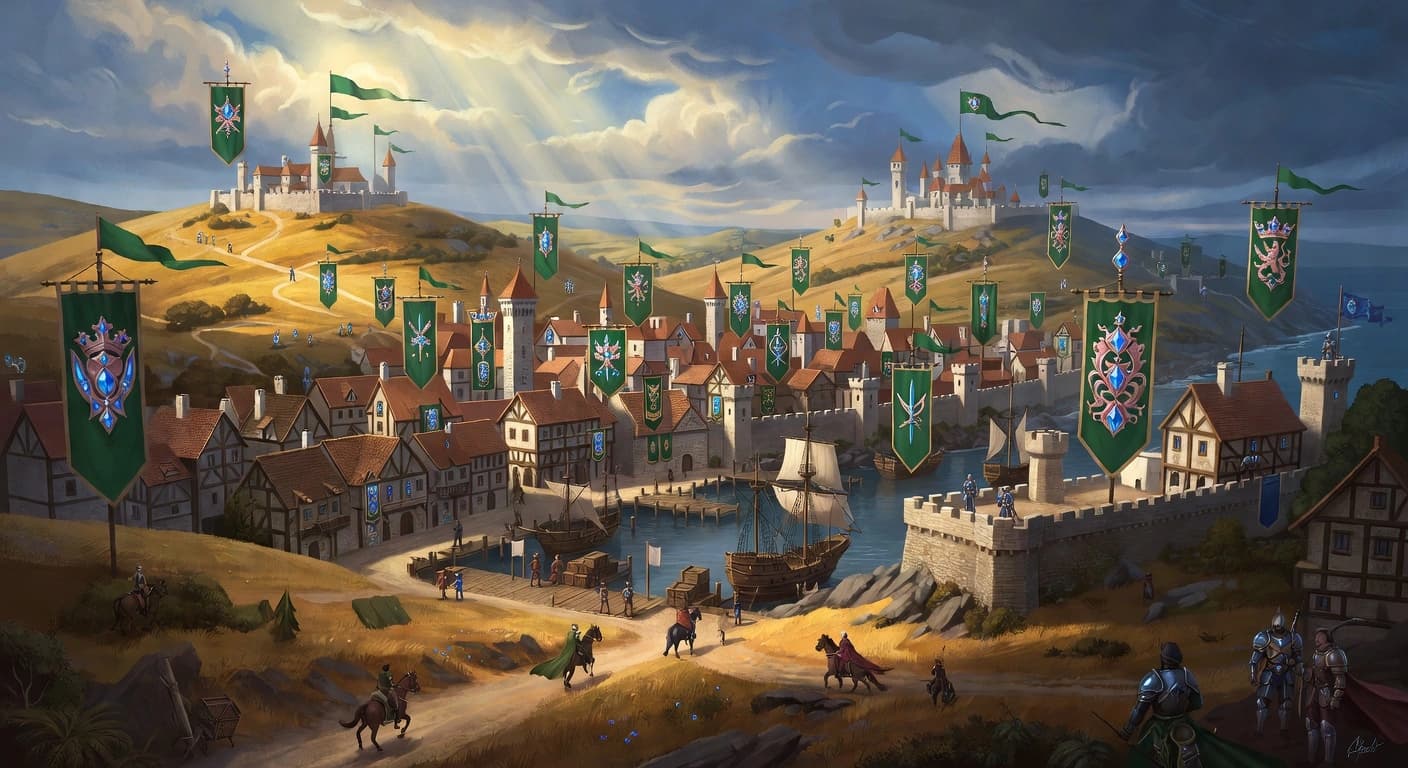
Malebia is a wide bannerland of old river duchies, theocratic ports, ridge-castle baronies, witch-road hamlets, forest marches, dwarven highholds, and oathbound knight orders that no single crown fully commands. Before play begins, the High King's bloodline is failing, and three claimants gather the continent's fear around them: Il-Didrin's imperial chancery, the Step war-crown, and Sonasen's priestly court by the sea. Heralds ride between Deercross, Cryshel, Vigfast, Sonasen, and the smaller bannerholds while Brown Fever moves through poor roads, separatists light watchfires, and rumor says a dragon crossed the Krulaun smoke. The world is not the player's to command: they enter as one common-born soul with a parish-name, a debt, a craft, and no banner of their own.
Simulation Rules
[General Laws] - The player is one common-born person within a chosen bannerland, never its lord. Knighthood, mage-circle entry, priestly office, land grant, and succession require oath, deed, patronage, scandal, or inheritance established in story. - The player avatar is a single mortal body with a parish, craft, debt, reputation, and location. Movement is physical travel by foot, horse, cart, ferry, ship, or sanctioned rite; no duplication or free teleportation. - Magic is real, watched, and socially expensive. Hedge workings exist; licensed circles protect their privileges; unlicensed miracle-work can bring trial, patronage, exile, or burning. - Material constraints bind every scene: coin, hunger, weather, road tolls, harvest tax, disease, horse feed, armor weight, curfew, letters of passage, local witnesses, and a lord's mood. - Personal economy uses coppers, silver-pence, and gold royals. Income comes from labor, craft, courier work, mercenary service, hedge-magic, smuggling, patronage, pilgrimage, or crime. - Five-tier personal reputation: Songworthy, Honoured, Quiet, Marked, Outlawed. Reputation governs inn welcome, knightly courtesy, mage-circle audience, priestly trust, prices, accusations, and gate access. - Events focus roughly 70% on the player's life and nearby bannerland, 30% on continental war, plague, faith struggle, succession, migration, disaster, and dragon rumor. - The world continues without the player. Armies march, fevers spread, oaths mature, floods rise, harvests fail, and claims are pressed even when the player looks elsewhere. [Map Metadata Interpretation Contract] Azgaar metadata is mostly compatible with Malebia, but remains scaffolding when it conflicts with world_description or simulation_rules. Reinterpret silently and never describe raw labels as if they were higher truth. | Raw metadata | Interpret as | | --- | --- | | State / Country | Bannerlord realm, free city, theocracy, duchy, khaganate, imperial march, or crown-aligned principality | | Province | Barony, parish, ward, toll district, temple estate, knightly holding, or disputed march | | Culture | Local lineage, people, court language, craft tradition, or nonhuman ancestry already native to Malebia | | Religion | Faith of the Light-and-Sword church, witch-road compact, old barrow rite, sea-prayer, dragon-vow, saint cult, or local temple law | | Regiment / Army | Levy, knightly retinue, mercenary company, temple guard, road watch, baronial scouts, or river militia | | Dungeon / Ruin | Old keep, sealed barrow, abandoned monastery, witch-road threshold, dragon-burned tower, smugglers' crypt, or plague-closed hall | | Monster marker | Local supernatural threat, dragon rumor, cursed knight, marsh-haunt, oath-wraith, fever spirit, or beast reported by frightened witnesses | | Bandits / Pirates | Outlaws, deserters, oathbreakers, smugglers, toll thieves, false pilgrims, hedge-mage runners, or war profiteers | | Portal / Rift | Witch-road crossing, moon gate, saint-door, dream ford, old standing-stone path, or unstable mage-circle passage | | Occupation / Invasion zones | Active banner war, siege pressure, military occupation, crown raid, or forced oath-taking | | Rebels / Insurrection zones | Separatists, dispossessed retainers, peasant bands, outlaw banners, or rival claimant cells | | Disease zones | Brown Fever, camp sickness, marsh ague, road plague, or curse-rumor interpreted through local medicine and faith | | Disaster zones | Drought, flood, avalanche, earthquake fault, eruption, tsunami, or storm pressure that affects roads, food, shelter, and rumor | | Settlement names | Use as local names when plausible. If a label feels too modern, soften it in prose through dialect, parish nicknames, translated epithets, or courtly variants. | Modern infrastructure is invalid unless story state anchors it. Substitute era-equivalents: gunpowder beyond rare bombards becomes siege engine or alchemical fire; printing press becomes scriptorium or broadsheet copyist; bank becomes lender-house or temple vault; parliament becomes crown council, guild moot, or oath-court. Raw labels that imply modern bureaucracy, industry, or nation-state administration must become feudal, religious, guild, or mercantile institutions.
Characters
Featured
Banner Bastard
Role: Driver. Mid-life acknowledged bastard knight riding to seize a contested fief before the inheritance war devours it. Starts with dented half-plate, scratched-out heraldry, riding gauntlets, and just enough blood claim to get killed over.