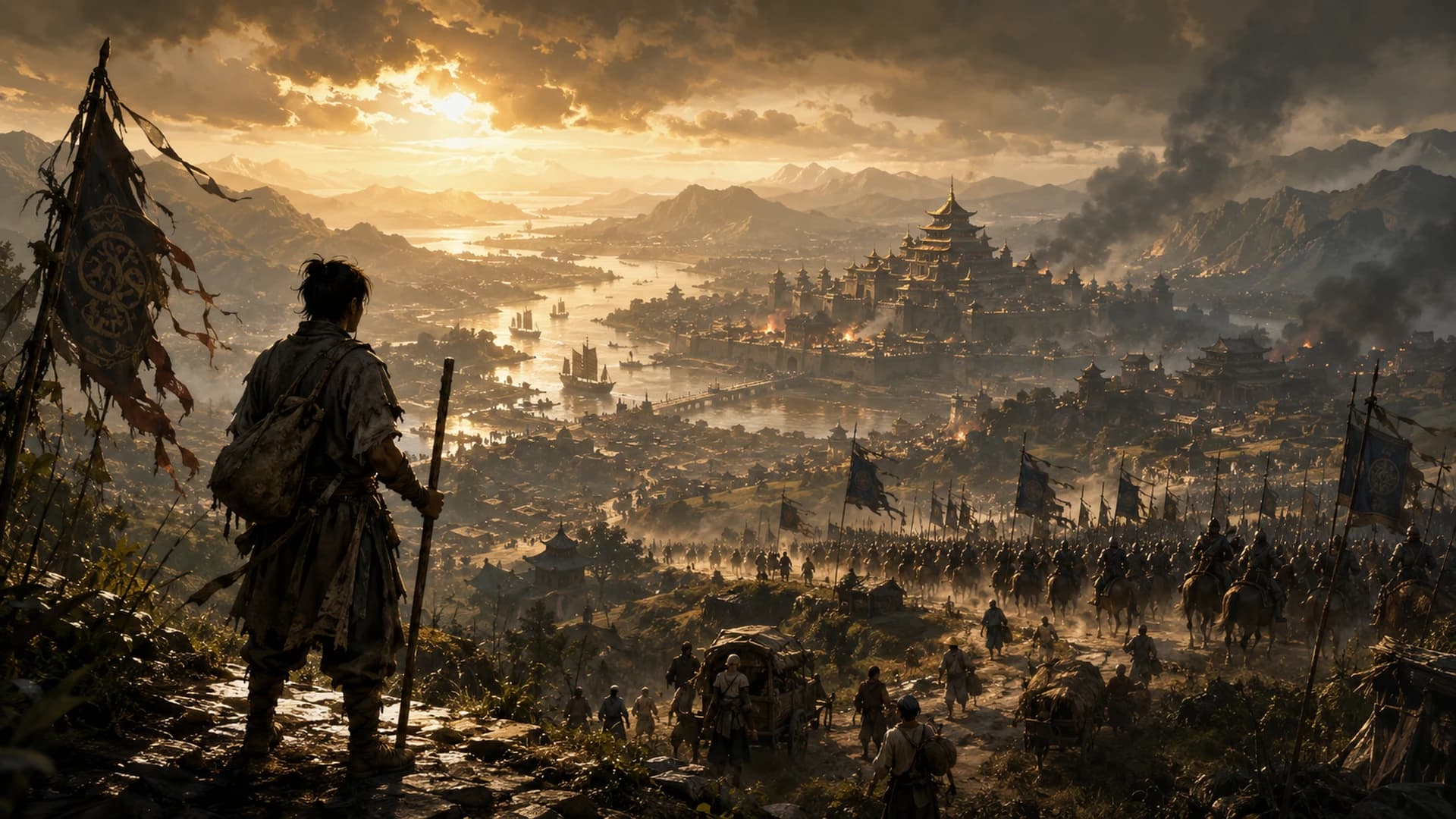
1285: From Dust to Dynasty
A grand historical and life simulation: from a nameless commoner to a dynasty that could reshape the Old World.
- 179
- Games
- 3,386
- Turns
- 3
- Upvotes
Characters
World Map
World Description
The world of 1285 is not a world of modern nation-states. Board cells use contemporary geography purely for gameplay navigation, but the underlying data reflects 13th-century political realities, deliberately using composite authority labels wherever a single cell spans multiple realms. Most of China rests under Kublai Khan's Yuan Dynasty, while Kaidu and Duwa govern the rival Ögedei-Chagatai alliance across Central Asia; Goryeo preserves its dynastic court under heavy Yuan imperial influence; Japan remains ruled by the Kamakura Shogunate, vigilant after the Mongol invasions of 1281; Đại Việt under the Trần Dynasty braces for the second Yuan invasion while Champa resists Sogetu's forces in the south. Southeast Asia is a mosaic of mandala realms: Sukhothai, Ngoenyang, Phayao, Hariphunchai, Lavo, Tambralinga, the Khmer Empire, Muang Sua, Pagan, Wareru, Shan chiefdoms, Singhasari, Melayu-Dharmasraya, Pasai, Malay port-polities, and island chiefdoms compete across overlapping spheres of influence. India is divided between Balban's Delhi Sultanate, Bughra Khan's Bengal, the Yadavas of Devagiri, Rudramadevi's Kakatiya Kingdom, the Hoysalas, the Pandyas, the Eastern Gangas, the Vaghelas, the Rajputs, and numerous regional principalities; Sri Lanka endures deep crisis following the Pandyan sack of Yapahuwa and the seizure of the Sacred Tooth Relic in 1284. The Middle East is partitioned among Arghun's Ilkhanate, Qalawun's Mamluk Sultanate, the Mongol-dominated Sultanate of Rum, emerging Turkic beyliks, the kingdoms of Georgia and Cilician Armenia, Rasulid Yemen, the Sharifs of the Hejaz, the Usfurids, and Hormuz, with Crusader Acre and Tripoli clinging to the Levantine coast. Western Europe features Edward I's England, Philip III's France, Castile-León, Aragon, Portugal, and neighboring Iberian realms; the Holy Roman Empire constitutes a decentralized web of princes and free cities under Rudolf I; Bohemia, Hungary, fragmented Polish duchies, Lithuania, the Teutonic Order, Scandinavian kingdoms, Serbia, Bulgaria, the Byzantine Empire, Latin Greece, and Italian maritime republics all pursue competing ambitions. The War of the Sicilian Vespers leaves Sicily under Aragonese rule while Naples remains Angevin. North Africa is held by the Marinids, Hafsids, Zayyanids, and Mamluks; the Sahel sees the Mali Empire rising under Mansa Sakura alongside Kanem and trans-Saharan caravan routes; East Africa encompasses Yekuno Amlak's Solomonic Empire in Ethiopia, Muslim sultanates in the Horn, and the Swahili city-states, where Kilwa channels inland gold from Great Zimbabwe into the Indian Ocean. The Congo rainforests, Southern Africa, Australia, Papua, and numerous archipelagoes are not empty lands, but thriving indigenous societies organized by customary land rights, kinship systems, exchange networks, environmental lore, and distinct local politics. Modern archaeology indicates Polynesian voyagers settled New Zealand's North Island around 1250–1275 and the South Island around 1280–1295, making 1285 the very dawn of human settlement in Aotearoa. This world is bound together by caravan routes, steppes, the Indian Ocean, the Red Sea, the Persian Gulf, the Mediterranean, the Baltic, the South China Sea, and major river arteries; yet knowledge, pricing, faith, language, and legitimacy do not move without friction—distance and season remain formidable barriers.