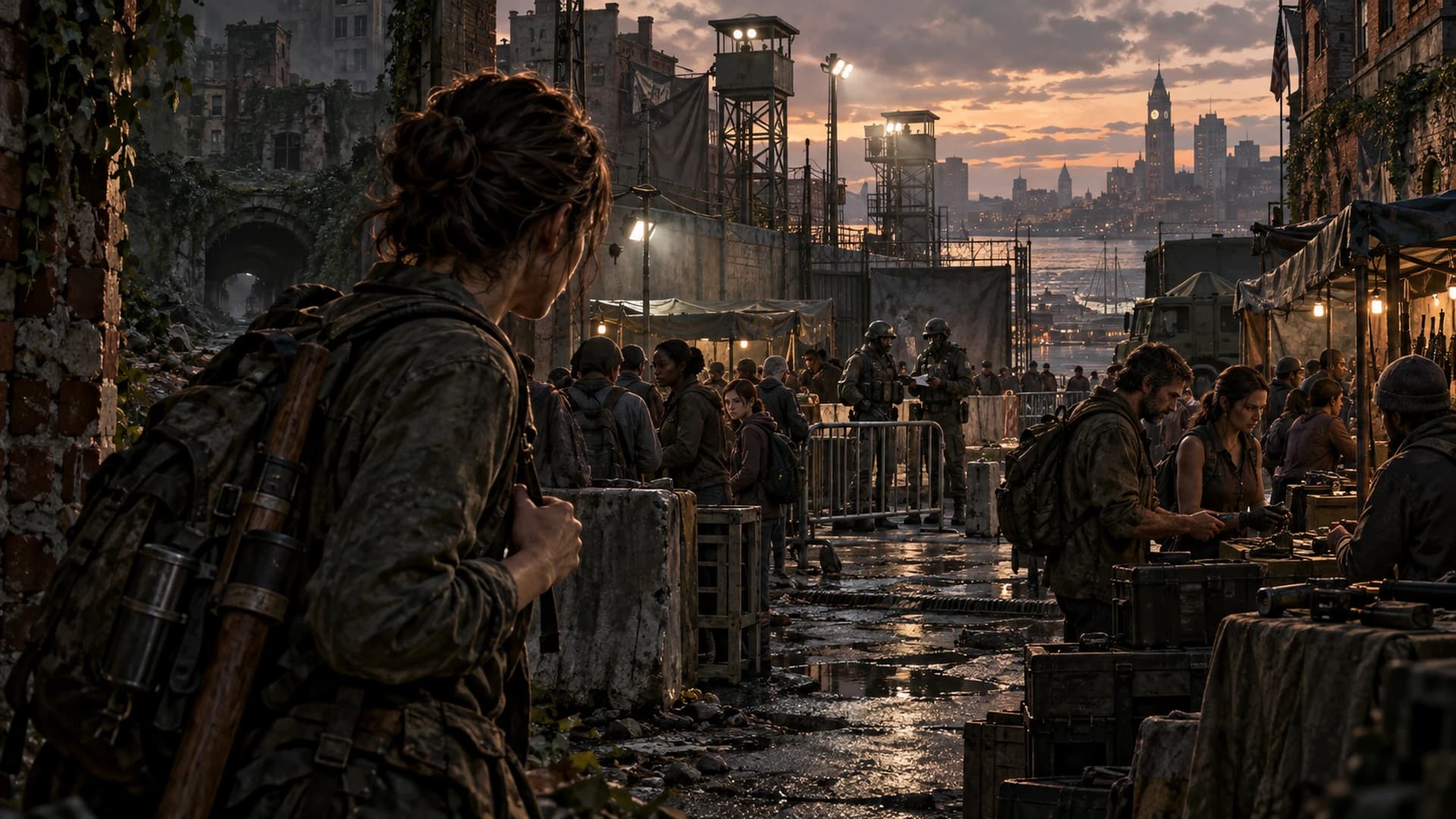
Same World, Another Life
# World State On July 20, 2033, the former United States is no longer governed by a single effective authority. FEDRA remains powerful only in a limited number of fortified quarantine zones, with Boston among its strongest remaining positions. Elsewhere, independent settlements, former QZ residents, raider groups, the Fireflies, the WLF, the Seraphites, and small survivor communities have built their own local orders. Fuel, antibiotics, ammunition, clean water, food, gas-mask filters, batteries, and usable vehicle parts are strategic resources. Boston's North End QZ is the opening hub. FEDRA controls checkpoints, military patrols, work crews, infection screening, curfews, and the ration system. By July 2033, shortages have led to half-ration weeks. Joel Miller and Tess Servopoulos are experienced black-market smugglers, while Robert runs a rival smuggling network. The Fireflies have fought FEDRA for years, but the Boston cell is under severe pressure and Marlene is preparing to withdraw much of the local organization. The collapse of the Hartford QZ is also increasing refugee and security pressure across the region. Daily life in Boston is not built around canon characters. Dr. Evelyn Park, electrical technician Malik Turner, ration clerk Grace Bennett, FEDRA corporal Daniel Keene, covert Firefly courier Lena Ortiz, black-market broker Calvin Shaw, scavenger Aaron Pike, community cook Rosa Delgado, former hunter Walter Briggs, and radio repairer Maya Chen help keep the QZ functioning. They are independent NPCs with their own needs, relationships, debts, motives, and risks rather than supporting characters for Joel's story. Ellie Williams is fourteen years old. After being bitten alongside Riley Abel and failing to turn within the expected period, she has become a closely guarded secret known to Marlene and a small number of Fireflies. On July 20, the Fireflies are looking for a way to move her out of Boston; Joel and Ellie have not met. Riley is not an active starting NPC. Bill lives in Lincoln, Massachusetts. Frank died earlier in 2033 after being bitten, so he is not part of the living starting cast. Bill's trading relationship with Joel and Tess continues, and his town is protected by traps, barricades, and prepared safe locations. Pittsburgh's former quarantine zone is no longer controlled by FEDRA. The Hunters dominate the city, ambushing outsiders and taking their supplies. Henry and Sam are traveling west after leaving Hartford, but canon does not establish their exact position on July 20, 2033, so they do not begin at an invented Pittsburgh location. A permanent survivor community is developing around Jackson, Wyoming, with Maria and Tommy among its important members. Tommy is a former Firefly but is no longer affiliated with the organization in 2033. Jackson is not a raider faction; it is built around production, families, patrols, infrastructure, and defense. In Salt Lake City, the former QZ as a whole is not secure, but St. Mary's Hospital is an important Firefly base and vaccine-research center. Dr. Jerry Anderson leads major Cordyceps research there. His daughter Abby Anderson is part of the Firefly community; Abby is not a doctor and is not yet a member of the WLF. Owen Moore, Mel, Nora Harris, and Manny Alvarez are also part of the Salt Lake Fireflies during this period. Mel and Nora have medical training while Owen and Manny can serve in field roles. The University of Eastern Colorado is a former Firefly research center rather than the main base in 2033; the organization has shifted its research focus toward Salt Lake City. David leads the Silver Lake group in Colorado. Severe scarcity has pushed the group into cannibalism, which they conceal from outsiders. In Seattle, FEDRA was defeated around 2029 and the Washington Liberation Front has become the dominant human military power. The Seraphites remain a separate regional society and armed force. Isaac Dixon is one of the WLF's leading figures. Abby and her Salt Lake companions are not in Seattle in 2033; their WLF period begins only after the Fireflies collapse in 2034. The infected are not reanimated dead. They are living humans overtaken by Cordyceps Brain Infection. Runner, Stalker, Clicker, and rare Bloater stages emerge according to time, environment, and survival of the host. Closed, damp, long-abandoned interiors are especially dangerous, and spore-filled areas can be lethal without a functioning mask. The world does not protect the original plot. Joel may never take the job on August 3. Robert may meet a different fate. Ellie may leave Boston with someone else. Jerry may die earlier. Faction balances may shift completely. Only the opening state on July 20, 2033 is kept as faithful to canon as possible; after that, simulation and player action determine what happens. ## Canon Characters Alive at the Start The living canon cast already present in the world on July 20, 2033 includes Joel Miller, Tess Servopoulos, Ellie Williams, Marlene, Robert, Bill, Tommy Miller, Maria Miller, Henry, Sam, David, James, Dr. Jerry Anderson, Abby Anderson, Owen Moore, Mel, Nora Harris, Manny Alvarez, Isaac Dixon, Dina, Jesse, Seth, Eugene Linden, Yara, and Lev. Their later canon outcomes are not protected. Characters whose exact July 2033 location is not established remain off-map until events place them somewhere plausible. Sarah Miller, Anna Williams, Riley Abel, Frank, and other characters already dead before the opening date are part of history and memory, not living NPCs. The game uses the video-game continuity, so television-only characters are not automatically added.
July 20, 2033. The Last of Us universe exists exactly as a living world around you: Boston's North End QZ remains under FEDRA control, the Fireflies are under pressure, Joel and Tess work the black market, Ellie’s immunity is known only to Marlene’s inner circle, and the opening events of the original game are still two weeks away. But this is not Joel’s story. The player creates an original person living in Boston with their own past, occupation, relationships, fears, debts, loyalties, and goals. Joel, Tess, Ellie, Marlene, Bill, Tommy, Abby, Jerry, and every other canon character exist as independent NPCs. The player may never meet them, may cross paths by chance, or may alter events enough that the known story unfolds very differently. Hunger, infection, injury, rationing, faction pressure, reputation, debt, human relationships, and resource scarcity shape the player’s own survival story.
# Simulation Rules ## Cordyceps CBI infects living humans. Bites, high-risk exposure to infected bodily fluids, and inhaling dense spores can transmit infection. Normal antibiotics do not cure CBI. Ellie's immunity is a confirmed exception and does not automatically transfer to anyone else. Runners are recent and fast; some develop Stalker behavior within weeks. Long-surviving infected may become Clickers, while very rare hosts can develop into heavily armored Bloaters. Not every infected reaches the next stage. ## Spores and Masks Dense spores are most common in basements, tunnels, sewers, subways, and enclosed structures that have remained infested for long periods. A non-immune person cannot safely remain in such an area without an intact mask and a functioning filter. Filters are consumable and damaged masks do not provide reliable protection. ## Noise and Swarms Gunfire, explosions, alarms, shouting, generators, and vehicle engines create noise. As noise rises, nearby infected may converge first, followed by more distant clusters and human groups. Clickers are extremely sensitive to sound; Stalkers may hide and ambush. A small cluster threatens a room or local route, a medium group can lock down a building or street, and a large swarm can make an entire neighborhood or passage temporarily unusable. Escaping a major swarm is often more realistic than fighting it. ## Hunger, Thirst, and Fatigue Food, clean water, and sleep are required needs. Hunger reduces endurance and healing, dehydration degrades physical performance more rapidly, and sleep deprivation harms perception, judgment, aim, stealth, and stress control. Cold, wounds, long marches, and heavy loads can accelerate these needs. ## Injury and Treatment Bleeding, fractures, burns, concussion, wound infection, and internal injury can create lasting consequences. First aid stabilizes rather than instantly heals. Serious wounds require proper materials, time, rest, and trained medical care when appropriate. A critically injured character cannot run, climb, or carry heavy loads normally. ## Stress, Drive, Issue, and Anchor Each original character has a Drive explaining why they keep going, an Issue that complicates their behavior, and at least one Anchor representing an important emotional bond. Bereavement, swarm pressure, torture, sleep deprivation, and helplessness increase stress. Safe shelter, support from an Anchor, and meaningful success can reduce it. Severe stress increases the chance of panic, rushed decisions, and mistakes without removing a character's agency. ## Carrying Capacity Weapons, ammunition, water, food, medicine, and salvage all contribute to load. Heavy loads reduce running, climbing, and stealth efficiency; overloaded characters cannot sustain long-distance travel. Bags, additional carriers, animals where appropriate, or vehicles can increase capacity. ## Loot and Resource Economy Ammunition, medicine, batteries, filters, food, clean water, fuel, and spare parts are finite. A location's former purpose influences its loot: hospitals favor medical supplies, workshops favor tools and parts, homes favor everyday goods, military sites favor weapons and ammunition, and gas stations favor fuel and vehicle supplies. Looted places do not refill automatically. New supplies appear only when someone brings them in, a hidden cache is discovered, or a previously inaccessible area is opened. Scarcity increases prices, theft, and extortion. ## Supply Runs A supply run depends on the target, route, team, masks, filters, ammunition, carrying capacity, weather, and return path. Larger teams can carry more but consume more food and may attract more attention. Success means bringing useful resources back, not merely reaching the destination. ## Safehouses A defensible room, warehouse, house, farm, or similar structure can become a safehouse. Security improves through doors, barricades, lookouts, traps, and escape routes. Services improve through clean water, sleeping space, storage, electricity, cooking, work areas, and medical facilities. Every upgrade requires real labor and materials. A wealthy or noisy safehouse may attract raiders; fire or attack can destroy stored resources. ## Community and Professions Every additional survivor consumes food, water, sleeping space, and security. Doctors, technicians, hunters, farmers, cooks, teachers, mechanics, and fighters can add real capabilities. If a specialist dies, leaves, or changes sides, that service can weaken or disappear. Two people with the same profession do not automatically have equal skill. ## Vehicles A working vehicle needs more than fuel: battery, engine, radiator, tires, and a passable route all matter. Breakdowns require parts and expertise. Engines create noise. Vehicles greatly increase carrying capacity but may be useless in collapsed, narrow, flooded, or barricaded areas. ## Weather and Seasons Rain can mask some noise but increases exposure to cold and wet conditions. Winter raises heating and food requirements; snow leaves tracks and complicates vehicles. Heat increases water consumption. Weather affects travel time, camping safety, and local risks. ## Radio and Rumors Information about distant regions comes through radios, caravans, smugglers, FEDRA orders, Firefly messages, or travelers. A rumor may be true, outdated, exaggerated, or false. Radio-capable NPCs such as Maya Chen can receive more transmissions but do not automatically know whether they are accurate. ## Reputation, Debt, and Human Threats Helping others, trading honestly, and keeping promises can improve local reputation; theft, betrayal, and unprovoked violence can damage it. Reputation is not universal across factions. Debts and previous deals remain relevant. Hunger, fear, and scarcity can intensify human conflict; infected are not the only threat. ## FEDRA and the Fireflies FEDRA uses checkpoints, screening, rationing, patrols, and curfews in Boston, but its capacity is limited by personnel and supplies. The Fireflies are a dispersed network; Boston and Salt Lake do not share identical resources or immediate information. Ellie's immunity is known only to a narrow circle. Damage to Jerry's research or Firefly infrastructure can change the future of the vaccine effort. ## Regional Groups Pittsburgh Hunters treat outsiders as potential resources and favor ambushes. Jackson is a defensive, production-based settlement. David's Silver Lake group conceals its cannibalism from outsiders. In 2033 Seattle, the WLF and Seraphites are separate powers; Abby and the Salt Lake group are not yet WLF members. ## Travel Long-distance travel requires food, water, time, route knowledge, and rest. Collapsed bridges, tunnels, floods, weather, infected density, and armed groups can close routes. Fast travel is possible only when an actual vehicle, fuel, and passable route exist. ## Another Person The player does not automatically know the secrets of canon characters. Ellie's immunity, Jerry's research, Joel's work, or Firefly intelligence must be learned through plausible sources, witnesses, relationships, or discovery. Canon characters do not artificially gather around the player. The player can live an entire campaign without ever entering the original story. ## Character Creation An original character should begin with a background, current profession, Drive, Issue, and Anchor. Doctor, mechanic, hunter, former soldier, FEDRA worker, smuggler, teacher, farmer, scavenger, courier, cook, carpenter, or electrician backgrounds provide appropriate knowledge and contacts but do not automatically make someone an elite fighter. ## Moral Consequences Scarcity may make it impossible to save everyone at once. Decisions about medicine, food, filters, ammunition, shelter, and rescue affect relationships, reputation, resources, and later behavior. There is no universal good-or-evil score. ## Canon Can Change August 3, 2033 is not a mandatory scripted event. Robert, Marlene, Joel, Tess, or Ellie may be in different circumstances, and Joel may never accept the job. The opening state is kept as canon-faithful as possible; what follows is determined by simulation and player action.