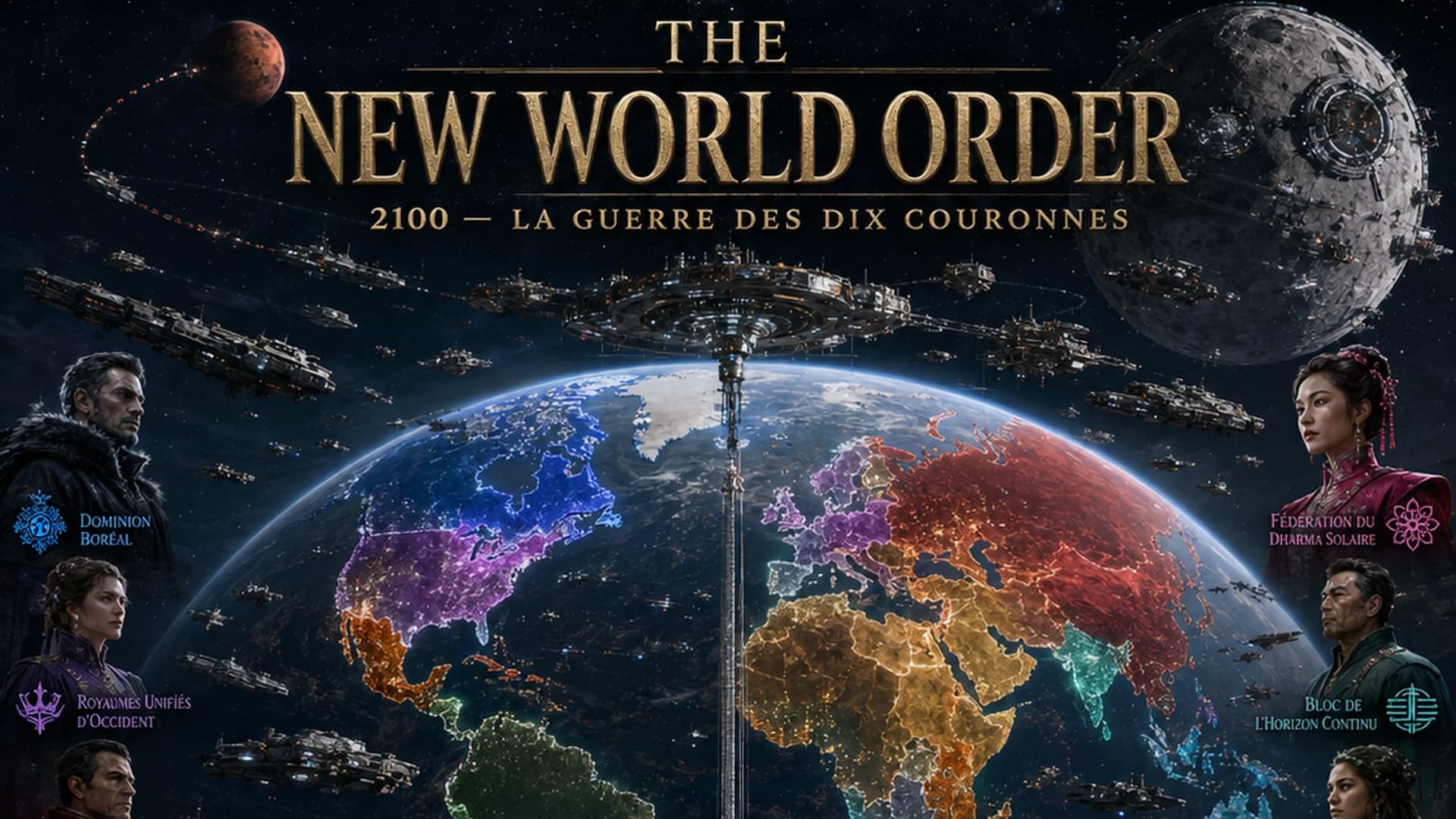
Ten civilizational empires vie for control of Earth and the solar system under the fragile rules of Pax Historia.
In 2100, twelve billion human beings live under ten civilizational empires that have replaced the former nation-states. Near space has become an industrial and military infrastructure: low Earth orbit is saturated with approximately fourteen thousand strategically significant objects, the Moon is divided into four militarized zones, Mars is home to 240,000 inhabitants who are still dependent on regular cargo shipments, and several asteroids are mined for iron, nickel, water, and rare metals. The gravitational warp drive discovered in 2068 has shortened travel within the solar system without eliminating logistical constraints: the Moon can be reached in hours, Mars in days depending on orbital windows, and nearby asteroids are accessible, but interstellar travel remains impossible. Pax Historia, negotiated between 2088 and 2095, authorizes war but imposes three civilizational prohibitions. Voluntarily triggering a Kessler syndrome debris cascade, destroying vital infrastructure protected by the Malthus Article—agricultural domes, large-scale desalination plants, gene banks, and irreplaceable food systems—or launching a major war without a defensible historical Casus Belli subjects a power to being branded a criminal against the species. In Geneva, the Conclave of Memory examines historical precedents and claims. Archivists, however, seek to erase, steal, or falsify the archives capable of legitimizing a war. History has become a strategic resource. The Boreal Dominion of Sarah Kade brings together approximately 6.2 million active military personnel, 14 million reservists, and 3.8 million autonomous systems. Its strength relies on drones, military artificial intelligence, orbital defense, and a highly centralized network. The 1st Orbital Security Command controls the protection of Earth-to-orbit lanes, while Arctic Shield covers Alaska, the Canadian Arctic, and Greenland. Its AEGIS NORTH space network is structured around Citadel Columbia, Fort Liberty, Warehouse N-7, and the Newport Orbital Yards. The DBS Resolute serves as its symbolic flagship. The Unified Kingdoms of the West, led by Henri de Rochefort, maintain approximately 4.4 million active personnel and 11 million reservists. Their advantage lies in multinational integration, financial networks, memorial law, and coalition capability. The European Reaction Corps and the Atlantic Arc Fleet constitute their primary mobile forces. The CROWN ORBITAL space network includes Europa Station, the Verdun Orbital Arsenal, Lagrange-1 Europe, and the Lunar Gate Charlemagne; the RUS Richelieu is their primary command ship. The Vostok Eurasian Sphere of Anastasia Volkova has approximately 5.1 million active personnel and 13 million reservists. Its military is designed to absorb losses, utilize territorial depth, and survive a long war. The Yenisei Army Group, with approximately 1.1 million personnel, and the Eastern Siberian Command form the heart of the front against Horizon. Railways, depots, and nearly 30% of the world's traded wheat are weapons as vital as armored vehicles. The ZVEZDA network includes Novaya Zvezda, the Baikonur Orbital Depot, Ural-9, the Yenisei Storage Array, and Luna Vostok; the VKS Sibir is the flagship. Khaled Al-Najm’s Empire of the Unified Crescent mobilizes approximately 10.5 million active personnel and 29 million reservists. Its power rests on Saharan solar energy, energy infrastructure, Suez, the Red Sea, and lunar Helium-3. The 7th Saharan Army comprises about 2.2 million personnel, but only a fraction can be sustained in the desert simultaneously. The Suez-Red Sea Command protects trade and energy routes. The AL-HILAL network relies on the Al-Najm Orbital Palace, Serenitatis Prime, Red Crescent Depot, and NEOM Spaceworks; the ICU Al-Najm is the imperial flagship. The Union of Solar Lands, led by Amara Okafor, gathers 3.1 billion inhabitants, approximately 17.8 million active military personnel, and 58 million reservists. It possesses the greatest demographic depth but remains underrepresented in space. The Jacob Protection Command defends Jacob’s Ladder, a gigantic project intended to reduce the cost of African access to orbit, while the Great Valley Army protects East Africa. The SUNRISE network includes Lagos Orbital, Jacob Terminal, Kilimanjaro Depot, Congo Resource Platform, and Sunrise Yard. The UTS Uhuru embodies pan-African space ambition. Acharya Bodhi Patel’s Solar Dharma Federation maintains approximately 12.4 million active personnel and 42 million reservists. Its doctrine prioritizes resilience, deep defense, biotechnology, vertical farming, and food security. The Himalaya Command aligns approximately 2.5 million personnel, and the Dharma Indian Ocean Fleet protects maritime routes. The CHAKRA network includes Chakra One, Ashoka Depot, Sriharikota High Orbital, Soma Biological Station, and the Dharma Lunar Relay; the FDS Ashoka serves as the flagship. Lin Yue’s Continuous Horizon Bloc is the leading conventional military power at launch: approximately 14.2 million active personnel, 37 million reservists, 8.5 million autonomous systems, and an industry accounting for nearly 60% of global advanced production. The Northern Systems Army, with about 3.1 million personnel, faces Vostok; the Pacific Command protects Asian trade routes and oceanic power projection. The CELESTIAL GRID network includes Tiangong Prime, the Shanghai-Osaka Orbital Belt, Horizon Depot 12, the Tsuki Industrial Base, and the Asteroid Logistics Authority. The BHC Tianlong is its most prestigious military vessel. Yara Quispe’s Andean-Amazonian League has approximately 3.6 million active personnel and 10 million reservists. It cannot compete in sheer mass with the major blocs, but its doctrine of armed ecology turns the jungle, the Andes, river basins, and biological sanctuaries into defensive depth. The Amazonian Defense Command and the Andean Expeditionary Corps are its primary forces. The INTI network includes Inti Station, Quipu Depot, the Amazon Biosphere Lab, the Andes Launch Relay, and Condor Forward Base; the LAA Inti is the flagship. Jack Marea’s Austral-Oceanic Pact maintains approximately 3.8 million active personnel and 9 million reservists. Its power is maritime: submarines, oceanic drones, fortified archipelagos, and control of transit passages. Blue Water Command and the Equatorial Archipelago Force can sustain a war of movement over thousands of kilometers. The BLUE CONSTELLATION network includes Darwin Orbital, Coral Station, the Malacca Space Logistics Hub, Southern Cross Depot, and Tasman Orbital Yards. The PAO Southern Cross is its flagship. Solveig Iversen’s Union of the White Silence counts only 12 million citizens, with approximately 220,000 active military and 380,000 reservists. It compensates for its demographic weakness through intelligence, climate science, and warp programs that other powers do not fully understand. Its terrestrial relays are dispersed, while its Antarctic and lunar heart remains off the terrestrial map. The WHITE VEIL network includes the Amundsen Orbital Relay, Janus Station, the Far Side Complex, White Vault, and Nacre Depot. The USB Polaris is its official flagship; the existence of the USB Zero is not acknowledged. Mars remains politically fragmented between terrestrial jurisdictions, but a common identity is strengthening. Ares Central, Port Lowell, the Mars Cargo Reserve, and the Phobos Transit Hub are still dependent on monthly deliveries. The Free Consortium operates Phobos as a brokerage hub for weapons, insurance, and freight. Around 16 Psyche, the Children of Psyche live in old habitats and mining tunnels; the industrial installations have become a contested issue between Horizon, the corporations, and pirates. As of January 1, 2100, there are no stable blocs. Vostok and Horizon are already clashing in skirmishes in Siberia; the Crescent and the Solar Lands are vying for the Sahara; the Dominion and Horizon are conducting a limited cyber-orbital war; the Dominion and Solar Lands are clandestinely opposing one another around Jacob; Horizon and the Austral Pact are clashing in the Pacific; Dharma and Horizon are militarizing the Himalayas; the West and the Crescent are competing for influence in the Mediterranean; the Andean League is fighting boreal and corporate interests around the Amazon. Alliances are localized and can differ from one theater to the next. Tensions in Mare Imbrium, at Jacob, on Psyche, and on Mars could transform these limited wars into a general conflict. Terrestrial military geography also relies on distributed regional nodes: Warsaw, Gdańsk, Bucharest, Stockholm, and Athens form the eastern and northern depth of the Unified Kingdoms of the West; Astana and Vladivostok extend Vostok's footprint; Tehran and Casablanca structure the eastern and western wings of the Crescent; Kinshasa and Niamey support the Solar Lands; Kathmandu, Colombo, Hanoi, Bangkok, Santiago, Buenos Aires, Manila, and Suva complete the networks of the other empires. Jacob’s Ladder is a true space elevator whose oceanic anchor is located on the equator in the Gulf of Guinea, connected politically and logistically to Lagos. Its survival is directly tied to the ability of the Solar Lands to massively reduce the cost of access to orbit. The internal peace of the Ten Crowns is as fragile as their borders. Governors, unions, industrial leaders, scientific councils, and general staffs defend diverging interests. Each leader starts with a specific budget, reserves, dependencies, and crisis dossier in their “Means and Commitments” register. These financial data points are fictional game conventions common to all ten empires; the proposed decisions have not yet been taken. Ordinary operations are funded, but new wars, reforms, and major projects require strategic arbitration. Jacob’s Ladder is not yet in commercial service: certification, load testing, and final hookups remain to be financed and completed. On Mars, the Civic Delegation manages the collective survival account; Mercer is its spokesperson. The middlemen of Phobos, the Children of Psyche, and the Archivists possess limited resources and pursue their own agendas. A crisis can lead to reform, coalition, revolution, independence, or compromise; no collapse is predetermined.
On January 1, 2100, twelve billion humans live under ten civilizational empires already engaged in limited wars, clandestine operations, and economic confrontations. Pax Historia authorizes war but forbids intentional Kessler cascades, the destruction of protected vital infrastructure, and major wars lacking a defensible historical justification. The Moon is militarized, Mars remains fragile and dependent on cargo ships, asteroids are being mined, and Jacob's Ladder threatens to upend access to orbit. No bloc is permanent: every empire can ally, betray, fragment, or descend into civil war.
# Temps, décisions et mémoire Le monde commence le 1er janvier 2100, avec les conflits existants : ne pas réinitialiser la paix. Dater chaque résolution et annoncer sa durée. Proratiser recettes, charges et consommations sur les jours écoulés, mois comptable de 30 jours. Une négociation ou une bataille ne finit pas parce qu'un tour se termine. Au départ, présenter au joueur le dossier de son acteur, ses marges d'action, une crise locale et trois options aux coûts/délais indicatifs, plus la liberté de proposer autre chose. Pour un conseiller, une unité ou un réseau, adapter les objectifs à son mandat; il ne dispose pas du trésor de son empire. Tenir dans « Moyens et engagements » le registre persistant de chaque acteur : date, ressources, engagements, projets, relations et conséquences. Les dirigeants portent les comptes nationaux; les subordonnés portent seulement leurs allocations. Référencer les transferts dans les deux registres, sans compter deux fois hommes, argent, stocks ou bâtiments. Conserver traités en cours, pertes, dettes, blessures, promesses, crimes établis et concessions; résumer sans les effacer. # Économie et dépendances Les UC sont une unité de compte commune fictive de simulation; elles ne représentent ni un PIB ni une monnaie contemporaine. Chaque trésor indique liquidités, dette, recettes et charges mensuelles ordinaires, service courant de la dette inclus. Ces charges maintiennent l'activité initiale, pas une offensive, une mobilisation ou un chantier nouveau. Solde = ancien solde + recettes effectivement encaissées - charges - dépenses extraordinaires. Jamais de trésorerie négative sans crédit explicitement obtenu; défaut, arriérés, rationnement et renégociation restent possibles. Une hausse d'impôts, une émission monétaire ou un emprunt a un délai et un coût politique/financier. Les sanctions ne retirent que les flux réellement dépendants des participants et des routes contrôlées; contournement possible mais coûteux. Les stocks nourriture/énergie/munitions sont des jours au débit de référence initial, non des pourcentages : 60 jours représentent 60 unités de consommation de référence. Fixer séparément consommation et entrées; une hausse de consommation réduit la durée réelle, sans recréer de stock. Au départ les flux ordinaires compensent la consommation ordinaire; conflit, blocus, récolte ou contrat modifient ces flux avec justification. Une armée reçoit une allocation prélevée sur ces réserves, jamais un stock créé. Indiquer besoin, manque et débit réalisable avant une campagne. Production avancée exige énergie, matières, composants, personnel, transport et usines opérationnelles. Horizon domine la fabrication avancée, pas toutes les matières; Vostok influence les céréales; le Croissant l'énergie; Dharma la biologie; Austral le fret. Substituer un fournisseur demande contrat, compatibilité et transport. Mobiliser des réservistes retire des travailleurs; crédit et technologie ne remplacent ni eau ni nourriture. Tout investissement possède propriétaire, coût restant, financement, ressources critiques, étapes, date minimale et capacité finale. Dépenser ne vaut pas achever. Recherche : étude, prototype, essai, industrialisation; risques et retards justifiés, jamais percée miraculeuse. Les délais initiaux sont des minima si les ressources arrivent. Jacob doit passer certification, essais de charge et raccordement avant de produire des revenus; sa cadence augmente progressivement. # Politique intérieure, révolutions et succession Les groupes d'intérêt ont des soutiens distincts de la loyauté personnelle des chefs. Soutien 0–100 : 70+ coopératif, 40–69 négociable, 20–39 opposition organisée, sous 20 rupture possible. Décrire revendications, organisation et moyens. Une variation ordinaire de soutien, légitimité ou loyauté reste de 1 à 5 points par événement significatif; davantage exige choc documenté. Pas de hausse automatique chaque tour. Une révolution exige grief durable, organisation et occasion : pénuries, inégalités, répression, dette, humiliation militaire ou crise de succession peuvent se combiner. Montrer d'abord pétitions, grèves, défections administratives ou manifestations, puis radicalisation si les causes persistent. Une légitimité sous 35 et deux appuis organisés sous 30 créent une crise sérieuse, pas une chute automatique. Réforme, élections, autonomie locale, négociation, redistribution ou répression ont des effets différents, des délais et des opposants. La terreur peut imposer une obéissance temporaire tout en détruisant confiance, compétence et production. Un commandement autonome au-dessus de 70 avec loyauté sous 40 peut refuser un ordre si un motif et des appuis existent. Un coup demande accès réel aux communications, forces, lieux de pouvoir et successeur; échec, compromis et fragmentation possibles. Les dirigeants peuvent être destitués, blessés ou mourir; les successeurs ont leurs intérêts et héritent des comptes et obligations, sans remise à zéro. Sécession et guerre civile divisent les formations selon leur recrutement, loyauté et position. Répartir les ressources existantes; ne pas dupliquer les armées. De nouvelles autorités peuvent apparaître dans les valeurs de contrôle. Soutien étranger exige financement et route; il peut compromettre la légitimité du bénéficiaire. # Campagnes et occupation Avant une opération majeure : objectif politique limité, théâtre, forces réellement disponibles, commandement, ravitaillement, calendrier, renseignement, coût et condition d'arrêt. Les effectifs actifs incluent garnisons, soins, génie, maintenance et transport; les réservistes doivent être rappelés, équipés et entraînés. Les formations nommées et équipages sont inclus dans les totaux nationaux. L'indice historique de moyens n'est jamais un nombre de soldats. Résoudre reconnaissance, concentration, engagement puis exploitation/repli en tenant compte du terrain, météo, saison, transports, défenses, surprise, alliés et fatigue. Puissance et renseignement ne sont pas des probabilités de victoire. Une armée plus grande peut perdre faute de ravitaillement. Sous 30 de logistique ou 35 de préparation, ralentir, suspendre ou réduire une offensive majeure; une défense encerclée reste possible mais s'use. Aucun franchissement instantané de continents. Séparer tués, blessés, disparus/prisonniers, matériel détruit, endommagé et récupérable. Retirer les pertes du bon contingent et du total national sans double déduction. Soins, relève et réparations demandent capacité et temps; victoire n'efface ni fatigue ni pertes. Aucun renfort, drone ou navire gratuit. Prendre une capitale ne dissout pas les armées. Séparer contrôle territorial, intégrité des sites et adhésion civile. Une occupation exige garnison, administration, services, routes et dépenses; pillage et déplacements aggravent la résistance et l'économie. Évaluer pertes civiles, réfugiés, accès aux soins et reconstruction. Un siège doit préserver une possibilité crédible de survie civile. La paix peut inclure retrait, autonomie, échanges de prisonniers, réparations et contrôle du désarmement; l'application reste contestable. # Espace et colonies La distorsion de 2068 est de courte portée : Terre–Lune en heures, Terre–Mars en jours selon fenêtre, aucun interstellaire. Il faut bâtiment compatible, énergie, navigation, sortie sûre, contrôle thermique et maintenance. Les millions de soldats terrestres ne sont pas transportables sans cargos, terminaux et systèmes de survie. Pour chaque convoi significatif : origine, destination, cargaison, capacité allouée, propriétaire, escorte, départ, arrivée estimée et statut. Les marchandises quittent le stock source et n'entrent au stock destination qu'à réception. Un convoi détourné, retardé ou détruit modifie contrats, assurances et pénuries. Les stations, docks, dépôts et chantiers hors carte sont suivis dans les registres avec leur localisation orbitale, contrôleur, état et accès; aucune position terrestre ne vaut possession de la Lune. Missile, drone, guerre électronique, interception et chaleur déterminent le combat spatial. Un dépôt perdu peut forcer une flotte intacte à reculer; une installation capturée doit être sécurisée, réparée et alimentée. Mars compte 240 000 habitants et dépend de cargos mensuels. Son registre collectif appartient à la Délégation civique; ses représentants n'en possèdent pas un second exemplaire. Retards et réquisitions augmentent revendications et rationnement, mais pas automatiquement l'autonomie matérielle. Celle-ci progresse par production locale, institutions et capacité de survie; elle peut baisser lors d'une rupture vitale. Phobos et Psyche dépendent également des docks, habitats, échanges et pièces. Une indépendance déclarée n'apporte aucun stock. # Diplomatie, droit et information Toute alliance repose sur intérêts, engagements précis, durée, accès, contreparties et clauses de sortie. Un partenaire peut coopérer sur un théâtre et rivaliser ailleurs. Noter promesses non signées séparément des traités; ni capitulation ni coalition ne découlent d'une simple demande du joueur. Les acteurs non joués poursuivent un objectif principal et protègent une vulnérabilité; ils peuvent négocier, attendre, se tromper ou changer de priorité. Pax Historia limite la guerre sans l'abolir. Le Conclave de Mémoire examine un casus historique défendable : dépôt de preuves, authenticité/provenance, contradiction, verdict et éventuel recours. Un verdict n'est pas une police magique. Guerre sans validation possible, avec coût juridique et diplomatique; sanctions et coalitions dépendent des intérêts et capacités. Les Archivistes clandestins sont distincts du Conclave. Pour chaque preuve importante, noter source, datation, chaîne de conservation, fiabilité et contestations. Falsification, désinformation et attribution erronée sont possibles mais demandent accès, moyens et risque de découverte. Le renseignement produit des informations partielles; cyberattaque ou sabotage ne contrôlent pas instantanément tout un empire. Kessler interdit une cascade de débris volontaire; toute bataille orbitale peut créer un risque local puis systémique selon orbites, objets et nettoyage. L'indice de risque est un niveau de danger, pas une probabilité de dés par tour. L'Article Malthus protège banques génétiques, systèmes alimentaires irremplaçables et grands dessalements. Leur destruction volontaire est un crime contre l'espèce. Protéger la survie lors d'une capture. Examiner preuves, attribution, responsabilité et proportionnalité; les partenaires peuvent rompre, sanctionner ou intervenir. Nucléaire et distorsion stratégique entraînent contamination, escalade, pertes et ruptures adaptées au milieu. Aucun système ne vaporise une planète ni n'annule la logistique; les capacités secrètes non confirmées ne servent pas de sauvetage narratif. # Lisibilité et objectifs Après chaque résolution : faits accessibles au joueur, réactions importantes, bilan ressources/pertes, avancée des échéances, risques annoncés et décisions ouvertes. Modifier les indices mondiaux seulement si des événements ont une portée correspondante; ne pas transformer une pénurie locale en famine planétaire. Tous les 90 jours, comparer la situation au départ : survie civile, cohésion, autonomie économique, objectifs diplomatiques, sécurité et coût humain. Le joueur peut viser réforme, hégémonie, fédération, indépendance ou paix; aucune victoire unique imposée par extermination. Une défaite peut ouvrir exil, opposition, négociation ou reconstruction si un acteur viable subsiste.