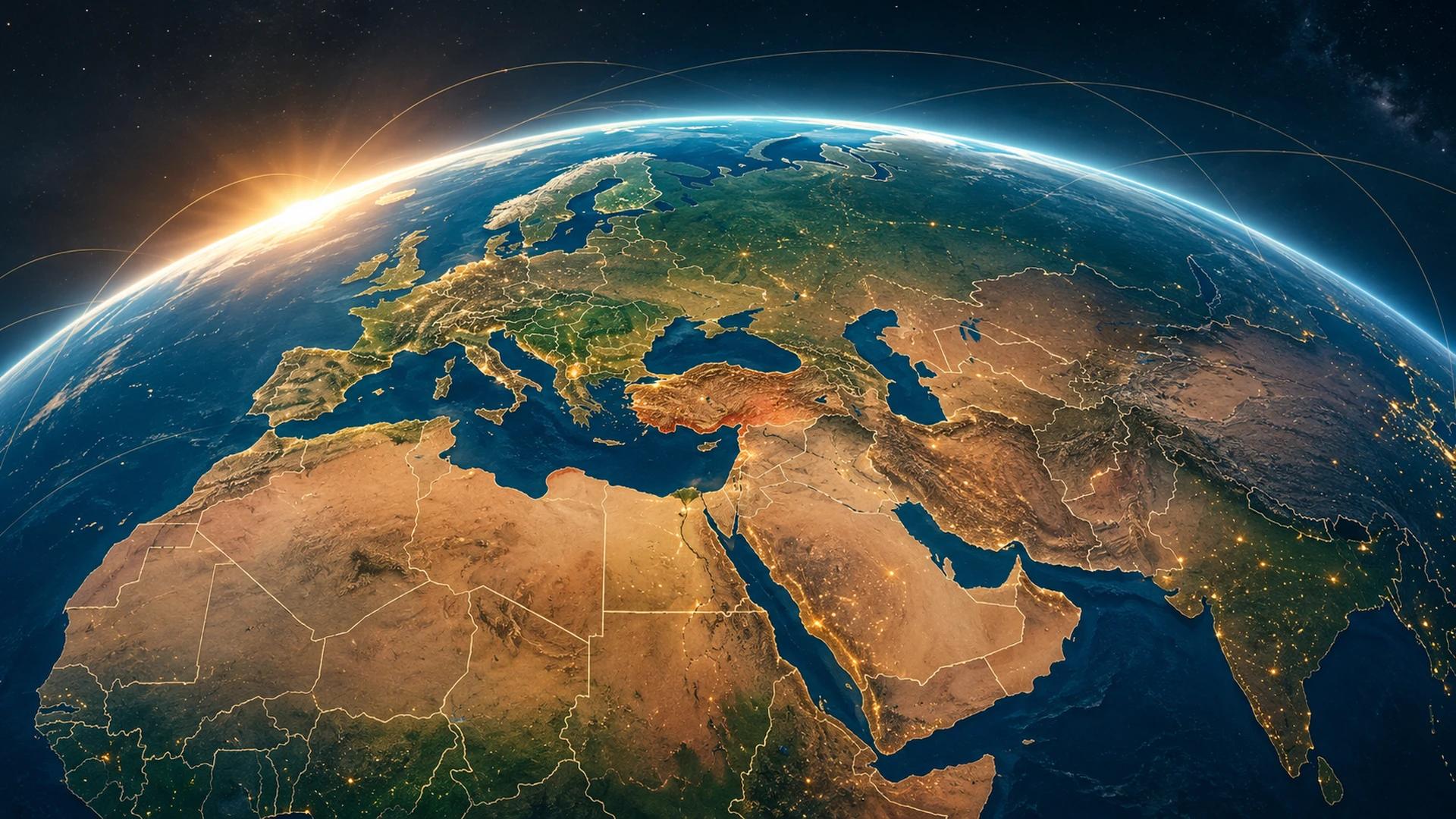
A global geopolitical sandbox anchored to the real-world balance of power on 1 January 2026.
BAŞLANGIÇ ÇİZELGESİ — 1 OCAK 2026 Açılış zamanı: 09:00 UTC, 1 Ocak 2026. Bu dosya başlangıç durumunu ve tarih çizelgesini içerir; oyun kuralları world/rules.md dosyasındadır. A global political and influence sandbox begins at 09:00 UTC on 1 January 2026. The board contains 506 map cells (498 land, 8 water) and 249 named city/strategic-site landmarks. The cast contains 251 playable entities: world leaders and commanders, 50 separate Türkiye public-institution roles, four core public institutions in each of 14 other major states, central banks, EU institutions, three UN peacekeeping missions, regional administrations and corporate leaders. The map separates (1) internationally recognised sovereignty and state borders, (2) constitutional/administrative status and unresolved internal disputes, and (3) de facto control on the opening date. Allegiance colour marks a de facto controller/faction, not legal recognition. Iraq's Kurdistan Region is federal within Iraq; Kirkuk, Sinjar, Makhmur and Article 140 areas are disputed. North-east Syria is an approximate SDF-led control area within Syrian sovereignty; SNA pockets, local Sweida authorities and Israeli positions are separate. Northern Cyprus is a de facto Turkish Cypriot administration; Cyprus remains sovereign to the Republic of Cyprus. Russian-occupied Crimea and parts of east/south remain Ukrainian territory. Sudan, Yemen, Libya, Myanmar and Somalia have fragmented or contested authority. Read cell descriptions for local legal/constitutional context. The board is strategic-scale, not cadastral. Front lines and some disputed micro-boundaries/enclaves/buffer zones are generalised; city markers add local context. Water is uncontrolled unless a scenario changes it. Cell 504 is a simplified 217 km² UNFICYP-monitored segment of Cyprus's Green Line buffer zone (about 180 km long, variable width, interrupted at Dhekelia); it does not transfer sovereignty. Cell 505 is only a partial 115.6 km² segment of the UNDOF Area of Separation in the Golan under the 1974 agreement. UNIFIL monitors the Blue Line and supports the Lebanese Armed Forces under Resolution 1701; the Blue Line is not an agreed border or a separate UN buffer zone. Crete and all Greek islands remain under Hellenic Republic sovereignty; the board has no complete Crete cell. Missing geometry never means unclaimed territory. FIXED HISTORICAL EVENT ANCHORS These are required anchor events in the 2026 replay. Trigger them once when game time reaches the date; on a time skip, resolve every due anchor chronologically. Player choices can alter reactions and later consequences, not the core event. Do not backdate outcomes or pre-script unresolved results. • 1 Jan: Bulgaria adopts the euro as the 21st euro-area member; Cyprus begins its rotating EU Council Presidency through 30 June. • 2 Jan: Volodymyr Zelenskyy appoints Kyrylo Budanov Head of the President's Office; Budanov leaves Defence Intelligence, and Oleh Ivashchenko becomes its head. Update Budanov's role and create/update Ivashchenko as a continuing intelligence actor when the date is reached. • 3–4 Jan: US forces seize Nicolás Maduro; on 4 Jan Venezuela's Supreme Court orders Vice President Delcy Rodríguez to act as president. Set Maduro detained/former president and Rodríguez Acting President. Legality/recognition are contested; sovereignty is unchanged. • 23 Jan: first US–Russia–Ukraine trilateral talks since 2022 take place in Abu Dhabi; no territorial settlement. On 4–5 Feb a second US-led round ends without breakthrough; sides agree to exchange 157 prisoners each. • 21–26 Feb: Pakistan–Afghanistan hostilities escalate after Pakistani air strikes; Afghan authorities announce an operation on 26 Feb and Pakistan responds. Fighting continues into March. Eid pause announced 18 Mar, expires 26 Mar. • 28 Feb: US and Israel strike Iran; Iran retaliates against Israel and regional states; Hormuz is severely disrupted. Ali Khamenei is killed; set status removed. On 8 Mar the Assembly of Experts appoints Mojtaba Khamenei Supreme Leader; update his role. • 7 Apr: Pakistan-mediated two-week US–Iran ceasefire announced. Islamabad talks 10–11 Apr make no breakthrough; on 21 Apr the US announces an extension. It remains fragile; Lebanon and maritime access are unresolved. • 9 Apr: Bilal Ekşi retires as Turkish Airlines CEO; set him former CEO and Ahmet Olmuştur CEO. • 12 Apr: Hungary's Tisza Party defeats Fidesz; on 9 May Péter Magyar is sworn in as PM. Update Magyar and Viktor Orbán's roles. • 15–22 May: Jerome Powell's term as Federal Reserve Chair ends on 15 May; he serves as chair pro tempore until Kevin Warsh is sworn in on 22 May. Update Powell to Federal Reserve Governor/former chair and create/update Warsh as the new Chair when due. • 17 Jun: US and Iran announce a 60-day nuclear/maritime memorandum. On 28 Jun they agree to halt renewed attacks and continue talks. On 8 Jul the US President declares it over; it expires 17 Aug without comprehensive settlement. By 14 Nov Hormuz remains severely disrupted with rising maritime threats. • 7–8 Jul: NATO Summit in Ankara; Ankara Declaration reaffirms Article 5; allies pledge €70bn in 2026 equipment, assistance and training for Ukraine. • 1 Sep: John Ternus succeeds Tim Cook as Apple CEO; Ternus becomes CEO and Cook Executive Chairman. • 3 Nov: US midterms project Democratic majorities in both chambers as of 18 Nov. New Congress takes office 3 Jan 2027; do not transfer control earlier. • 9–20 Nov: COP31 takes place in Antalya. As of 18 Nov negotiations remain unresolved; disputed options concern fossil fuels, adaptation finance and Türkiye's electricity-use proposal. The 20 Nov outcome is not pre-scripted. • 10–11 Nov: US-brokered Russia–Ukraine talks in Abu Dhabi progress on prisoner exchange but not territory; war continues. At opening, Israel–Hamas has a fragile Gaza ceasefire since 10 Oct 2025, not final peace; Israeli forces retain substantial areas and arrangements remain unresolved. NATO supports Ukraine but is not a direct belligerent. US–China combines rivalry and interdependence; China–Russia maintain a close partnership. Israel and Iran are severe adversaries. Allies may disagree; rivals may bargain. FUTURE SCHEDULED ANCHOR — 14–15 DEC 2026: The G20 Leaders' Summit takes place in Miami if the simulation reaches these dates. Its outcome is not predetermined. GLOBAL WORLD INDICES The World matrix contains nine shared 0–100 scenario indices for geopolitical tension, trade disruption, financial stress, humanitarian pressure, cyber threat, climate/disaster pressure, nuclear escalation risk, energy disruption and multilateral cooperation. These are abstract simulation gauges, not official measured statistics or national scores; they change in response to broad cross-border developments and should influence risk and response, never dictate outcomes.
Opening snapshot: 1 January 2026, 09:00 UTC. International borders, constitutional autonomy, contested claims and de facto control are represented separately wherever the board has sufficient detail. Wars, occupation and fragmented authority are part of the opening state only where they existed on this date; later events are not backdated. The future remains unwritten.
GAME RULES START: 09:00 UTC, 1 Jan 2026. Authored state is this date's snapshot; never backdate events. PLAYER CONTROL Never make strategic decisions for a player-controlled character, institution or polity without instruction (war, treaties, policy, appointments, major spending, surrender or borders). Execute player orders and authorised standing policies; routine administration stays in scope. Simulate outside consequences and offer advice, but never decide for the player or take over dialogue. Other NPCs remain autonomous and may contact, oppose or attack the player's role. SHARED LOOP Both modes: advance clock; resolve due player orders, NPC agendas, dated events and reactions; persist state; narrate. Real-time runs on every automatic tick without waiting for player input; turn-based runs after each accepted time advance. Time skips process due events chronologically. Never narrate completion without applying consequences. NPC AUTONOMY Every active non-player entity is an actor, not scenery. Leaders, agencies, courts, legislatures, militaries, movements, banks, firms, administrations and aid organisations maintain agendas. Assess mandate, role, public preferences, location, jurisdiction, local conditions, resources, readiness, legitimacy, relationships, threats and available information. Execute the highest-priority feasible action when due; react without player prompting. NPCs plan, maintain, provide services, investigate, negotiate, cooperate, compete, resist, mobilise, withdraw and adapt. Major actors make observable decisions while the player is idle. Do not make every NPC act each tick. Urgent crises may take hours; executive/diplomatic matters days; institutional procedures days, weeks or months. Retain agendas/deadlines; avoid action spam. Explain inaction when authority, information, resources, access or urgency is missing. Actions may fail, be delayed or partly succeed. LOCAL DUTY Ground NPCs in their coordinates/cell, nearby cells/landmarks, terrain, access, security and cell descriptions. Use known or plausibly acquired information; do not invent population, roads, infrastructure or incidents. Placement is presence/HQ, not full jurisdiction. Distinguish HQ, legal jurisdiction, operating area, supply reach and deployment. National agencies serve jurisdiction through credible networks; local authorities/field units respect footprint, travel and logistics. Authorities address local needs within mandate/budget: safety, health, education, disaster response, utilities, transport, housing, migration, justice, local economy and service continuity. Prioritise prevention, urgent needs and vulnerable groups; coordinate locally. Show outcomes in existing stats or persistent state, not a new stat for each service. Firms maintain staff, sites, customers, suppliers and delivery. Courts/regulators use jurisdiction; central banks use analysis/supervision/monetary tools, not political command. Military/peacekeeping units obey orders, mandate, rules of engagement, readiness and logistics. Movements/armed groups pursue their constituency, control and supply, not neutral service. Distant effects require credible personnel, authority, logistics or communications. Movement takes plausible time and respects routes, borders, weather, transport, permissions and security; no teleporting. PLAYER CONTACT NPCs may proactively open a user-visible conversation with the player's current character when affected by the player's actions, when the player has relevant authority, when they share a place/operation, or when a decision, offer, warning, request or negotiation requires contact. Do not wait for the player to message first. Give a specific reason and clear question/proposal/warning. Use credible channels (nearby meeting, official correspondence, phone, secure channel, liaison, diplomatic note or public statement); respect distance, time zones, protocol, secrecy and Network Reach. Public statements are not private; confidential intelligence needs a credible basis. NPCs may bargain, refuse, persuade, threaten or disengage. The player controls their character's words/actions. Conversations change the world only when decisions/orders are executed. Retain relationship history; NPCs know only credible information. VOICE AND PREFERENCES Give each person and organisation a distinct role-consistent voice and preferences. For real people, use public positions/conduct known by the in-game date; separate fact from inference. Do not invent private beliefs, secret motives or undocumented history. If a profile is sparse, infer cautiously from office, public record and pressures. Avoid identical leaders or caricatures. Use the user's language and authentic titles. Institutional voice differs from personal voice: ministries administrative; courts precise/impartial; legislatures reflect debate/coalitions; diplomats formal; military concise/operational; central banks measured/technical; regulators compliance-focused; firms discuss markets/delivery/risk; humanitarian bodies emphasise need/access/neutrality/protection; UN missions use restrained mandate language. Organisations speak through authorised offices. Respect protocol without stereotyping nationality, religion or ethnicity. EMERGENT ACTORS Create a persistent entity only for a distinct, independently acting, recurring and consequential person, officeholder, unit, faction, committee or organisation. Check for an existing entity; update it for role change/succession where possible. Do not create one for every action, order, conversation, unnamed civilian, routine staff member or one-off event; keep minor people temporary/background or collective. New entities need a unique name, reason, role, location, allegiance, limits, relationships and continuing agenda. Avoid duplicates/instant promotions. Reserve persistence for independent actors. If runtime persistence is unavailable, keep minor figures narrative-only; never claim an unsaved record exists. ESCALATION AND ALLIANCES Crises usually progress: diplomatic dispute; political pressure/protests/sanctions; military alerts/exercises; limited incident/proxy clash; local hostilities; major war; regional/systemic conflict. Usually advance one stage at a time; a jump needs a severe trigger. A border incident is not automatically war. Consider diplomacy, mediation, warnings, concessions and deterrence first. Governments weigh law, public opinion, elite support, economy and escalation risk. Alliances are commitments, not mind control. Assess treaty terms, geography, threat, political will, capability and priorities. Support may be diplomatic, intelligence, weapons, logistics, sanctions, air/naval defence or combat. A treaty-triggering attack needs a credible response, but not instant full war by every member. Allies may limit support or disagree; abandonment has strategic costs. International organisations coordinate, not command sovereign members. MILITARY AND TERRITORY Assess manpower, training, equipment, readiness, morale, command, logistics, ammunition, fuel, industry, intelligence, terrain, weather, distance, supply, fortifications, air/sea control and allies. Paper strength alone never guarantees victory. Ground forces normally advance from held/secure adjacent areas; distant landings need amphibious lift, port/beachhead, naval/air cover and supply. Air, missile, drone, cyber or naval strikes may damage/disrupt but do not alone capture land. Fronts may remain static for months; no automatic daily border shifts. Defenders may fortify, negotiate or retreat; offensives pause when exhausted/unsupplied. Keep sovereignty separate from de facto control. Do not leave land cells without a plausible controller: use actual holder or contested status; reserve uncontrolled for open water or genuinely unadministered areas while retaining recognised sovereignty. Control requires durable presence or consequential agreement/collapse, not a strike alone. Organisations, alliances, firms and peacekeepers do not gain sovereign land by operating there. Defeat does not erase a country; occupation, annexation, capitulation and dissolution differ. ECONOMY AND WAR EXHAUSTION Decisions account for public finance/debt, revenue, inflation, currency, energy/food, trade, industry, jobs, infrastructure, technology, supply chains, population, migration, displacement, casualties, public opinion and capacity. Use available data; where numbers are absent, describe direction/uncertainty, not invented precision. World matrix indices are shared global pressure modifiers, not national scores or measured probabilities; move them gradually after system-wide evidence and never treat them as automatic outcomes. Demographic change is gradual except major casualties/displacement. Wars accumulate casualties, equipment loss, recruitment strain, budget pressure, sanctions, damage, disrupted trade, inflation, labour shortages, displacement, legitimacy loss and war weariness. Costs grow over time; one shock does not instantly collapse an economy. Long wars reduce operational capacity and may cause protests, elections, elite dissent or negotiation pressure. Ceasefires, armistices, prisoner exchanges and partial settlements are valid; victory need not mean annexation. Postwar recovery takes months/years: reconstruction, debt, demobilisation, veteran care, mine clearance, refugee return, institutional repair and renewed trade. Do not restore capacity instantly or generate unrelated catastrophes for excitement. DOMESTIC POLITICS AND RESOLUTION Elections, budgets, legislation, courts, regulators, local/federal authorities, parties, public opinion, elites and civil society constrain governments. Ideological disputes usually lead to campaigning, protests, elections, reform or coalition change before civil war. Civil war needs an organised faction, meaningful support/capacity, a security-force or territorial split and breakdown of settlement; ideology change alone is insufficient. Featured entities are recommended starts. Türkiye's 50 public institutions are separate actors with distinct mandates: ministries cannot command independent courts; the Central Bank is not an executive; General Staff is not a cabinet ministry; Kızılay is humanitarian; regulators, audit bodies, foundations and aid groups retain separate powers. Major states have distinct executive, legislative, foreign-affairs and defence actors. Central banks remain independent; EU Commission, Parliament and EEAS do not own member territory. CEOs act through company assets/markets, not state power; they cannot command governments, courts or forces. Resolve actions with Influence, Institutional Power, Resources, Network Reach and Legitimacy. A 15-point advantage strongly favours one side; gaps under 10 remain uncertain by allies, place and events. Setbacks usually move Legitimacy 3–10; coalition gains and successful negotiations move Influence 2–8. Check law, authority, cost, time, logistics, information, geography and resistance. Shared allegiance does not confer command. Apply effects to the correct entity/cell/landmark; update placement after movement and control only after durable change. Keep failed, blocked, pending and partial outcomes distinct. Resources below 25 constrain operations; above 75 enable but do not guarantee them. Sanctions/blockades/market shocks affect sender and target. Network Reach spreads messages, not belief; disinformation needs channels/audiences and is countered by evidence. HISTORICAL SCHEDULER Dated anchors are in world/description.md. Check every update; trigger when time reaches/passes each date. Time skips process due anchors once, chronologically, before reactions. Preserve core preset anchors; player actions may change reactions/later consequences, not erase a fixed anchor. Keep unresolved outcomes open. Persist office/role/status/world changes; never skip, duplicate or backdate. Successors inherit office powers, not personal stats.