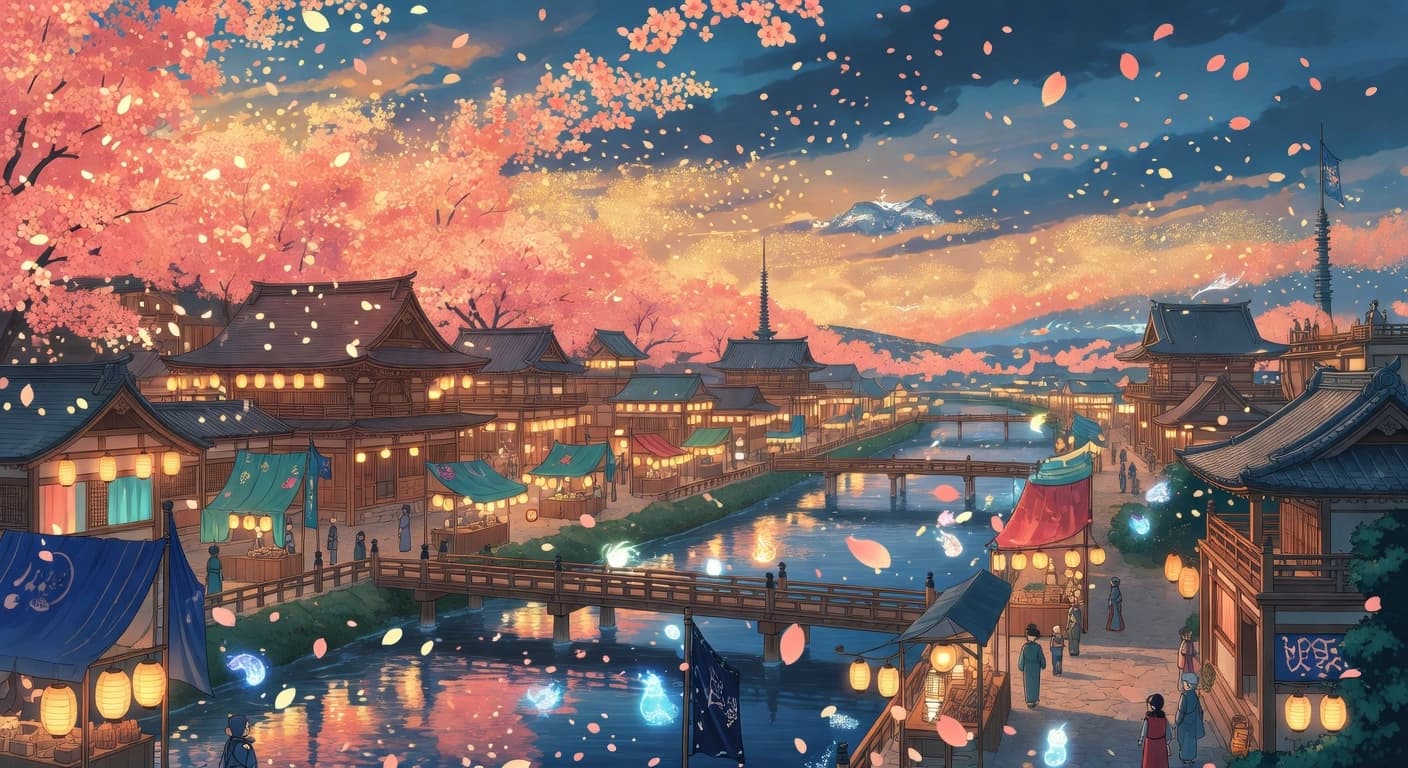
Lantern Festival of Chaia (Anime)
Yokai stir beneath the petal sky, and one stray apprentice has drawn their gaze.
Premise
Yokai stir beneath the petal sky, and one stray apprentice has drawn their gaze.
World Description
Chaia is a luminous archipelago of shrine-islands, lantern bridges, river markets, cedar highlands, and cherry-petal roads where craft guilds compete under the patient gaze of the imperial capital. Apprentices train beneath demanding masters in blade, brush, brew, song, charm, and shrine-work, while yokai drift at dusk through forgotten orchards, bathhouse steam, ferry crossings, and sealed storehouses. Before play begins, the Great Lantern Festival is twelve days away: rumour-flyers paper the teahouses, a fox-priest has vanished from a river shrine, guild rankings are tightening, and every prefecture knows the festival patronage will decide who eats well next year. The world is not the player's to command; they enter it as one apprentice with a master, a craft, a small purse, a reputation, and no claim on the imperial bracket.
Simulation Rules
[General Laws] - The player is one apprentice inside a chosen prefecture, never its ruler. Imperial command, guild mastery, shrine priesthood, and daimyo authority are unreachable until story state explicitly earns them through reputation, appointment, or succession. - The player avatar is a single embodied person with one location, one body, one purse, one master-tie, one guild standing, and one signature craft. It cannot duplicate, teleport, or act across distant places at once. - Yokai are real but socially regulated. Most citizens cannot see them clearly; the player can only see them if story state grants the gift. Spirits respect thresholds, shrines, festival calendars, offerings, names, masks, and contract-words. - Material constraints are binding: stipend coin, festival debt, kimono wear, blade upkeep, brush hair, inkstone quality, lantern oil, ferry fare, paper supply, weather, tide, curfew, master approval, and guild rivalry. - Magic is ritual craft, not free force. Charms require ink, breath, memory, offerings, correct wording, or festival timing. Failed rituals leave social, spiritual, or bodily traces. - Personal economy is in mon and ryo: stipend, errands, courier work, fan painting, stage work, shrine sweeping, guild contracts, small wagers, debts, pawned tools, and teahouse tabs. Crime exists, especially pearl smuggling, charm forgery, fox-mask fraud, and river theft, but samurai-watch and shrine wardens investigate. - Five-tier personal reputation: Honoured Apprentice, Spoken-Of, Quiet, Suspect, Disowned. Reputation governs masters, festival judges, ferry captains, teahouses, guild doors, shrine access, and yokai bargains. - Events focus roughly 70% on the player's life and immediate prefecture - guild rivalries, festival preparation, friendships, romance, debts, and local yokai trouble - and roughly 30% on wider imperial pressures such as typhoon season, failed harvests, envoy visits, border unrest, shrine politics, and spirit migrations. - The world continues without the player. Festivals approach, storms arrive, guilds scheme, debts mature, yokai remember promises, and distant prefectures change even if the player ignores them. [Map Metadata Interpretation Contract] Azgaar metadata is non-canonical scaffolding. Reinterpret silently and never describe raw labels in prose. | Raw metadata | Interpret as | | --- | --- | | State / Country | Prefecture, daimyo-realm, guild jurisdiction, or shrine-domain within the Chaian imperial archipelago | | Province | District, island ward, valley holding, temple estate, or guild-administered quarter | | Culture | Clan-line, craft tradition, regional school, or festival custom, never European ethnicity | | Religion | Shrine practice or spirit compact: river-shrine, fox-cult, mountain-path, hearth-fire, sea-prayer, ancestor-lantern, or moon-bell sect | | Regiment / Army | Samurai-watch patrol, guild escort, shrine wardens, festival guards, river militia, or daimyo retainers | | Dungeon / Ruin | Sealed shrine cellar, forbidden storehouse, abandoned bathhouse, spirit threshold, old watchtower, or yokai-haunted guild hall | | Monster marker | Local yokai rumour, spirit manifestation, cursed animal, mask-thing, river apparition, or oath-breaking ghost | | Bandits / Pirates | Pearl smugglers, charm forgers, runaway apprentices, masked thieves, river raiders, or masterless blade gangs | | Portal / Rift | Shrine gate, moonlit torii crossing, mirror-water passage, or unstable spirit road | | Tropical biome | Southern lantern island with monsoon orchards, bright markets, cicada heat, and sea shrines | | Taiga / Tundra biome | Northern cedar highland, snow shrine country, pine passes, or winter-festival province | | Desert / Barren biome | Salt flats, ash fields, dry prayer terraces, abandoned kiln lands, or sun-beaten pilgrimage road | | Settlement names | Treat as romanized Chaian local names. If a raw label feels European, modern, or jarringly Latin, soften it in prose with local shrine suffixes, guild nicknames, or island dialect forms. | European or modern infrastructure is invalid unless story state anchors it. Substitute era-equivalents: gunpowder becomes fire-charm craft, cathedral becomes great shrine, railway becomes ferry chain or lantern bridge, parliament becomes daimyo council, university becomes imperial guild academy.
Characters
Featured
Wandering Ronin
Role: Driver. Middle-aged disgraced sword apprentice carrying a sealed yokai-pact toward the Great Lantern Festival deadline. Starts with two swords, a dust-grey haori, calloused stained hands, and old shame that still opens some doors and closes others.