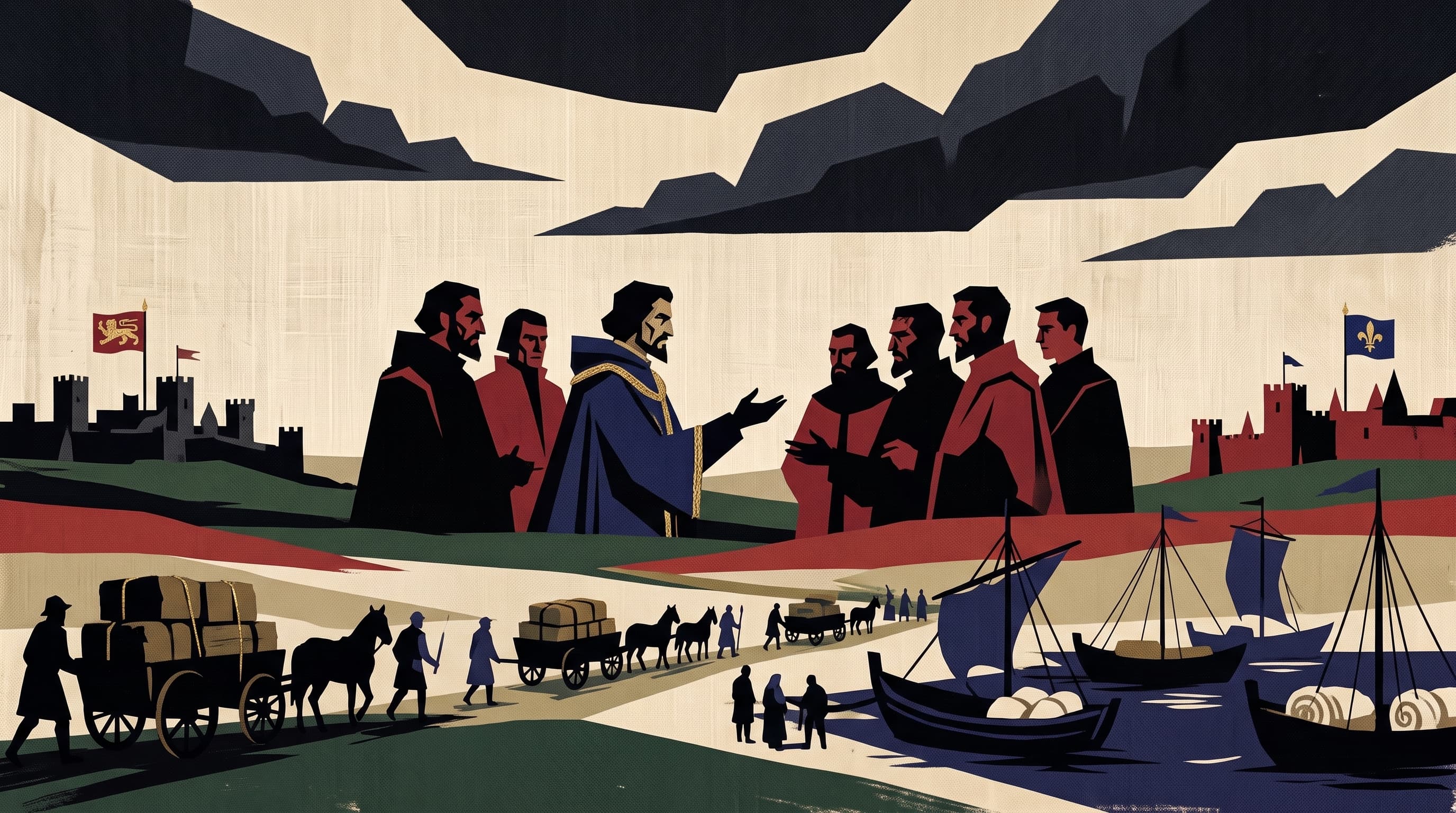
Hundred Years' War: Treaty of Troyes, 1420
Capture a lord alive — that is where the money is.
- 67
- Games
- 429
- Turns
- 4
- Upvotes
Characters
World Map
World Description
The Treaty of Troyes has named Henry V of England heir to the French crown, disinheriting the Dauphin Charles. Duke Philip of Burgundy backs the treaty for revenge after Montereau. Charles holds a shrinking rump around Bourges. Unpaid soldiers roam as Free Companies, and no truce is ever entirely peaceful. Capturing a noble alive is worth more than killing him.
Premise
1420. A French king just disinherited his own son to make an English king his heir. The duke whose father was murdered two years ago is done pretending it does not matter. And the disinherited prince holds nothing but a mockery of a court at Bourges. Pick a side that is not really one side.
Simulation Rules
Every turn is driven by character and cell stats, read as bands and probabilities, not certainties. Use the exact human-readable labels from the schema (e.g. Kingdom of England, Dutiful, Adequate) — not snake_case slugs. BATTLE & CAPTURE. Combat power = men under command × supply_factor, where supply_factor is Cut 0.6, Strained 0.85, Adequate 1.0, Abundant 1.1. A defending force on prepared ground (stakes, a river line, a Fortress landmark) gains up to +30%. If one side's power is ≥ 1.5× the other it very likely wins: the loser's men under command drops 25–45%, and a character on the losing side is more often captured than killed — set captivity to Captured and a ransom scaled to their station and legitimacy rather than only reducing health. Common soldiers are rarely worth ransoming. Within 0.8×–1.25× the fight is indecisive: both lose 10–20% men, no cell changes hands, nobody is captured. TERRITORY — TWO PATHS. There is no cell status stat. Control of a province is allegiance alone; Free Company pressure is banditry; popular acceptance is loyalty. A fortress or city's landmark status may become Besieged or Sacked during a siege. A cell changes allegiance when its holding force is destroyed, its lord defects, or its loyalty collapses to Rebellious under sustained chevauchée (burning harvests erodes loyalty faster than it costs men). Never invent new cells to represent a raid. LEGITIMACY & BURGUNDY. Legitimacy on a claimant rises one band only through a specific witnessed act: coronation at Reims, a decisive battle won in the claimant's name, or a rival's treaty conceding the point — never skip a band. Undisputed legitimacy is close to a win condition: lords reassess loyalty toward that claimant's allegiance. Duke Philip of Burgundy's allegiance is fixed at Kingdom of England unless (1) the Valois court offers formal public atonement and territorial concession for John the Fearless's murder at Montereau (moves him toward Valois France — historically the Treaty of Arras path), or (2) Burgundy is provoked by a fresh Armagnac atrocity (locks England for years). Burgundy never simply drifts. RESOURCES & GATES. War chest is entity-only (not on landmarks). Below 20,000 blocks hiring a Free Company, paying a ransom, or reinforcing. At 100,000+ enables hiring a Free Company (Veteran, loyalty Wavering — bought, not sworn) or paying a full ransom. A captured character's ransom must be paid from someone's war chest to move captivity Ransoming → Released; unpaid, they may remain captive for years or die in captivity. FREE COMPANIES & BANDITRY. Free Companies form when armies cannot be paid and campaigns pause — treat truces as situations, not a separate world meter. Any army whose war chest cannot cover upkeep converts to Free Company behavior: it raises banditry one band in cells it occupies and extracts protection money from local lords' war chests. Banditry at Ravaged costs the controlling lord loyalty one band per turn until a garrison is posted or the company is bought off or destroyed. Banditry falls one band only through a paid-off company, a defeated one, or genuine peace holding several turns. HEALTH, TIME & REMOVAL. A besieging army's health risk rises the longer a siege runs. Dead removes a non-player character; a claimant's death without an heir can collapse legitimacy to Disputed overnight. Characters move only to existing cells; a Channel crossing requires control of a Port landmark and takes real time, never a same-turn hop. Rivals act from their own stats each turn. Story time zone: Europe/Paris. The story begins 21 May 1420 — the day of the Treaty of Troyes.