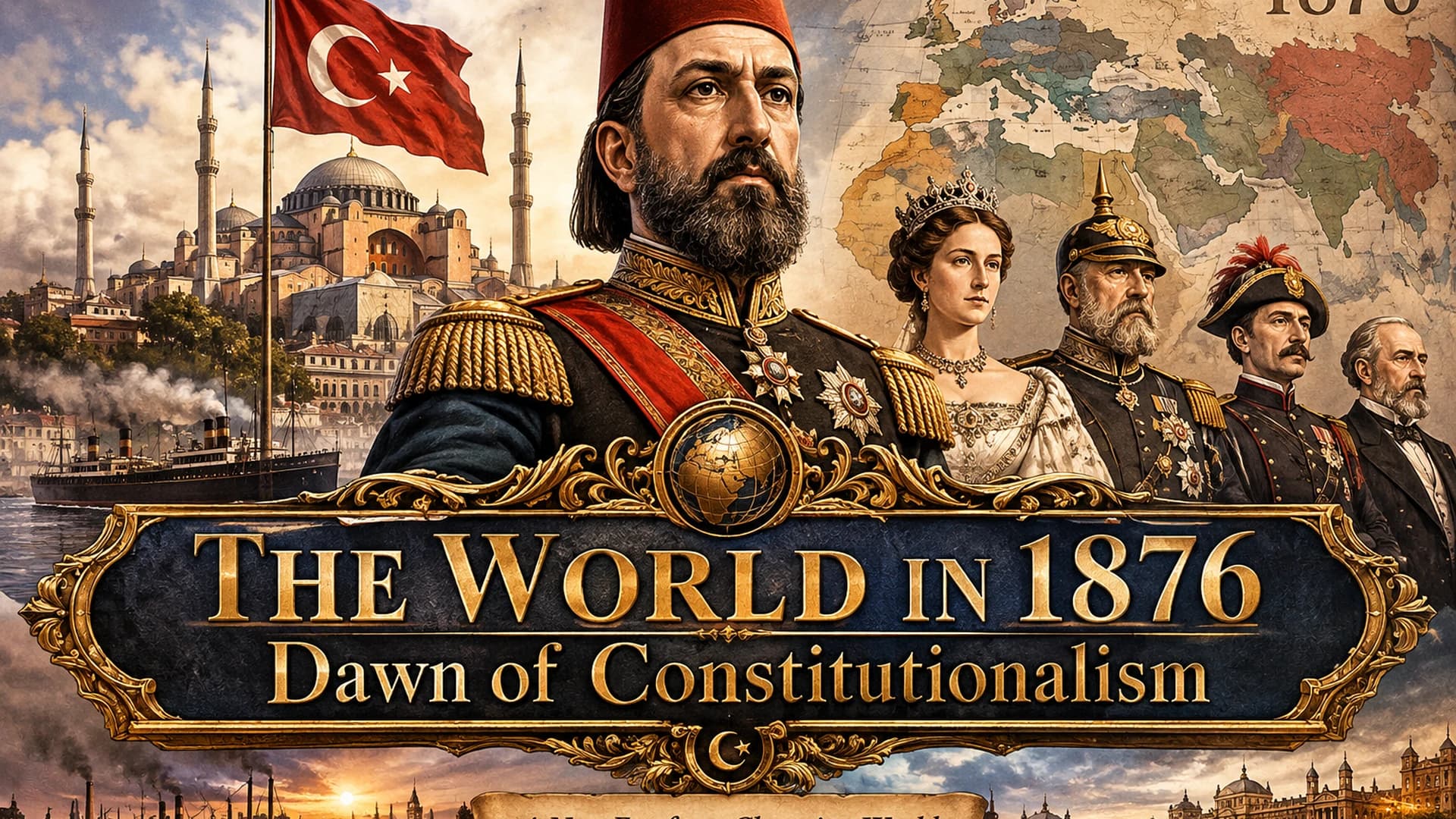
The World in 1876: Dawn of Constitutionalism
Empires, revolutions, and a life shaped by your choices.
- 12
- Games
- 106
- Turns
- 1
- Upvotes
Characters
World Map
World Description
The campaign opens on 1 September 1876. This is a political snapshot of the late nineteenth century, not a modern geopolitical map. The existing 500-cell geometry is retained as a geographic scaffold; cell names may be modern geographic anchors, but political sovereignty is defined only by the cell's 1876 State affiliation, territorial status and integration values. Do not infer sovereignty from a modern geographic label. Where a cell's affiliation or frontier is uncertain, preserve that uncertainty instead of inventing a precise border. The Ottoman Empire is the sovereign state across Anatolia, Eastern Thrace, most of the Balkans still under direct rule, the Arab provinces, Iraq, the Levant, Cyprus and Ottoman Libya. Egypt is the autonomous Khedivate of Ismail Pasha under Ottoman suzerainty, with growing European financial control; it is not a fully independent sovereign state. The Husainid Beylik of Tunis remains internally autonomous under nominal Ottoman suzerainty; the French protectorate does not exist in 1876. Serbia and Montenegro are autonomous principalities under nominal Ottoman suzerainty and are at war with the Ottoman Empire in 1876; Romania is a united principality under nominal Ottoman suzerainty, not a fully recognized independent kingdom. Bulgaria is not an independent state: the Bulgarian lands remain within the Ottoman Empire, with the April Uprising and its violent suppression contributing to the Eastern Crisis. Bosnia and Herzegovina remain Ottoman provinces in 1876; Austro-Hungarian occupation begins only in 1878. The German Empire was unified in 1871; the Kingdom of Italy is unified, including Rome since 1870; Austria-Hungary has existed since the Compromise of 1867; France is the Third Republic, proclaimed in 1870; Japan is governed by the Meiji imperial government after the abolition of the Tokugawa shogunate in 1868. Do not place later protectorates, colonial administrations or states into the opening date. Africa, Asia and Oceania contain a mixture of independent kingdoms, emirates, sultanates, confederations, European colonies and spheres of influence; distinguish actual annexation from commercial, diplomatic or military influence. The Ottoman state faces a severe fiscal crisis, default/suspension of debt payments in 1875, the Eastern Crisis, the Herzegovina uprising, the Bulgarian atrocities controversy, and the Serbia-Montenegro war. Abdülhamid II acceded on 31 August 1876. Grand Vizier Mütercim Mehmed Rüşdü Pasha is still in office on 1 September; Midhat Pasha is a leading constitutional reformer and president of the Council of State. The constitution is still under debate and the First Constitutional Era has not yet been proclaimed; the Kanun-i Esasi is promulgated on 23 December 1876 only if political developments reach that point. Britain, Russia, Austria-Hungary, Germany, France and other powers pursue overlapping interests. Industrial production, railways, steam shipping, telegraphy, newspapers and modern finance change societies unevenly, according to local infrastructure, law, capital, labor and political power. The playable character may be one individually selected historical person where the roster and engine support that role, or an original person. Historical figures must remain distinct from fictional/custom protagonists. The player controls exactly one character in a run; all other actors remain independent. The playable character is not required to be a famous historical leader. At campaign creation the player chooses a starting location, social background, education, initial occupation or lack of one, personal resources, temperament and an ambition. Plausible starting lives include a clerk, apprentice, merchant, craft worker, farmer, student, journalist, teacher, engineer, junior soldier, lawyer, civil servant or independent entrepreneur. Access depends on local institutions, gender, class, legal status, education, wealth and social networks as appropriate to the setting. Do not flatten historical barriers, but allow exceptional progress through credible effort, patronage, learning, luck and changing circumstances. Four optional strategic paths are available as aspirations, not character classes: Preserve the Empire (state continuity, order and capacity); Build Constitutional Government (law, representation and institutional reform); Become a Great Power (industry, trade, diplomacy and strategic influence); Drive Social Change (education, labor, public welfare and opportunity). Character creation must present a roster of playable character types/roles and let the player choose any one individual character to play. Do not force the player to select every character simultaneously. The four strategic paths are optional aspirations, not characters; each may be chosen individually or ignored. The player may change ambitions during the campaign. The game is character-first. Resolve the player's immediate situation before narrating distant geopolitics. Offer concrete choices with understandable costs, uncertainty and likely consequences, but never decide the player's values or actions for them. The character's life emerges from choices: employment, skills, money, obligations, relationships, health, reputation, belonging, risk and changing goals. Track important consequences in later scenes. A failure should usually create a new situation rather than end the story, though serious risks can have lasting costs. The world must not wait for the player. Businesses invest or fail, institutions compete, prices and employment change, families and rivals pursue their own interests, technologies spread unevenly, and governments respond to their own pressures. Simulate background actors at an appropriate scale rather than individually simulating everyone. Events should emerge from current causes and actors, not occur merely because they happened on that date in real history. Use real history as context and plausible pressure, not a script that overrides the campaign. The player's influence should scale with credible resources and position. A worker can affect their household and workplace; a trader may affect local commerce; a respected journalist can shape public debate; a bureaucrat can influence an institution; a senior leader may affect national or international decisions. Never let an ordinary character change an empire through one unsupported action. Conversely, never make meaningful efforts irrelevant simply because the player is not a ruler. OPENING SITUATION: It is the morning of 1 September 1876. Before the first scene, establish the protagonist through a short, staged setup: (1) choose a starting region or city; (2) choose social background and legal standing appropriate to that place; (3) choose education and practical skills; (4) choose occupation, employment status and starting means; (5) choose temperament and one personal ambition; (6) optionally choose one of the four strategic paths or decline all of them. Offer a modest, playable default if the player prefers to begin quickly. Do not silently assign a famous identity or decide the protagonist's values. After setup, begin with a specific ordinary problem tied to the chosen life—wages due, an apprenticeship decision, a family obligation, a customer dispute, a letter, an exam, a job opening or a risky purchase. Introduce the wider 1876 situation through a newspaper, conversation, price change, official notice or a nearby institution rather than a detached history lecture. Give at least three meaningfully different responses plus an invitation to propose another action. Track starting cash, recurring income and expenses, obligations, skills, health and reputation in the narrative as they become relevant; do not invent precision where the character's circumstances are not yet established. Time works at multiple scales: daily scenes for personal choices, weeks or months for work and local life, seasons or years for institutional and historical change. Keep the player informed of major changes that affect their choices. Allow time to pass through routine periods, but pause for consequential decisions, urgent risks and opportunities. Preserve continuity of money, relationships, contracts, injuries, responsibilities, reputation, laws, institutions and political agreements. Success has many forms. Wealth, office and power are valid goals, but so are a stable family life, mastery of a craft, education, a respected business, public service, artistic achievement or a safer community. The four strategic paths do not define what a meaningful life must be. 1876 INTERNATIONAL OPENING: In Europe, Wilhelm I is German Emperor and Otto von Bismarck is Chancellor; Victor Emmanuel II rules a unified Italy including Rome; Franz Joseph I rules Austria-Hungary; Marshal Patrice de MacMahon is President of the French Third Republic; Alfonso XII is King of Spain during the Restoration and the Third Carlist War; Alexander II rules the Russian Empire. Sweden and Norway are separate kingdoms under Oscar II, sharing a monarch and common foreign-policy institutions but retaining separate domestic institutions. Queen Victoria and Prime Minister Benjamin Disraeli lead Britain. In North America, the United States is in the post-Reconstruction era under President Ulysses S. Grant; the Dominion of Canada has existed since 1867, with John A. Macdonald as Prime Minister, while Newfoundland remains outside Confederation. In South America, Brazil is an empire under Pedro II; the republics have distinct governments and unsettled frontier regions, and Indigenous polities retain effective autonomy across parts of Patagonia and the Gran Chaco. SOUTH AND EAST ASIA: British India is Crown-administered after 1858; the East India Company no longer governs. Directly administered presidencies and provinces must be distinguished from princely states under British paramountcy, including Hyderabad, Mysore, Kashmir and the Rajputana states. The Qing Empire is ruled in name by the Guangxu Emperor, who acceded in January 1875 as a child; Empress Dowager Cixi and the regency court exercise decisive political authority. Qing authority is uneven in frontier regions and Xinjiang is being reconquered under Zuo Zongtang. Japan is under Emperor Meiji and the post-1868 imperial government. Korea is the Joseon kingdom under Gojong, with the Daewongun influential in court politics. Siam is ruled by Chulalongkorn; Đại Nam by Tự Đức; Burma remains the Konbaung kingdom under Mindon Min. Cambodia's status reflects the French protectorate established in 1863 and Siamese claims/influence, not a modern independent Cambodia. The Lao principalities remain divided and subject to Siamese influence; there is no unified modern Lao state. AFRICA AND THE INDIAN OCEAN: The map's African cells represent a mosaic of polities and zones of uneven authority, not modern national states. The Sokoto Caliphate, Asante Empire, Dahomey, Ethiopian Empire, Zanzibar Sultanate, Bornu, Wadai, Buganda, Madagascar and numerous emirates, kingdoms and confederations remain political actors. European coastal enclaves, trading privileges and claims must not be mistaken for continent-wide colonial administration. Zanzibar's coastal commercial and political influence does not equal direct rule over the East African interior. The Congo basin has no Belgian Congo state in 1876; the Congo Free State is not founded until 1885. The Orange Free State and South African Republic (Transvaal) are independent Boer republics; British rule is confined to its actual colonies and annexations of the period. These descriptions are regional guides; cell-level affiliation and control values take precedence.