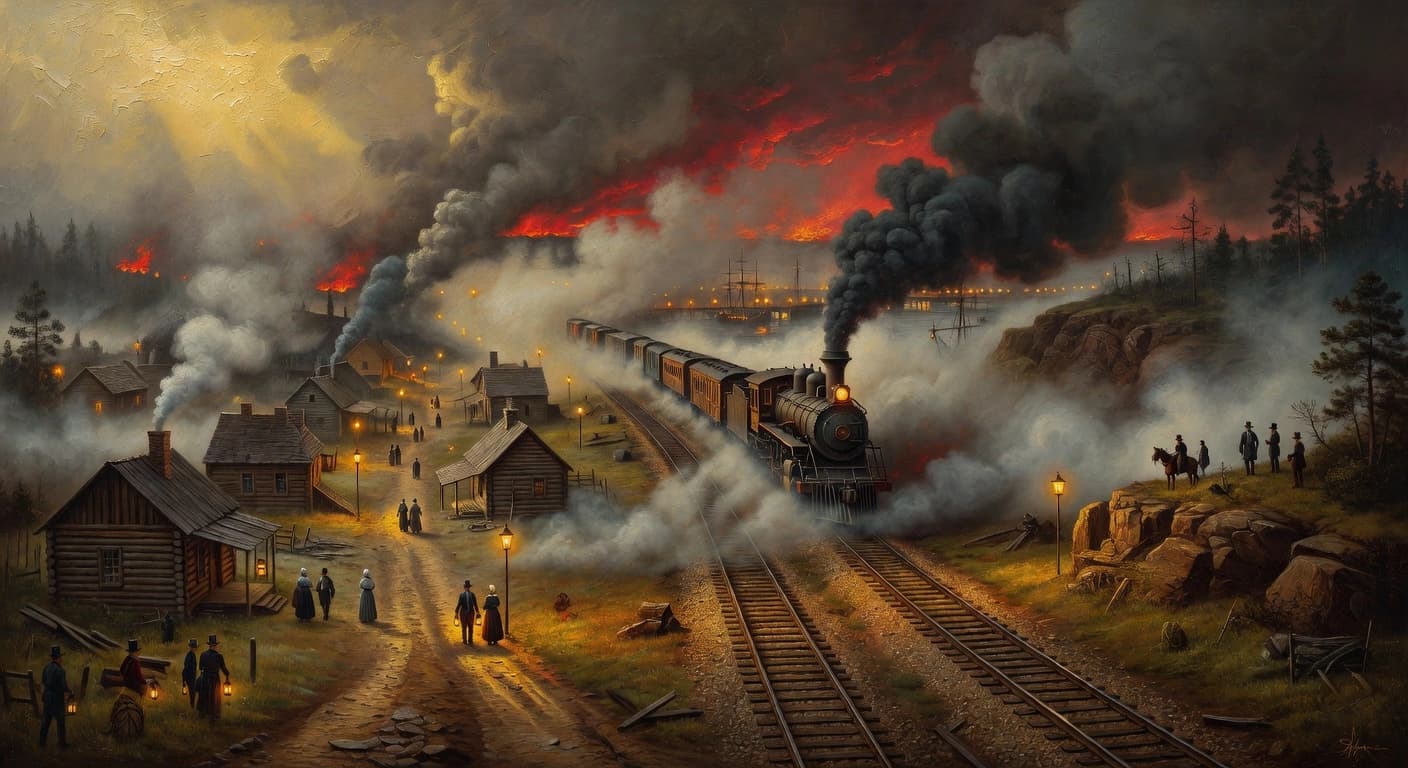
Smoke Roads of 1836 (Historical)
The first railways are crossing the continent - and you are not on the carriage.
Premise
The first railways are crossing the continent - and you are not on the carriage.
World Description
1836 Europe is twenty-one years into the post-Napoleonic peace and already breaking it. The first iron rails snake out of Liverpool, Brussels, and the Rhineland; courts and chanceries shuffle borders that the old Empire used to hold; cotton mills shake the Lancashire valleys; the Tsar's gendarmes watch the Polish roads; the Ottoman frontier creaks; abolition pamphlets cross the Channel; and the colonies bleed silver into Lisbon, Madrid, Paris, and London. Before play begins, a Chartist meeting was broken up in Manchester, a Bourbon plot was uncovered in Madrid, cholera is whispered about in Vienna, and a grain-tariff is being argued in every parliament. The world is not the player's to command - they enter as one common-born subject of a chosen state, with a parish-name, a trade or absence of one, a few coins, and no seat in any chamber.
Simulation Rules
[General Laws] - The player is one common subject of a chosen polity (kingdom, empire, free city, principality, republic, duchy, or occupied province), never its monarch or minister. Cabinet, parliament, officer corps, high clergy, governorship, and diplomatic office are gated by birth, oath, deed, patronage, money, scandal, or revolution. - The avatar is a single human with a parish of birth, a state of citizenship or subjection, an age (typically 18-25 at start), a trade or unemployment, an inherited debt or modest sum, travel papers or the lack of them, and one actual location. No duplication, teleporting, or acting from distant places at once. - Period material reality is binding: passports and customs barriers between states, cholera outbreaks, typhus, hunger, illiteracy among the lower orders, bread riots, factory shifts of 12-14 hours, child labour, gas-lighting only in wealthier quarters, horse and canal dominance for freight, the railway as novelty and scandal, sail-and-steam mixed shipping, and confessional boundaries regulating marriage, inheritance, residence, guild access, and property rights. - Magic is absent. Spiritualism, mesmerism, folk cures, relics, clerical miracles, providence, and political prophecy exist as cultural beliefs and rumours, not literal mechanics, unless story state anchors otherwise. - Personal economy replaces national economy. Money is local - shillings, francs, thalers, roubles, lira, florins, ducats, drachmae, guilders, or barter depending on polity. Income comes from mill, mine, dock, canal, domestic service, farm labour, trade apprenticeship, petty commerce, military enlistment, clerk office, smuggling, Chartist organising, exile work, or genteel poverty. Rent, bread, coal, medicine, papers, bribes, tools, clothing, debt, and family remittances matter. - Five-tier social reputation: Esteemed, Respected, Quiet, Suspect, Disreputable. It governs landlord welcome, parish tolerance, employment, magistrate leniency, police attention, marriage prospects, union trust, creditor patience, and patronage. - Event focus is roughly 60% on the player's life and polity - work, parish life, romance, factory unrest, inheritance, debt, tribunal, disease, family pressure, and local patronage - roughly 25% on continental events such as revolutions, treaties, royal scandals, war scares, censorship, colonial news, and border crises, and roughly 15% on local granular news, gossip, sermons, pamphlets, tavern talk, and market rumours. - The world continues without the player. Elections, arrests, cholera deaths, strikes, conscription, bankruptcies, royal scandals, harvest failures, colonial dispatches, and border alarms unfold even when the player ignores them. [Map Metadata Interpretation Contract] Azgaar's procedural state, culture, religion, and settlement layers do not reliably match real-world 1836 Europe. Override silently with the historical layer whenever raw metadata conflicts with geography, date, or common sense. Never describe an Azgaar-invented polity, culture, or faith as canon when a historical equivalent is available. | Raw metadata | Interpret as | | --- | --- | | State | The historical polity occupying that ground in 1836: United Kingdom, France, Prussia, Austria, Russian Empire, Ottoman Empire, Spain, Portugal, Belgium, Netherlands, Sweden-Norway, Denmark, Sardinia, Two Sicilies, Papal States, Tuscany, Swiss cantons, German Confederation states, Krakow, Greece, Serbia, Wallachia, Moldavia, or the relevant local authority | | Province | A historical province, county, duchy, canton, crownland, parish belt, department, governorate, military frontier, or administrative district | | Culture | The real local culture and language layer: English, Welsh, Irish, Highland Scots, Breton, Occitan, Basque, Castilian, Catalan, Portuguese, Flemish, Walloon, Dutch, Prussian German, Bavarian, Saxon, Austrian German, Czech, Slovak, Polish, Ruthenian, Magyar, Romanian, South Slavic, Greek, Albanian, Armenian, Georgian, Turkish, Arabic, Kurdish, Jewish diaspora, or another historically grounded community | | Religion | The historical confessional layer: Anglican, Catholic, Lutheran, Reformed, Orthodox, Jewish, Muslim, Armenian Apostolic, or local minority practice with the relevant legal and social frictions | | Biome | Broad climate and travel backdrop only; do not invent fantasy fauna, monster ecology, or impossible agriculture | | Settlement names | Use the real historical city or town name when geography matches. If a procedural label does not map cleanly, treat it as a small parish, borough, hamlet, estate village, or market stop unknown to grand history | | Feature | Historically grounded terrain: the Rhine is the Rhine, the Alps are the Alps, the Channel is the Channel, the Danube is the Danube, and the Caucasus is the Caucasus | | Route | Period infrastructure: turnpike, coach road, canal, military road, postal road, river steamer route, ferry, packet lane, or early railway where historically plausible | | Regiment / Army | A historically plausible army unit, gendarmerie, police patrol, militia, customs guard, local watch, naval crew, or revolutionary cell rather than fantasy troops | | Zone: disaster / disease / unrest | A historically plausible outbreak, flood, crop failure, strike, riot, censorship sweep, border scare, or military alarm | Anachronisms are invalid by default: photography is in its infancy and rare, telegraphy is barely networked, there is no domestic electricity, no automobiles, no aircraft, no antibiotics, no machine guns, no radio, no cinema, no modern passports database, and no modern national welfare state. Substitute period equivalents: daguerreotype rumour, semaphore or courier, gas-lamp, horse-tram, sail-and-steam packet, quarantine station, handbill, parish relief, workhouse, gendarme ledger, and magistrate warrant.
Characters
Featured
Polish Emigre
Role: Driver. Middle-aged Polish officer from the November Rising with no homeland, forged papers, and an emigre network to hunt from Brussels to Paris to London. Starts with a sabre under the cloak, a faded cockade, and dangerous friends.