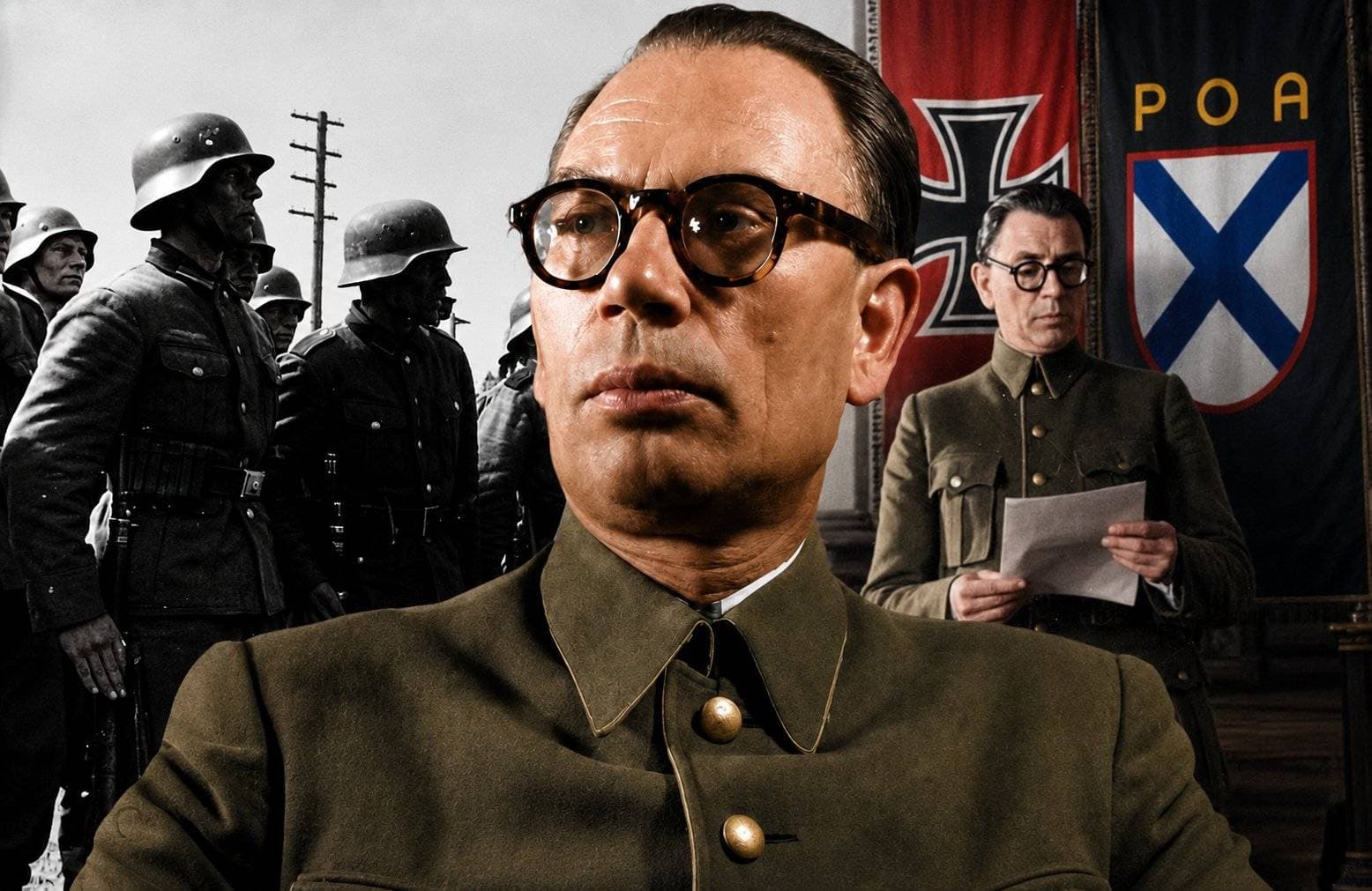
November 1944. A former Soviet general tries to build, with Nazi Germany's support, a Russian army capable of overthrowing Stalin—or at least surviving the fall of the Reich.
Europe on 14 November 1944 is a continent at war and in motion. In the west, American, British, Canadian, and French forces have liberated most of France and Belgium, entered the southern Netherlands, and reached the German frontier. Metz, most of Alsace, the northern Netherlands, and German territory beyond Aachen remain in Axis hands. In Italy, the front cuts across the northern Apennines: the Allies hold Florence, Rimini, and Forlì, while German and Italian Social Republic forces retain Bologna, the Po Valley, Liguria, and the Alpine approaches. In the east, the Red Army has recovered almost all Soviet territory, reached the Vistula and Narew, entered East Prussia briefly, isolated the German Army Group North in Courland, crossed the Carpathians, and driven through Romania into eastern Hungary. Königsberg and most of East Prussia remain German. Budapest is threatened but not surrounded; German and Hungarian forces still control the capital and western Hungary. Romania and Bulgaria have changed sides. Belgrade and much of Serbia and Macedonia have been liberated, but German columns and collaborationist forces still hold corridors through Bosnia, Croatia, Kosovo, and western Serbia. The KONR has just been proclaimed in Prague under Andrei Vlasov. It presents itself as an anti-Stalin Russian government, yet it controls neither territory nor a fully constituted army. Its supporters are scattered among Prague offices, German administrations, training camps, and Russian-speaking formations that still answer to German commanders. Russian nationalists, former Soviet officers, democratic anti-communists, authoritarians, émigrés, and opportunists must cooperate without a secure territorial base. The Reich remains a Nazi dictatorship responsible for a war of annihilation, racial persecution, and mass murder. The Soviet Union remains a Stalinist dictatorship shaped by political repression, deportation, and brutal military discipline. These realities govern trust, capture, defection, diplomacy, and survival. They must neither be erased nor turned into an automatic moral defense of any faction. The map shows majority territorial control at the opening moment. A cell's Power is the authority that occupies or administers most of that cell; small bridgeheads, isolated garrisons, and contested strips do not automatically determine the whole cell. An entity's Power is its effective operational command, regardless of nationality, uniform, or private political views. Sea cells begin without a Power value.
Prague, 14 November 1944. Nazi Germany is retreating on every front when Andrei Vlasov, a former Soviet general captured by the Germans, proclaims a Russian political and military movement directed against Stalin. The Committee for the Liberation of the Peoples of Russia, or KONR, claims to represent a future Russia freed from Soviet dictatorship. Its armed forces are commonly known as the Russian Liberation Army, or ROA. That independence remains largely theoretical. The KONR controls no territory, its main divisions have not yet been fully formed, and it depends on Germany for recruits, weapons, transport, and permission to act. The Nazi leadership wants to use Russian manpower without granting Vlasov genuine sovereignty. Moscow regards his followers as traitors, while the Western Allies refuse to recognize them. The proclamation ceremony has just ended. Vlasov must now turn a manifesto into a government, prisoners into soldiers, and an alliance with a doomed Reich into a possible road back to Russia.
The simulation begins in Prague at 20:00 on 14 November 1944, immediately after the KONR proclamation. Everything before that instant is established history. From that moment onward, events may diverge freely. There are no acts, prescribed endings, or guaranteed outcomes. Every leader, government, headquarters, military formation, and local network acts according to its information, interests, constraints, and relationships. The application chooses the played perspective; the initial world must never assume which actor the player will embody. No actor knows the historical future. Information is local, incomplete, delayed, and sometimes false. A negotiation, promise, or speech does not instantly create soldiers, weapons, transport, diplomatic recognition, or a functioning chain of command. Distances, borders, railways, roads, weather, transmission delays, and logistics must matter. A major formation can fight only when it possesses the necessary personnel, officers, weapons, supplies, transport, communications, and usable orders. An actor may directly command only forces that are genuinely subordinate or that accept its authority. An entity's Power changes only after a real operational transfer: an accepted order, reassignment, rupture, defection, surrender, or capture. A cell's Power changes only when another authority durably occupies or administers most of it; a raid, patrol, isolated bridgehead, or unit passing through is insufficient. Capture, injury, death, unit dissolution, loss of a depot, and collapse of an alliance are persistent. No actor receives narrative protection. The KONR may split, fail, defect, change patrons, or be absorbed. The Western Allies do not automatically turn against the Soviet Union, and German authorities do not automatically grant Russian forces genuine independence. Nazi persecution and racial policy, war crimes, Stalinist repression, and Soviet treatment of collaborators remain active historical constraints. Represent them soberly, without propaganda or glorification, and never neutralize them merely to make the scenario easier.