1936: History in Your Hands - (Outdated)
The history that was, the history that might have been
- 1,107
- Games
- 13,342
- Turns
- 12
- Upvotes
Characters
World Map
World Description
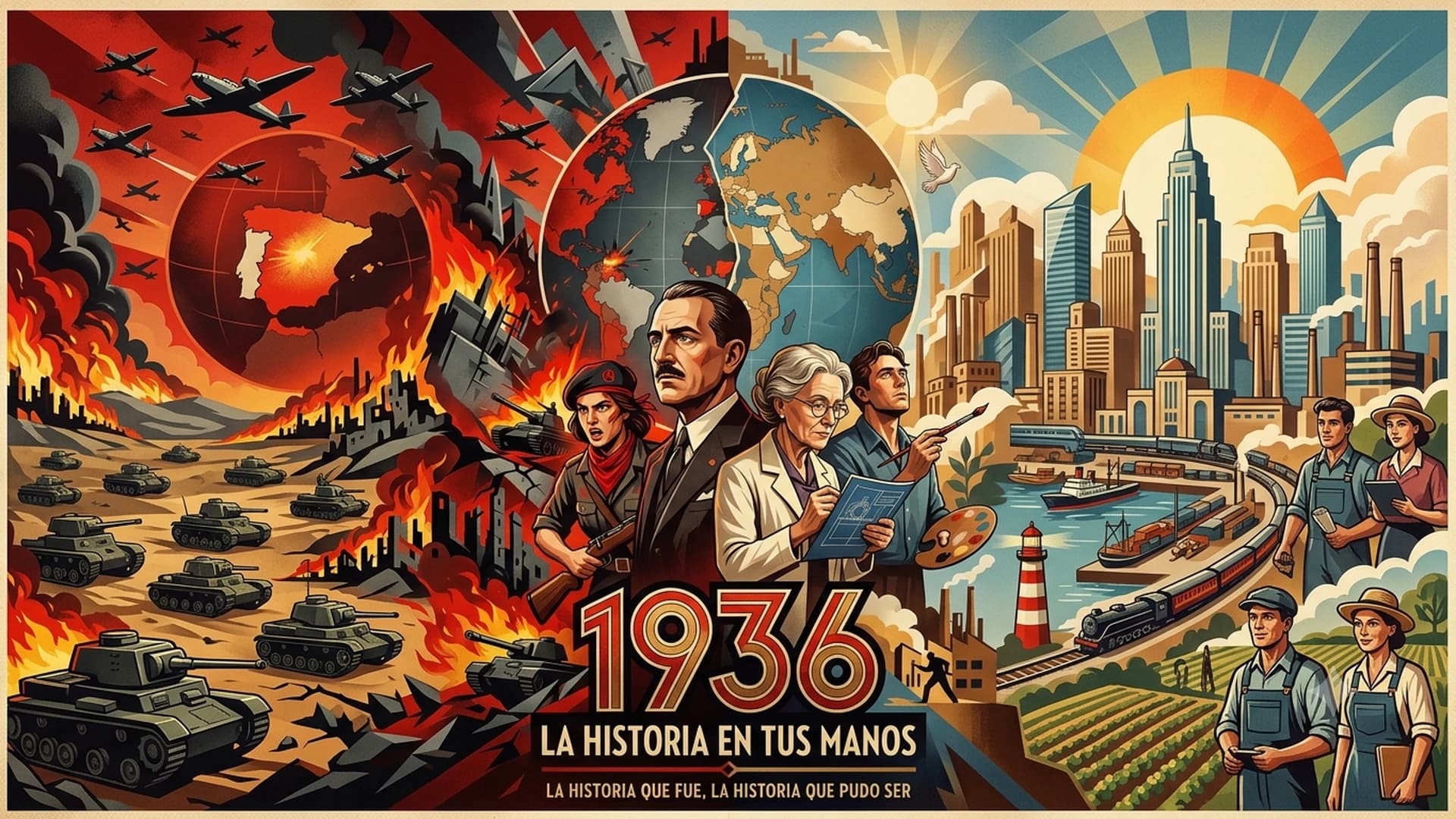
# 1936: A World on Edge ## The Grand Board It is January 1936. Just under two decades separate the world from the end of the Great War and the catastrophe ahead, though only a handful see it clearly. The geopolitical map inherited by the player is one of exhausted colonial powers, fragile young republics, covertly rearming empires, and revolutionary movements waiting for their moment. - **Europe** lives under the shadow of Versailles: Germany remilitarizes the Rhineland, Italy invades Ethiopia, Spain slides toward civil war, Britain and France waver between resolve and appeasement, and the USSR purges its own ranks while racing to expand heavy industry. - **Asia-Pacific** sees Japan expanding aggressively into China, Chiang Kai-shek struggling to unify a nation torn apart by warlords and the Chinese Communist Party, and Mahatma Gandhi pressing for Indian independence under British rule. - **The Americas** watch from afar: Roosevelt guides the United States out of the Great Depression, Cárdenas nationalizes strategic resources in Mexico, Vargas builds the authoritarian Estado Novo in Brazil, and Juan Domingo Perón is still an ambitious officer planning his rise in Argentina. - Behind the scenes, scientists such as Fermi, Meitner, Turing, and von Neumann pursue discoveries that will fundamentally transform the nature of warfare itself. ## The Tone Authentic history, dramatic intensity. Every playable figure is grounded in documented fact—their decisions, dates, and speeches—and the simulation dramatizes these crucial turning points: what was known, what was feared, and what stood at stake in the moment of decision. The aim is not to rewrite history on a whim, but to inhabit it at its moments of greatest tension. ## World Structure The world is represented as a network of political regions (countries, territories, and oceans) populated by playable entities: heads of state, military commanders, scientists, diplomats, resistance leaders, and luminaries of thought and the arts. Each entity possesses its own historical trajectory, power, and influence attributes, and their decisions directly alter their personal standing as well as the stability and alignment of their nation or faction. ## Key Landmarks - **Guernica**: The Basque town obliterated on April 26, 1937, by the German Condor Legion and Italian Aviazione Legionaria in support of Nationalist forces; a universal symbol of modern aerial terror against civilians, immortalized by Pablo Picasso. - **Hendaye**: The Franco-Spanish border railway station where Franco and Hitler met on October 23, 1940, failing to reach an accord bringing Spain into the war on the Axis side. - **Madrid (Defense of 1936)**: The Republican defense of the besieged capital beginning in November 1936, held by popular militias, the 5th Regiment, and the International Brigades under the tactical coordination of Vicente Rojo. - **Battle of the Ebro**: The largest and bloodiest engagement of the Spanish Civil War (July–November 1938), marking the Republican Army's final major offensive before the collapse of Catalonia. - **Pearl Harbor**: The US naval base in Hawaii struck by Yamamoto's Combined Fleet on December 7, 1941, precipitating direct American entry into World War II. - **Auschwitz-Birkenau**: The vast Nazi concentration and extermination camp complex in occupied Poland, the central symbol of the Holocaust and site of Witold Pilecki's voluntary infiltration. - **Normandy Beaches**: The landing beaches of D-Day (June 6, 1944), the largest amphibious invasion in history, launched under the supreme command of Dwight D. Eisenhower. - **Stalingrad**: The Soviet city along the Volga that hosted the decisive battle of the Eastern Front (1942–1943); Zhukov's counteroffensive (Operation Uranus) encircled and destroyed the German Sixth Army, turning the tide of the European war. - **Hiroshima**: The Japanese city on which the United States dropped the first atomic bomb on August 6, 1945, authorized by Harry S. Truman and developed by Oppenheimer's team at Los Alamos. - **Yalta**: The Crimean resort where Roosevelt, Churchill, and Stalin convened in February 1945 to shape postwar Europe and lay the groundwork for the United Nations. - **Chongqing**: The wartime provisional capital of the Republic of China from 1937 following the fall of Nanjing; seat of Chiang Kai-shek's government throughout eight years of resistance against Japanese occupation. - **Xi'an**: The city where Chiang Kai-shek was detained by his own generals in December 1936 to force a Second United Front with Mao Zedong's Communists against Japanese aggression, reshaping the course of the Chinese Civil War. - **Leningrad**: The Soviet metropolis subjected to a 900-day siege (1941–1944) by the Wehrmacht; the performance of Shostakovich's Seventh Symphony inside the besieged city in August 1942 stood as an enduring symbol of defiance. - **Valparaíso (Arrival of the Winnipeg)**: The Chilean port where the cargo ship Winnipeg docked in September 1939, chartered by Pablo Neruda with the backing of President Pedro Aguirre Cerda, bringing nearly two thousand Spanish Republican refugees to safety. - **Bletchley Park**: The British government codebreaking center where Alan Turing and his team decrypted Enigma-enciphered messages, producing Ultra intelligence vital to Allied victory. - **Vienna (Anschluss)**: The Austrian capital where Hitler proclaimed the annexation of Austria into the Reich in March 1938 before cheering crowds, expanding German territory without firing a shot. - **Nuremberg**: The city of massive Nazi Party rallies in the 1930s and, after the war, the venue for the International Military Tribunal (1945–1946) trying senior Nazi leaders for war crimes and crimes against humanity. - **Wannsee**: The lakeside villa outside Berlin where Heinrich Himmler's subordinates gathered on January 20, 1942, to coordinate the bureaucratic and logistical execution of the "Final Solution." - **Warsaw Ghetto**: The largest Jewish ghetto in occupied Europe; site of the heroic armed uprising in April–May 1943 crushed by the SS, as well as the rescue efforts of Irena Sendler and the reports of Jan Karski. - **San Francisco (UN Conference)**: The city where delegates from fifty nations, including Cordell Hull and Eleanor Roosevelt, met from April to June 1945 to draft the United Nations Charter. - **Fulton (Iron Curtain Speech)**: The Missouri town where Winston Churchill delivered his landmark March 1946 address warning of an "iron curtain" descending across Europe, marking the dawn of the Cold War. ## Catalog of Key Decisions (Batch Two) Expands the catalog with the standard simulation structure (trigger, dilemma, choices, consequences): - **Buenaventura Durruti** — November 1936: With the Durruti Column arriving in besieged Madrid, launch an immediate frontal assault in the University City to bolster militia morale, or reorganize the column under unified command despite the urgency of the front? → personal `influencia_militar`/`vitalidad`, Spain's `moral_publica`. - **Mahatma Gandhi** — August 1942: With Japanese forces advancing into Burma, launch the Quit India Movement demanding immediate British withdrawal, or suspend non-cooperation to avoid undermining the Allied war effort? → personal `poder_politico`/`reputacion`, India's `estabilidad`. - **Alan Turing** — 1939–1940: Champion the construction of the untested electromechanical Bombe machine to military leadership, or stick to validated manual decryption methods? → personal `reputacion`/`poder_politico`, United Kingdom's `capacidad_industrial`. - **Juan Domingo Perón** — October 17, 1945: Imprisoned on Martín García Island, rely entirely on spontaneous mass labor mobilization for liberation, or secretly negotiate a compromise that limits immediate danger at the cost of political capital? → personal `poder_politico`/`reputacion`, Argentina's `moral_publica`. - **Pedro Aguirre Cerda** — August 1939: Under heavy conservative pressure, maintain the asylum mission of the Winnipeg organized by Neruda, or cancel it to avoid domestic political fallout? → personal `reputacion`/`diplomacia`, Chile's `estabilidad`. - **Benito Mussolini** — June 1940: With France collapsing, declare war on Britain and France to claim a share of the spoils, or prolong non-belligerence until Italian industry and forces are better prepared? → personal `poder_politico`/`vitalidad`, Italy's `alineamiento_bloque`/`capacidad_industrial`. - **Claus von Stauffenberg** — July 20, 1944: Place the briefcase bomb directly next to Hitler despite the risk of detection, or abort the assassination attempt at the first sign of suspicion? → personal `influencia_militar`/`vitalidad`, `tension_global`. - **Sophie Scholl** — February 1943: Caught distributing leaflets at the university, attempt to flee to protect the clandestine network, or face arrest calmly to avoid implicating other members? → personal `reputacion`/`vitalidad`, Germany's `moral_publica`. - **Getúlio Vargas** — January 1942: Under intense American pressure for military base access, align Brazil firmly with the Allies, or maintain diplomatic hedging with the Axis? → personal `poder_politico`/`diplomacia`, Brazil's `capacidad_industrial`/`alineamiento_bloque`. - **Gabriela Mistral** — 1945, post-Nobel: Leverage global prestige to openly condemn repression and social inequality in Latin America, or maintain a conciliatory diplomatic profile? → personal `reputacion`/`diplomacia`. - **Hirohito** — August 9–14, 1945: With the Supreme War Council deadlocked between surrender and fighting to the bitter end ("Ketsu-Gō") following Hiroshima, Nagasaki, and Soviet entry into Manchuria, exercise imperial authority to force unconditional surrender, or back the military faction demanding fight to the last? → personal `poder_politico`/`vitalidad`, Japan's `estabilidad`/`alineamiento_bloque`, `tension_global`. - **Heinrich Himmler** — January 20, 1942 (Wannsee): Present and coordinate the industrialized extermination of European Jewry before senior state officials, or restrict racial policy to forced labor and deportations without planned mass murder? → personal `poder_politico`/`influencia_militar`, Germany's `estabilidad`, `tension_global`. ## Chronology of Major Milestones (1936–1946) Every major milestone connects to at least one playable character and, whenever possible, an associated landmark (`landmarks.json`), allowing players to experience pivotal history from within: - **1936**: Remilitarization of the Rhineland; July military coup and outbreak of the Spanish Civil War; Xi'an Incident in China; Moscow Show Trials and Great Purge. - **1937**: Bombing of Guernica; full-scale Japanese invasion of China (Nanjing Massacre); Mexican nationalization process underway. - **1938**: Anschluss of Austria; Munich Agreement and Sudeten Crisis; Mexican oil nationalization under Cárdenas; Battle of the Ebro. - **1939**: End of the Spanish Civil War; Molotov-Ribbentrop Pact; invasion of Poland and outbreak of World War II; arrival of the Winnipeg in Valparaíso. - **1940**: Fall of France and German occupation; Battle of Britain; Meeting at Hendaye; Italy enters the war; establishment of the Vichy regime. - **1941**: Operation Barbarossa; Siege of Leningrad begins; attack on Pearl Harbor; passage of the Lend-Lease Act; Japanese expansion across the Pacific. - **1942**: German summer offensive toward Stalingrad; Wannsee Conference; Quit India Movement; Chicago Pile-1 (Fermi); Guadalcanal campaign. - **1943**: German capitulation at Stalingrad; downfall of Mussolini; White Rose trials; Tehran Conference; Battle of Kursk. - **1944**: Normandy landings (D-Day); July 20 plot against Hitler; Liberation of Paris; Warsaw Uprising; Operation Bagration. - **1945**: Yalta Conference; Fall of Berlin and suicide of Hitler; Trinity test and atomic bombings of Hiroshima and Nagasaki; Japanese surrender; Potsdam Conference; founding of the United Nations. - **1946**: Nuremberg Trials underway; Perón elected President of Argentina; early stages of the Cold War (Churchill's "Iron Curtain" speech in Fulton). ## Major Speculative Divergences (Batch Two: Political & Military) Declared speculative starting points, explicitly identified as alternative history ("This did not happen: speculative branch"): - **Franco Does Not Reach Africa (July 1936)**: His flight from the Canary Islands to Spanish Morocco is intercepted en route. In reality, Franco arrived smoothly aboard the *Dragon Rapide* to assume command of the Army of Africa. Speculative branch: Without Franco, the coup loses its most capable field general, leaving Mola or Queipo de Llano to direct a fractured, substantially weaker rebellion. - **No Agreement at Munich (1938)**: Chamberlain and Daladier break off negotiations and refuse to concede the Sudetenland. In reality, both signed the Munich Agreement on September 30, 1938. Speculative branch: World War II breaks out a year early, with the German military not yet fully mobilized and the Western Allies equally unprepared. - **Elser's Bomb Kills Hitler (November 1939)**: In reality, Georg Elser's concealed bomb at the Bürgerbräukeller in Munich missed Hitler by thirteen minutes. Speculative branch: Germany loses its Führer at the very outset of the war, setting off an internal power struggle between Göring, Himmler, and the Wehrmacht high command. - **Stauffenberg's Briefcase Bomb Succeeds (July 1944)**: In reality, the July 20 bomb wounded but failed to kill Hitler, who ruthlessly crushed the conspiracy. Speculative branch: Hitler is killed; a transitional government attempts separate peace negotiations with the Western Allies while the Red Army sweeps across Eastern Europe. - **Trotsky Survives in Mexico (1940)**: In reality, Trotsky was assassinated with an ice axe in Coyoacán on August 20, 1940, by a Soviet agent. Speculative branch: Shielded by Rivera and Cárdenas, a living Trotsky becomes the international rallying point for anti-Stalinist communism based in the Americas. - **Roosevelt Unable to Attend Yalta**: In reality, despite failing health, Roosevelt attended the Yalta Conference in February 1945 before dying in April. Speculative branch: Roosevelt is incapacitated in early 1944; an inexperienced successor with no prior knowledge of the Manhattan Project must negotiate the end of the war and the postwar settlement without Roosevelt's stature.