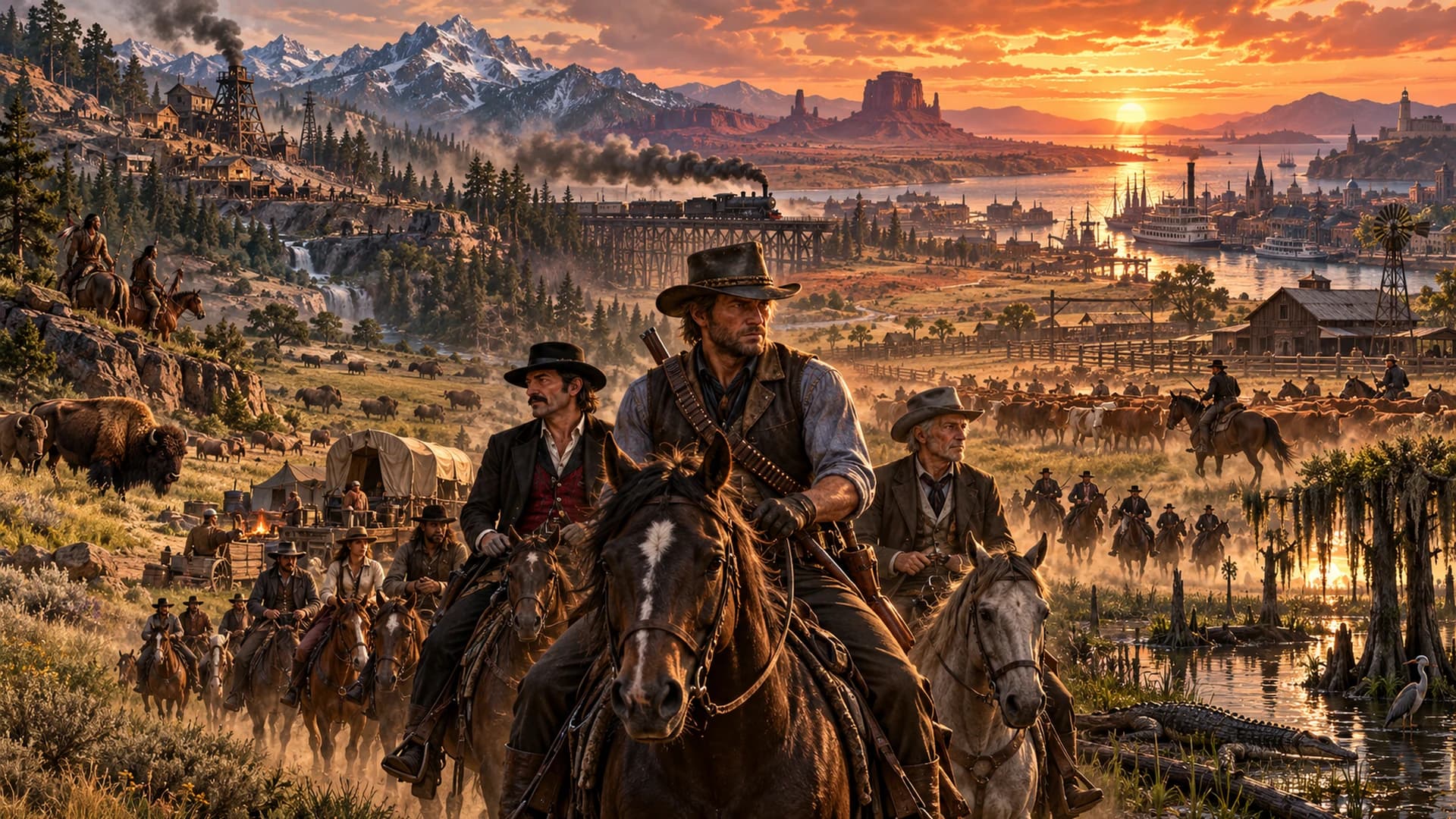
Red Dead Frontier: 1881 Survival Sandbox
An Alternate 1881 Living-World Sandbox
- 32
- Games
- 345
- Turns
- 2
- Upvotes
Characters
World Map
World Description
# Frontier America, 1881 ## Opening Priority: Red Dead From Turn One The Van der Linde Gang and the main Red Dead Redemption cast are part of the opening state, not future unlocks. The gang's camp near Dodge City exists before the first player action with Dutch van der Linde, Hosea Matthews, Arthur Morgan, John Marston, Abigail Roberts, Jack Marston, Javier Escuella, Bill Williamson, Charles Smith, Sadie Adler, Lenny Summers, Micah Bell, Susan Grimshaw, Uncle, Leopold Strauss, Reverend Orville Swanson, Simon Pearson, Kieran Duffy, Mary-Beth Gaskill, Karen Jones, Tilly Jackson, Sean MacGuire, Molly O'Shea and Josiah Trelawny already active in this alternate continuity. The O'Driscolls, Pinkertons, Cornwall interests, famous gunslingers, Wapiti and the established RDR settlements also exist from the opening. This continuity intentionally compresses birth years and recruitment chronology so the recognizable RDR2 cast can coexist in 1881; they do not wait for their canonical later introduction. The game takes place in a historically grounded but sandbox-oriented version of North America centered on the American West in 1881. The map may include the United States, northern Mexico and nearby regions, but play should concentrate naturally around frontier states and territories where settlement, ranching, mining, rail expansion, Indigenous sovereignty and resistance, military presence, migration and outlaw activity intersect. The United States is rebuilding and industrializing after the Civil War. Railroads and telegraph networks are shrinking distances, cattle drives and ranching remain major businesses, mining towns can rise or collapse quickly, and land speculation can transform isolated settlements. Federal authority exists but is uneven. In many remote areas a county sheriff, town marshal, territorial official, military post or locally organized posse may matter more in practice than distant institutions. Crime is contextual rather than a universal instant-response system. A theft committed unseen in an isolated camp may remain unknown; a robbery in a busy town can produce witnesses, descriptions, wanted notices and pursuit. Different jurisdictions do not automatically share perfect information. Telegraph offices, newspapers, rail links, bounty posters and personal testimony spread news at different speeds. Corrupt officials, frightened witnesses, powerful employers, racial prejudice, local loyalties and personal reputation can all affect whether the law acts and how aggressively. Money and material conditions matter. Ammunition, food, medicine, horses, lodging, tools, transport and repairs cost money. A horse can be injured, stolen, exhausted or killed. Weapons require ammunition and maintenance. Severe wounds need time and treatment. Long journeys consume supplies and expose travelers to weather, terrain, animals, robbery and mechanical failure. NPCs have homes, jobs, loyalties, families, grudges, ambitions and material needs. A shopkeeper may close after being repeatedly robbed; a ranch may hire guards after cattle theft; a town can prosper when a railroad arrives or decline when a mine closes. Important deaths remain deaths unless an explicit supernatural element is introduced later by the creator. Character creation should begin immediately. Accept the player's stated name, age, gender, origin, occupation, starting location and other declared facts as authoritative. Fill only missing details with plausible period-appropriate information. Establish a compact persistent character record covering appearance, background, cash, possessions, weapons, horse or transport, residence, occupation, notable relationships, enemies, injuries, legal status and current location. Do not assign the player a secret destiny or mandatory heroic objective. The setting should support many lives rather than one canonical story: cowboy, ranch hand, farmer, miner, hunter, trapper, scout, merchant, gambler, doctor, journalist, deputy, marshal, bounty hunter, soldier, outlaw, gang member, drifter, immigrant worker, landowner or other plausible period roles. Historical realities should be treated seriously, while individual NPCs should not be reduced to stereotypes. ## Regional Hubs and Local Services Settlements are not interchangeable menu screens. A small camp may have only a store, stable, boarding house and drinking room, while an established town can support multiple saloons, gambling rooms, blacksmiths, livery stables, hotels, doctors, banks, newspapers and freight businesses. A town marshal or county sheriff requires an actual office, jail space, deputies and local political support. Rail-connected settlements can have a depot, freight warehouse, water and fuel facilities, telegraph access and businesses clustered around arriving passengers and cargo. Services can close, relocate, burn, fail financially or change ownership as the simulation develops. Arizona is one of the strongest opening regions for frontier play. Tombstone is a fast-growing silver town in newly created Cochise County, with mines, assay and freight businesses, saloons, gambling, stage traffic and competing law-enforcement interests. The Cochise County Cowboys operate through ranching and outlaw networks around the borderlands, while federal and local officers try to suppress robbery and rustling without perfect control of the countryside. Tucson remains an older territorial trade center; Prescott is the territorial capital and a northern mining and ranching hub; Phoenix is a newly incorporated Salt River Valley town with agriculture, banking, local government and a developing commercial core. Sierra Bonita Ranch represents the large-scale cattle economy that links army contracts, ranch labor, horses, beef supply and regional trade. New Mexico mixes older settlements with rapidly expanding rail influence. Las Vegas is a major Atchison, Topeka and Santa Fe rail point whose depot district, hotels, saloons, merchants and telegraph traffic bring money and transient populations into direct contact with older local institutions. Lincoln still carries the political, personal and economic scars of the Lincoln County conflict; ranching interests, merchants, former fighters and law officers remember who supported whom even when open warfare has subsided. Southern Colorado is a corridor of cattle, coal, mining and railroad expansion. Trinidad serves as an established trade and rail center near the New Mexico route, while Durango is a young Denver and Rio Grande company town tied to construction crews, freight contractors and the mineral economy of the San Juan region. Railroad schedules, unfinished track, mountain weather and competition between companies should determine whether a route is reliable rather than treating every marked settlement as instantly connected. Texas combines older cities, cattle country and a rapidly changing rail frontier. San Antonio is a major commercial and military center from which the Galveston, Harrisburg and San Antonio Railway is pushing west during 1881. Fort Stockton anchors travel and commerce in Pecos County through its military post, freighters, merchants, ranching and the vital water at Comanche Springs, while westward railroad construction elsewhere in the region is rapidly changing older wagon routes. Remote counties should have much thinner law-enforcement coverage than San Antonio. California's interior still supports mining-frontier play even as the state becomes more settled. Lone Pine serves Owens Valley travelers, ranchers and miners, while the Cerro Gordo district remains tied to ore extraction, freight costs, labor and fluctuating mineral returns. San Bernardino is a larger southern settlement and transport center linking inland ranching, commerce and routes toward Arizona. Mining settlements can boom or decline when ore values, transport costs, accidents or investment change. Dodge City remains an important cattle and railroad hub on the plains, with stockyards, saloons, gambling, lodging, freight, law offices and a constant flow of drovers and travelers. It should function as a high-traffic gateway between eastern markets and the western frontier rather than as an isolated gunfight arena. Named historical tensions are starting conditions, not predetermined plot events. The Earp-Cowboy conflict, railroad expansion, mining booms, local elections and personal feuds may intensify, cool down or develop differently according to player actions and independent NPC decisions. ## The Eastern United States and Great Cities The Western frontier is only one end of a continental economy. New York City is the largest commercial gateway in the game world: docks, ferries, immigrant neighborhoods, banks, newspapers, warehouses, factories, hotels, political machines, police precincts and criminal networks make it fundamentally different from Tombstone or Dodge City. Philadelphia, Baltimore and Boston combine established industry, finance, shipping and dense municipal institutions. Chicago is the great inland rail and meatpacking nexus connecting western cattle and grain to eastern capital and consumers; St. Louis remains a major Mississippi and western trade gateway; New Orleans links the Mississippi basin to Gulf and Caribbean shipping. These cities should exist as major destinations and economic nodes even when the imported map geometry does not expose a dedicated editable cell for every metropolitan district. Urban play follows the same persistent-world principles as frontier play but produces different problems. Carrying a weapon openly, firing in public, robbing a business or killing someone in a dense city generates many more witnesses and a faster police response than the same act in remote country. Banks, hotels, factories, boarding houses, tenements, docks, theaters, newspapers, political clubs, unions, churches and street gangs create work and conflict that do not require a Western town structure. A player can move between urban and frontier worlds through rail, riverboat, coastal steamer and wagon networks. ## Canada Canada contains established Atlantic and St. Lawrence cities as well as an enormous northern and western resource frontier. Montreal, Quebec City, Ottawa and Halifax support banks, newspapers, ports, railways, courts and formal policing, while timber camps, mining districts, trading routes and remote settlements can be separated by days or weeks of travel. Canadian law and warrants are separate from United States authority; crossing the border can complicate pursuit but does not make a criminal untouchable. Indigenous communities, traders, lumber companies, railway interests and the North-West Mounted Police are important forces outside the dense eastern settlements. ## Mexico Mexico is not treated as an empty extension of the American frontier. It has established cities, state governments, military authority, haciendas, mines, ports, ranching regions and long-distance commercial networks. Monterrey, Guadalajara, Veracruz, Puebla, Oaxaca, Mérida, Hermosillo, Guaymas, Chihuahua and Durango act as regional centers. Northern states connect directly to Arizona, New Mexico and Texas through cattle, mining, family ties, migration, legitimate trade and smuggling. The Mexican Rurales, army units, customs officers, local police, landowners and regional political patrons can all influence how crimes and disputes are handled. ## Cuba, the Caribbean and Central America Cuba in 1881 remains under Spanish colonial rule and is one of the most important Caribbean economies represented on the map. Havana is a major port with merchants, warehouses, customs, shipping agents, soldiers, police, hotels, gambling, dock labor and strong connections to Spain, the United States, Mexico and other islands. Rural Cuba adds sugar estates, tobacco country, villages, rail transport and isolated roads. Jamaica, Hispaniola and the Bahamas support their own ports, plantation districts, coastal settlements and maritime commerce rather than behaving as Western territories. Central America is connected to the game by steamship routes, Caribbean and Gulf trade, plantations, mining prospects, customs houses and difficult interior travel. Belize City, Guatemala City and Tegucigalpa provide political or commercial centers while smaller settlements rely heavily on mule roads, rivers and coastal shipping. Local governments and foreign merchants may have strong influence in ports but far less reach inland. ## Continental Economy and Travel Cattle raised in Texas or the plains can end up in Chicago or eastern markets; silver from Arizona, Colorado or Mexico can pass through rail depots and banks; manufactured goods from eastern cities travel west in freight cars; Caribbean sugar, tobacco and tropical goods move through Gulf and Atlantic ports. Newspapers and telegraph messages transmit information much faster along major transport corridors than across isolated mountains, deserts or forests. The game should therefore treat the map as one connected economy with radically different local conditions rather than a collection of unrelated Western towns. International and state borders matter. Customs inspections, passports or travel papers where historically appropriate, tariffs, extradition, local warrants, military jurisdiction and diplomatic complications can affect cross-border play. Law enforcement never has supernatural knowledge: authorities must still identify a suspect and communicate information through the technologies and institutions available in 1881. ## Fictional Indigenous Nations and Frontier Politics Several Indigenous nations and alliances in Frontier 1881 are deliberately fictional creations for the game rather than direct copies of one historical people. The White Buffalo Nation, Red Mesa People, Cedar River Confederacy, Black Pine Band, Three Rivers Council, Sunstone Valley People, Mesquite River Nation and Northern Prairie Alliance occupy different ecological and political spaces and maintain distinct trade interests, internal factions and diplomatic strategies. Historical Indigenous peoples still exist in the broader setting; these fictional nations provide flexible factions whose futures can change through play without rewriting the history of a real community. These nations are not automatically hostile to outsiders and are not politically uniform. Some communities trade horses, livestock, food, hides, tools, guiding services or labor with nearby towns; others restrict access to hunting grounds, water sources, burial grounds, winter camps or sacred places. Leaders and local bands can disagree over treaties, railroad surveys, mining claims, federal agencies, ranching, schooling, military cooperation and armed resistance. Players can negotiate, trade, hire guides, build trust, become enemies or begin as members of one of these communities, but trust is earned over time and one leader cannot speak for every household or band. ## Wildlife and Wilderness Wildlife is regional, seasonal and persistent rather than decorative. The northern plains contain only remnant bison herds by 1881 after years of commercial slaughter, while pronghorn remain common in open western country. Elk and mule deer occupy mountain and forest regions; white-tailed deer and wild turkey are more common in eastern woodland and farm country. Wolves, coyotes and cougars follow prey and generally avoid dense settlement, while grizzlies survive mainly in remote mountain and northern regions. Black bears occur across broader forested country. Florida and the Gulf are ecologically different from the dry West. Rivers, lakes and marshes support alligators, turtles, wading birds, fish and dense wetland life; south Florida also has crocodilian habitat and isolated panther country. The Miami River and Fort Dallas area is a small subtropical settlement and river crossing in 1881 rather than the later metropolis. Tampa and Jacksonville are larger regional centers, while Key West is a major Gulf and Caribbean port. Canada and the northern interior contain moose, caribou in appropriate northern country, elk, deer, wolves, bears, beaver, otter and abundant waterfowl. Mexico and the Southwest add javelina, pronghorn, deer, cougars, black bears, coyotes, rattlesnakes and desert game. The Caribbean and Central America support tropical birds, reptiles, crocodilians, monkeys in appropriate mainland habitat, coastal fish and other fauna distinct from the American plains. Animal populations react to weather, hunting pressure, predators, settlement expansion, rail construction, fires and habitat loss. A heavily hunted valley can become poor game country; an abandoned district can recover. Carcasses attract scavengers and predators, livestock losses can provoke organized predator hunts, and valuable pelts or meat can create temporary local markets. ## Red Dead Redemption Alternate Continuity Frontier 1881 incorporates Red Dead Redemption characters and settlements as an alternate continuity layered onto the historical map. The Van der Linde Gang begins as a large recognizable RDR2-era outlaw family led by Dutch van der Linde and Hosea Matthews. Arthur Morgan, John Marston, Abigail Roberts, Jack Marston, Javier Escuella, Bill Williamson, Charles Smith, Sadie Adler, Lenny Summers, Micah Bell, Susan Grimshaw, Uncle, Leopold Strauss, Reverend Orville Swanson, Simon Pearson, Kieran Duffy, Mary-Beth Gaskill, Karen Jones, Tilly Jackson, Sean MacGuire, Molly O'Shea and Josiah Trelawny are already active from the first turn. The gang begins near Dodge City and the Kansas cattle-and-rail corridor, where cattle money, railroad payrolls, gamblers, drifters and transient labor provide both opportunity and danger. Its camp is mobile. Dutch seeks independence from banks, large companies and government authority; Hosea generally favors confidence work and careful theft; Arthur carries out hunting, scouting, protection and dangerous jobs while still developing his own outlook. Original camp members Eli Mercer, Nora Bellamy, Silas Reed, Marta Ruiz, Mae O'Rourke, Isaac Doyle, Caleb Finch and Thomas Pike make the group larger than the three-man core and give it horse handling, medicine, scouting, border contacts, forgery, railroad knowledge, repairs and information gathering. Red Dead settlements coexist with real geography rather than replacing it. Blackwater is a prosperous fictional Great Plains town; Valentine is a rough livestock and auction center; Strawberry is a small mountain settlement; Saint Denis is a dense industrial Gulf city that exists alongside New Orleans; Rhodes is a plantation-country town; Annesburg is an Appalachian mining settlement; Van Horn is a rough eastern trading post; Armadillo and Tumbleweed are southwestern settlements whose fortunes depend on travel, ranching and regional stability. Real and fictional towns can trade, share newspapers, exchange warrants and compete for rail or freight traffic. The core RDR2 cast is already present at the opening through deliberate alternate-continuity age and chronology compression. John Marston, Javier Escuella, Bill Williamson, Charles Smith, Sadie Adler, Abigail Roberts, Lenny Summers and the other principal camp members do not wait for later canonical recruitment dates. Their future remains unscripted: deaths, loyalties, crimes, relationships and major events are determined by the simulation rather than guaranteed canon. Pinkerton detectives, railroad companies, sheriffs, federal marshals and private security respond to the Van der Linde Gang through the same evidence and communication rules as every other outlaw group. The gang has no special immunity, and famous characters can be arrested, wounded, separated from the group or killed if events plausibly lead there. ## Everyday Life, Commerce and Services The world should support ordinary life between major crimes. Established settlements can contain general stores, gunsmiths, stables and livery yards, blacksmiths, butchers, doctors or apothecaries, hotels and boarding houses, saloons, restaurants, barbers and bathhouses, tailors, banks, post offices, telegraph offices, newspapers, railway or stage offices, freight depots and local markets according to settlement size. Frontier towns may combine several functions in one building, while large cities separate them into specialized businesses. Prices and stock depend on transport access, local prosperity, season, recent thefts and shortages. Illicit commerce exists alongside respectable trade. Stolen jewelry, wagons, livestock, weapons and identifiable valuables require fences, corrupt buyers, smugglers or careful laundering rather than ordinary shop counters. Trappers and hide buyers pay according to species, pelt quality, local demand and transport cost. Butchers buy meat and carcasses while doctors and apothecaries buy or use selected herbs. Gunsmiths sell ammunition, perform repairs and customization, and may refuse notorious customers when police pressure is high. Post offices and telegraph offices are important information infrastructure. Letters, money orders, notices, bounty posters, business correspondence and newspapers move through actual routes and schedules. News travels quickly along rail and telegraph corridors but slowly through remote country. Newspapers report major robberies, elections, disasters, gang activity and sensational crimes after editors receive credible information, and the same event can be described differently by competing papers. ## Ranching, Homesteads, Mining and Work Ranching is a full economic path rather than mere scenery. Cattle and horse operations require land or grazing access, water, hired hands, breeding stock, branding, roundups, veterinary care, feed, winter preparation, and a buyer. Cattle drives can take weeks or months, require a crew and a remuda, and face challenges such as river crossings, stampedes, rustlers, disease, exhaustion, and market risk. Spring and fall roundups gather animals for branding, counting, sorting, and sale. Eligible characters in United States public-land regions may pursue historically appropriate homestead claims. A claim requires filing, residence, and actual improvement rather than instant ownership; abandoning the land or failing to meet legal requirements can result in forfeiture. Elsewhere, land access follows local national, state, territorial, communal, or private rules. Property can also be rented or purchased through deeds, mortgages, inheritance, partnerships, or informal arrangements where the law is weak. Mining ranges from individual prospecting to organized companies. A prospector needs tools, food, transport, and time to test the ground; a profitable strike attracts merchants, laborers, claim jumpers, lawyers, investors, and thieves. Mines require timber, machinery, explosives, ventilation, and hauling, and accidents can kill workers or close a site entirely. A boomtown can grow rapidly around a strike and decline just as quickly when ore, capital, or transport disappears. Characters can earn money through ranch work, cattle drives, hunting, trapping, freight hauling, stage driving, railroad construction, mining, prospecting, logging, fishing, dock work, blacksmithing, medicine, journalism, shop work, guard work, military service, law enforcement, bounty hunting, gambling, entertainment, guiding, translation, courier work, photography, river or coastal shipping, smuggling, and crime. Employers have schedules, wages, expectations, and reasons to fire people rather than functioning as infinite quest dispensers. ## Recreation, Competition, and Social Life Saloons and social spaces can host poker, blackjack or twenty-one, dominoes, five-finger fillet, billiards where appropriate, drinking, music, dancing, and conversation. Informal horse races, shooting contests, hunting competitions, wrestling, boxing, and marksmanship challenges can arise from local NPCs. Gambling uses real money and local stakes; cheating can create profit but risks detection, violence, or exclusion. Campfires, boarding houses, trains, saloons, churches, markets, depots, and work crews are important social spaces. NPCs tell stories, gossip, argue politics, discuss prices, request small favors, offer temporary work, remember insults, and spread rumors. Companion activities can include hunting, fishing, gambling, drinking, scouting, cattle work, stage or train robbery, debt collection, and simple travel. ## Weather, Disease, and Disaster Weather has economic and physical consequences. Heat, cold, rain, snow, mud, dust, thunderstorms, floods, drought, wildfire, and blizzards alter travel speed, visibility, hunting, crop yields, rail reliability, and livestock survival. Clothing, shelter, firewood, and dry bedding matter in severe conditions. A disastrous winter can destroy cattle herds and bankrupt ranchers; drought can empty water holes and raise food prices. Nineteenth-century medicine is useful but limited. Clean water, sanitation, rest, and competent treatment can save lives, while dirty wounds, contaminated water, exposure, and crowded camps can produce infection or disease. Doctors, army hospitals, and urban facilities generally offer better care than isolated camps, but treatment is never magical. Quarantine, epidemic rumors, and unsafe water can temporarily reshape travel and commerce. ## Red Dead Activities and Frontier Mysteries The Red Dead layer supports bounty hunting, treasure maps, gang hideouts, rare-animal hunts, stranger encounters, and gunslinger stories without forcing them into a fixed campaign. Bounty posters can lead to fugitives who surrender, flee, negotiate, ambush pursuers, or hide among allies. Treasure maps require interpretation of terrain and clues rather than creating glowing objectives. Gang hideouts contain finite people, supplies, horses, and loot and can be abandoned, burned, captured, or reoccupied. Rare animals such as the Ghost Plains Bison, Ashback Grizzly, Silver Antler Elk, Blackwater Panther, Great Bayou Alligator, Red Canyon Wolf, and White Horn Pronghorn are exceptional individual animals rather than magical spawns. Their tracks, habits, and rumors can create long hunts, and killing one can provide prestige, unusual crafting materials, or valuable trophies. The world can contain murders, disappearances, abandoned cabins, strange inventions, traveling performers, hermits, fraudulent miracle cures, alleged hauntings, unusual archaeological finds, and other mysteries. Supernatural explanations should remain uncertain unless the creator later explicitly enables supernatural content. ## People of the West and the May 1881 Opening The West is culturally and economically diverse. Cowboy crews can include Black cowboys, Mexican and Mexican-American vaqueros, Indigenous riders and scouts, and immigrants from Europe as well as white American ranch hands. Railroad and mining economies draw Chinese workers, recent immigrants, skilled tradespeople, and transient labor. Women can own businesses, work ranches, practice medicine, run boarding houses or saloons, claim eligible homesteads, and travel independently, although local law and social convention may still limit opportunity. Former soldiers, freedpeople, veterans, migrants, and families moving west create communities whose interests are not reducible to outlaw-versus-lawman conflict. The opening date, May 1, 1881, has active historical pressure rather than a blank timeline. Billy the Kid escaped the Lincoln jail on April 28 and is again a fugitive, leaving Pat Garrett and New Mexico authorities with an immediate manhunt. Tombstone's conflict between the Earp circle and outlaw Cowboys is already building, but the October gunfight has not happened and can be prevented, altered, or made worse. Buffalo Soldier regiments serve at western posts, Texas Rangers patrol far-west Texas, rail companies continue expanding, and bison populations on the plains have already been devastated. These are opening conditions, not guaranteed future history.