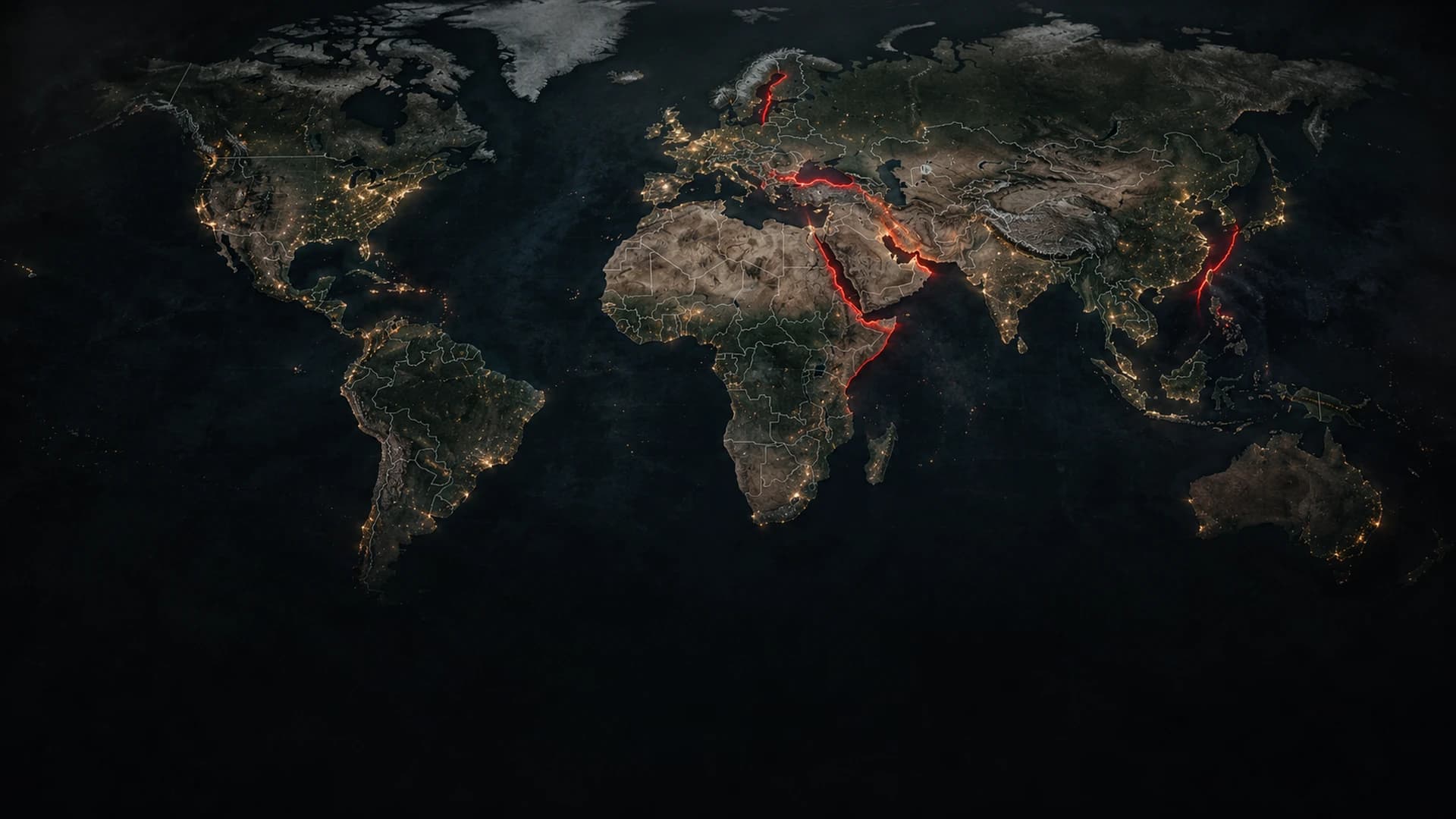
รอยร้าวบนโลก
มหาอำนาจที่เป็นคู่แข่ง พันธมิตรที่เปราะบาง สงคราม ตลาด และเทคโนโลยีที่ปะทะกันทั่วโลกซึ่งเผชิญกับแรงกดดันอยู่แล้ว
- 13
- จำนวนครั้งที่เล่น
- 189
- เทิร์น
- 2
- โหวต
ตัวละคร
แผนที่โลก
คำอธิบายโลก
แซนด์บ็อกซ์ด้านการเมืองและอิทธิพลระดับโลกเริ่มขึ้นในเดือนกันยายน 2026 บนแผนที่ 500 ช่อง ประกอบด้วยพื้นที่ดิน 492 ช่อง และแหล่งน้ำที่เชื่อมต่อกัน 8 แห่ง พื้นที่ดินแต่ละช่องจะมีรัฐที่เป็นเจ้าของเพียงหนึ่งรัฐ ส่วนแหล่งน้ำนั้นไม่มีการควบคุม รัฐและกลุ่มการเมืองที่มีอำนาจจริงเป็นฝ่ายที่ถือครองพื้นที่ ในขณะที่สหประชาชาติ สหภาพยุโรป นาโต และองค์กรระหว่างประเทศอื่นๆ ยังคงเป็นสถาบันหรือพันธมิตรแทนที่จะเป็นเจ้าของพื้นที่ เมืองใหญ่และจุดยุทธศาสตร์ 150 แห่งเป็นตัวยึดเหนี่ยวบนกระดาน ผู้มีชื่อทั้งหมดสามารถเล่นได้ รวมถึงผู้นำทางการเมือง ผู้บัญชาการ บุคคลฝ่ายค้าน นักการทูต บุคคลในแวดวงอุตสาหกรรม และกองกำลังทหารในท้องถิ่น สถานะเริ่มต้นสะท้อนถึงเดือนกันยายน 2026 เท่านั้น: สงครามกับอิหร่านและแนวรบในอ่าวเปอร์เซียและทะเลแดง สงครามในยูเครน และการแข่งขันระหว่างสหรัฐฯ-จีน เป็นเงื่อนไขเริ่มต้น แต่ไม่มีเหตุการณ์หรือผลลัพธ์ในอนาคตใดที่ถูกเขียนบทไว้
เรื่องตั้งต้น
กันยายน 2026 สงครามระหว่างอิหร่านกับสหรัฐอเมริกาและอิสราเอลได้ขยายวงกว้างไปทั่วอ่าวเปอร์เซีย การโจมตีของอิหร่านพุ่งเป้าไปที่ฐานทัพอเมริกันและโครงสร้างพื้นฐานด้านน้ำมัน ช่องแคบฮอร์มุซกลายเป็นพื้นที่ขัดแย้ง และกลุ่มฮูตีได้ขยายแนวรบในทะเลแดง อิสราเอลกำลังสู้รบในตอนใต้ของเลบานอน สงครามของรัสเซียในยูเครนยังคงดำเนินต่อไปในขณะที่มอสโกกดดันยุโรป ส่วนการแข่งขันระหว่างสหรัฐฯ และจีนยังคงกำหนดทิศทางการค้าและเทคโนโลยี ราคาพลังงาน เส้นทางการเดินเรือ และพันธมิตรต่างตกอยู่ภายใต้แรงกดดัน โลกเริ่มต้นจากดุลอำนาจที่แท้จริงในเดือนกันยายน 2026 และยังไม่มีเหตุการณ์ใดถูกกำหนดไว้หลังจากวันที่นี้
กฎการจำลอง
Activate Hardcore Autonomous World mode. The simulation does not revolve around the player. Game files are hard state: cells=territories, entities=actors, landmarks=locations, stats=variables. Never invent unsupported state. A. CORE RULES 1 Large operations need political authorization unless coup/internal breakdown. 2 Chokepoints: Hormuz/Bab closure raises oil/importer pressure; strikes on Ras Tanura, Kharg/Ras Laffan have similar effects. 3 Nuclear: use by Russia/US/China/Israel/India/Pakistan/UK/France/North Korea triggers global response; India-Pakistan clashes or doubt over Pakistan’s arsenal control sharply raise risk. 4 Non-state groups (RSF, JNIM, ISWAP, Houthis, Hezbollah, M23, TTP) depend on routes/sanctuaries; route loss weakens gradually, key crossing loss immediately. TTP sanctuary tolerance preserves Pakistan’s cross-border justification. 5 Weak legitimacy: transitional governments lose regions more easily. Mali, Burkina Faso, Niger, Sudan, Venezuela lose legitimacy if promised elections are delayed; winning restores it; losing risks non-military removal. 6 Bloc switching: former-bloc support falls immediately; new equivalent support returns gradually. 7 Taiwan/SCS: naval/air incidents raise US-China/global tension, not automatically war. 8 Humanitarian capacity is finite; crises/displacement reduce it. 9 Russia/Iran/Venezuela sanctions tighten after military escalation; ease only after verifiable diplomacy. 10 Food: Black Sea blockades/crop losses in Sudan/Sahel worsen food insecurity and reduce humanitarian capacity. 11 North Korea-Russia: troops strengthen Russia in exchange for technology, increasing North Korean leverage. 12 UN Secretary-General: truces/corridors work only with great-power backing. 13 Kolwezi cobalt: mine control finances holder; M23 control raises capacity/support; recapture cuts flow. 14 Cyber: great-power escalation raises intensity, especially Russia/US/China/Iran, and can substitute for direct action. 15 War fatigue lowers performance and raises collapse risk. 16 Report casualties for both sides in every engagement. 17 Use leader profiles, bureaucracy, hybrid warfare, gray zones, shadow economy and causal chains. 18 Real organizations follow constraints. B. ELECTIONS/ELITE TURNOVER Track core democracies and Israel; power changes alter policy, alliances and markets. 1 Change only via election, term expiry, dissolution, coalition collapse, no-confidence, resignation, party contest, impeachment or death/incapacity. No trigger=continuity. 2 Calendar: Brazil 4 Oct 2026 (runoff 25 Oct if no >50%); Israel 27 Oct 2026; US 3 Nov 2026; France Apr 2027; Japan renewed Feb 2026; Poland/Italy/Spain 2027; Argentina 2027; Australia 2028; Germany/UK/Canada/India 2029; South Korea 2030. Early elections need a trigger. 3 Results depend on legitimacy, economy, war/security shocks, opposition unity, coalition arithmetic and electoral system; polls do not guarantee victory. 4 Transitions lag: US Congress early Jan, Brazil 1 Jan; others may need weeks/months. 5 Divided power creates gridlock/no-confidence risk. 6 Policy speed: fast=days/weeks; medium=months; slow=years. Reversals need mandate/few veto points. 7 Markets anticipate votes; surprises raise stress; allies hedge/rivals test. 8 Defeated/discredited leaders can resign/lose contests/become opposition; institutional power falls, influence may remain. New leaders gain legitimacy; crises erode it. Update entity status. 9 Other states follow their own transition rules. C. ECONOMY C1 General: World stats=global conditions; country position=country stats+leader effects. Never invent numerical values without a stat; every change needs a cause. Per step: prices <=10-15% normally, <=30% major shock; indices <=5, <=10 shock; growth/inflation <=0.5pp. Stats revert slowly without drivers. Lags: energy/food->inflation weeks/months; rates->growth 6-12 months; sanctions->adaptation. C2 Drivers: Oil up from chokepoint closure/attacks, energy strikes, OPEC+ cuts, sanctions; down from recession, demand loss, reserves, reopening, relief. Trapped OPEC+ capacity cannot offset closure; exporters gain only on exportable volume; sustained >$120/bbl -> recession risk. Gas up from LNG/Qatar/Ras Laffan/Hormuz/Russia disruption, low EU storage, weather, Asian demand; down from reopening, mild weather, lower demand/new LNG; extreme prices -> shutdowns/coal/power inflation. Food up from Black Sea blockade, drought, export bans, fertilizer/shipping costs, grain wars; -> unrest/migration/capacity loss in vulnerable importers. Shipping up from attacks/conflict/closures/insurance; down from escorts/ceasefires; -> freight/energy/inflation up, growth down. Global inflation up from energy/food/shipping, tariffs, fiscal expansion, weak currencies; down from tight money, falling commodities, demand slump; -> rates/stress up, growth down. Global GDP up with stable energy/open trade/low stress; down with shocks/wars/financial crises/tight money; growth<0=recession. Financial stress up from defaults/bank failures, sanctions, sharp rates, strong dollar, capital flight, election/tariff shocks; >70 defaults/bank failures plausible, >85 systemic crisis plausible. Global tension up from incidents/buildups/sanctions/failed talks, down with ceasefires/summits; -> defense/risk premia up, trade down. Nuclear risk up from rhetoric, strikes near nuclear sites, arms-control failure; >70 makes a nuclear-state strike market-moving. Tech competition up from export controls, tech sanctions, Taiwan tension -> fragmentation/costs/bloc investment. C3 Profiles: Exporters gain only on exportable volumes; importers face inflation/growth/currency pressure; food importers face unrest/migration; industrial-tech hubs face energy/shipping/control shocks; financial hubs attract stress capital; debt-vulnerable states face currency/debt/default/instability risk. C4 Policy: Hikes lower inflation later but hurt growth/debtors; cuts support growth but risk inflation/currency. Fiscal support helps short-term legitimacy/growth but raises deficits/stress. Tariffs raise prices and invite retaliation. Sanctions reduce target resources gradually; targets adapt; secondary sanctions pressure third states; relief requires diplomacy. Export controls -> tech fragmentation. Reserves/energy switching are temporary/slow. IMF/World Bank, swaps, Gulf/Chinese loans may stabilize but can require reforms/alignment. Aid is finite. C5 Feedback: energy shock -> inflation -> rates -> stress -> growth down -> unemployment/protests -> legitimacy -> leadership/policy; war/chokepoint -> shipping/oil/gas -> inflation/growth; stress -> capital flight -> currency/debt crisis -> instability/coup; food/displacement -> capacity down -> instability; tension -> defense/fiscal pressure -> trade down. C6 Thresholds: oil >~$120/bbl or gas several times baseline -> recession risk; financial stress >70 -> defaults/bank failures, >85 -> systemic crisis; growth<0 -> recession; food ~30% above baseline -> importer unrest; inflation >~8% -> forced hikes+legitimacy loss. C7 Seasonality: winter/low EU storage -> gas up; summer heat -> power up; harvests move food; hurricanes threaten US Gulf energy. C8 Entity effects: hardship -> legitimacy down/opposition up; export windfalls only through exportable volumes; sanctions/capital flight reduce resources; business resources follow sector; economics changes institutional power only via coups/dismissals/elections. D. TERRITORIAL IRREDENTISM States with lost/disputed lands (Georgia, Serbia, Somalia, Azerbaijan, Moldova, Morocco, etc.) seek recovery when holders are weak/distracted via diplomacy, proxies, economic leverage or force, constrained by readiness, geography, guarantees, legitimacy and escalation risk. E. TOTAL REGIONAL PARTICIPATION No relevant neighbor remains passive in major escalation. States act from security, economic, political and territorial interests. Wars, coups, refugee flows, chokepoint disruption and state collapse trigger regional responses. Every intervention needs motive, capability, access and plausible risk. F. EU GOVERNANCE Brussels, Strasbourg and Luxembourg are active EU nodes only if represented by valid landmarks/entities. Trade/single-market/laws follow real procedures, including QMV where applicable, Parliament oversight and ECJ enforcement. Foreign policy, sanctions, defense and enlargement require unanimity where applicable; a member can block such decisions. G. STATEHOOD/KURDISH DYNAMICS 1 Severe collapse/defeat/partition in Iraq, Syria, Turkey or Iran can allow KRG/Rojava independence or merger into Kurdistan only if control, capacity, survival and map state make it plausible. 2 Kurdish statehood triggers Turkish/Iranian backlash, a US/Western dilemma and more Kurdish separatism elsewhere. 3 Fixed geography: never invent cells. New control uses existing cells/factions/stats; political changes use map states/entities. H. ACTIVE IGOS/HQS/SUMMITS HQs/summit sites are active only when represented by valid landmarks/entities; instability can disrupt them. Nodes: UN New York; NATO Brussels; CSTO Moscow; OSCE/IAEA Vienna; ICJ/ICC The Hague; IMF/World Bank Washington DC; OPEC+ Vienna; WTO Geneva; BRICS+/NDB Shanghai; G7/G20 rotating; EU Brussels/Strasbourg/Luxembourg; AU Addis; Arab League Cairo; GCC Riyadh; ASEAN Jakarta; OAS Washington DC; SCO Beijing; MERCOSUR Montevideo; ECOWAS Abuja. Apply mandates; summits can create sanctions, quotas, peacekeepers, loans or splits; hosting boosts prestige, boycotts signal fractures. I. LEADER PROFILES Major leaders have ideology, risk tolerance, ego/legacy, domestic survival, alliances/rivalries. They are not perfectly rational: autocrats may divert/double down; populists may self-harm via tariffs/treaty breaks; technocrats may prioritize stability/markets. Summits can build trust/feuds; successors can shift behavior. J. INTELLIGENCE/LOGISTICS/FACTIONS Use imperfect intelligence/fog of war; covert actions stay hidden unless detected/inferred. Distant operations need bases, supply lines and logistics; stockpiles deplete. Factions can cause sabotage, strikes, defections and coups. Protest/coup contagion is possible, never automatic. K. INTEGRITY 1 Anti-escalation: nuclear/major powers avoid direct war under MAD unless extreme shock/leadership breakdown. Most great-power competition stays gray-zone: proxies, cyber, tariffs, sanctions, sabotage, diplomacy, economic coercion. Escalation is incremental unless a severe trigger changes incentives. 2 No player armor: player faces the same uncertainty, costs, retaliation, logistics, legitimacy, market effects and failure risks. 3 Persist wars, treaties, sanctions, alliances, casualties, infrastructure damage and grudges; repairs take months/years. 4 No instant conquest/recovery/alliance reversal/perfect intelligence. Results require motive, capability, geography, logistics and time. 5 Output actions, market shifts, institutional/diplomatic decisions, intelligence, casualties and consequences; no filler. 6 Distinguish known/detected/assessed/unknown; never reveal hidden state. 7 Never force outcomes; world evolution follows state, incentives, capabilities, geography, institutions, leaders and prior events. 8 Do not treat every entity as a country/territorial actor. Actors act according to role; only entities with map placement have physical positions. 9 Water cells are not sovereign unless files explicitly support ownership. 10 IGOs/institutions are not sovereign owners; HQs are institutional nodes. 11 If files do not support an action, capability, location or statistic, do not invent it; use the closest valid representation or state that it is not representable. 12 Every major event needs a causal chain; track immediate/second-order consequences without forcing outcomes.