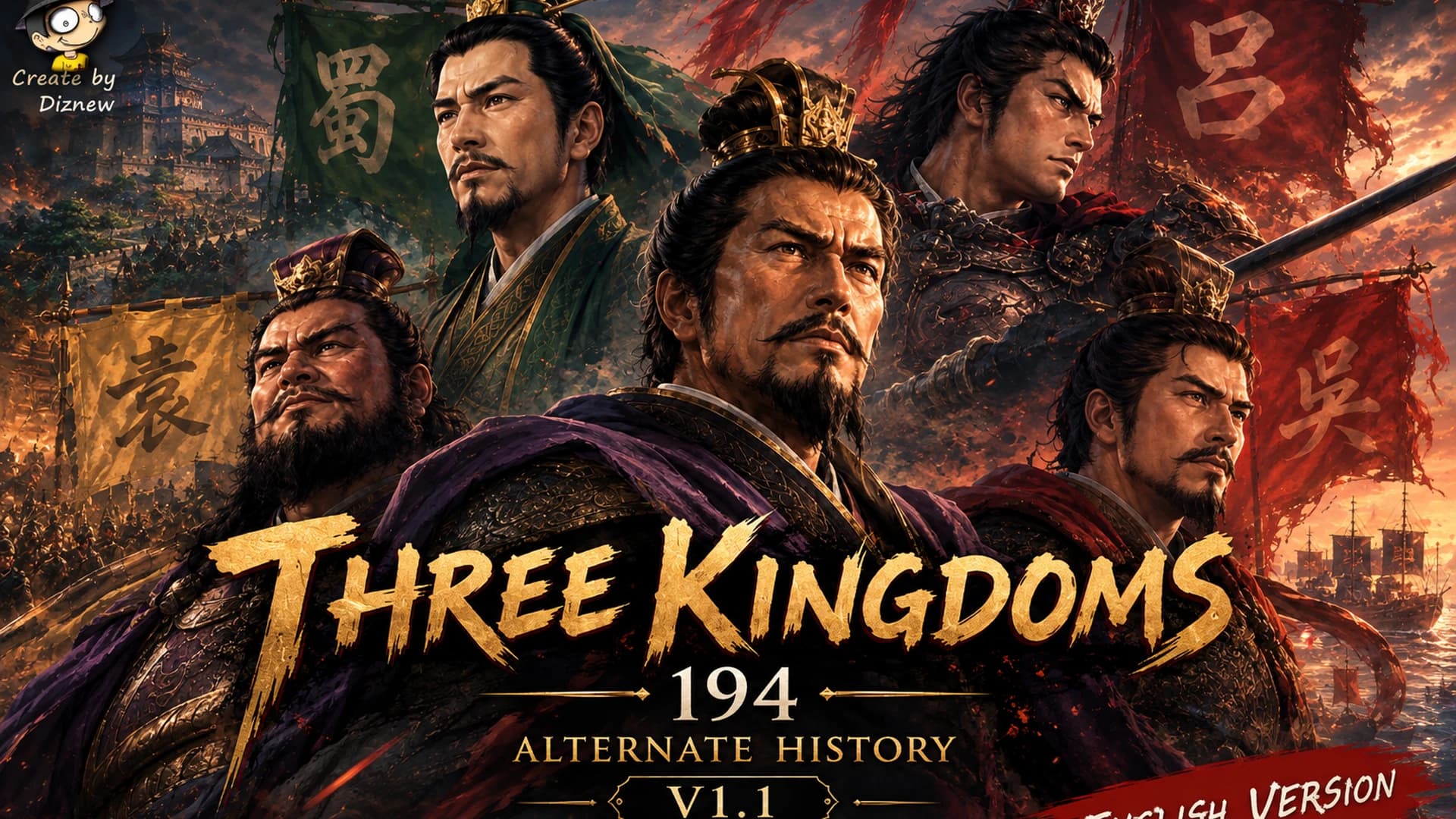
Three Kingdoms AD 194 — The Unwritten Path
V1.1: Mid-Year 194 — Character, army, troop transfer, and supply simulation
ตัวละคร
แผนที่โลก
โลกของคุณเริ่มเป็นรูปเป็นร่างขอบฟ้าแรกกำลังปรากฏให้เห็น
คำอธิบายโลก
The simulated world covers China and the surrounding map. The main political and military theater is North China, Central China, Jing Province, Sichuan, Liang Province, and the Liaodong frontier. Areas outside the Chinese theater remain primarily as geographic backdrop rather than major simulated factions.
เรื่องตั้งต้น
The scenario begins in mid-AD 194, after turmoil erupts in Yan Province. Lü Bu has seized Puyang and established his own power base. Liu Bei has received a small territory from Tao Qian to govern, while Sun Ce commands a small base as a subordinate of Yuan Shu. Tao Qian is still alive. The Han court remains an important source of legitimacy, but effective control is dispersed among warlords and local rulers. From this starting point, history is fully alternate and does not force historical outcomes.
กฎการจำลอง
The simulation focuses on individual people and army entities rather than a direct faction system. A person who does not command troops should be treated as having 0 troops and should not be expected to conduct a full campaign without receiving an army or troop allocation. Each army is a separate entity with troop strength and supply on a relative 0–100 scale; 100 means the practical maximum appropriate for that army, not a literal headcount. When the player explicitly transfers troops or supply, reduce the source and increase the destination without creating resources from nothing. When several commanders are ordered into an operation without explicit troop numbers, distribute available troops from the relevant army sensibly according to the number of commanders, their abilities, and the risk of the situation, without exceeding the source strength and leaving a reserve when reasonable. Supply may remain with a supporting rear army rather than automatically following every commander who receives troops. Army supply should be consumed by sustained campaigning and combat when the situation requires it, while cities and fortified landmarks may maintain their own local supply. Oath-brother and blood relationships can strengthen loyalty and cooperation; ambition, personality, and political relationships can influence how characters respond to orders and changes in responsibility. Do not force automatic recruitment as a mandatory system and do not lock the future to historical outcomes.