Rome: Republic at War (remixed)
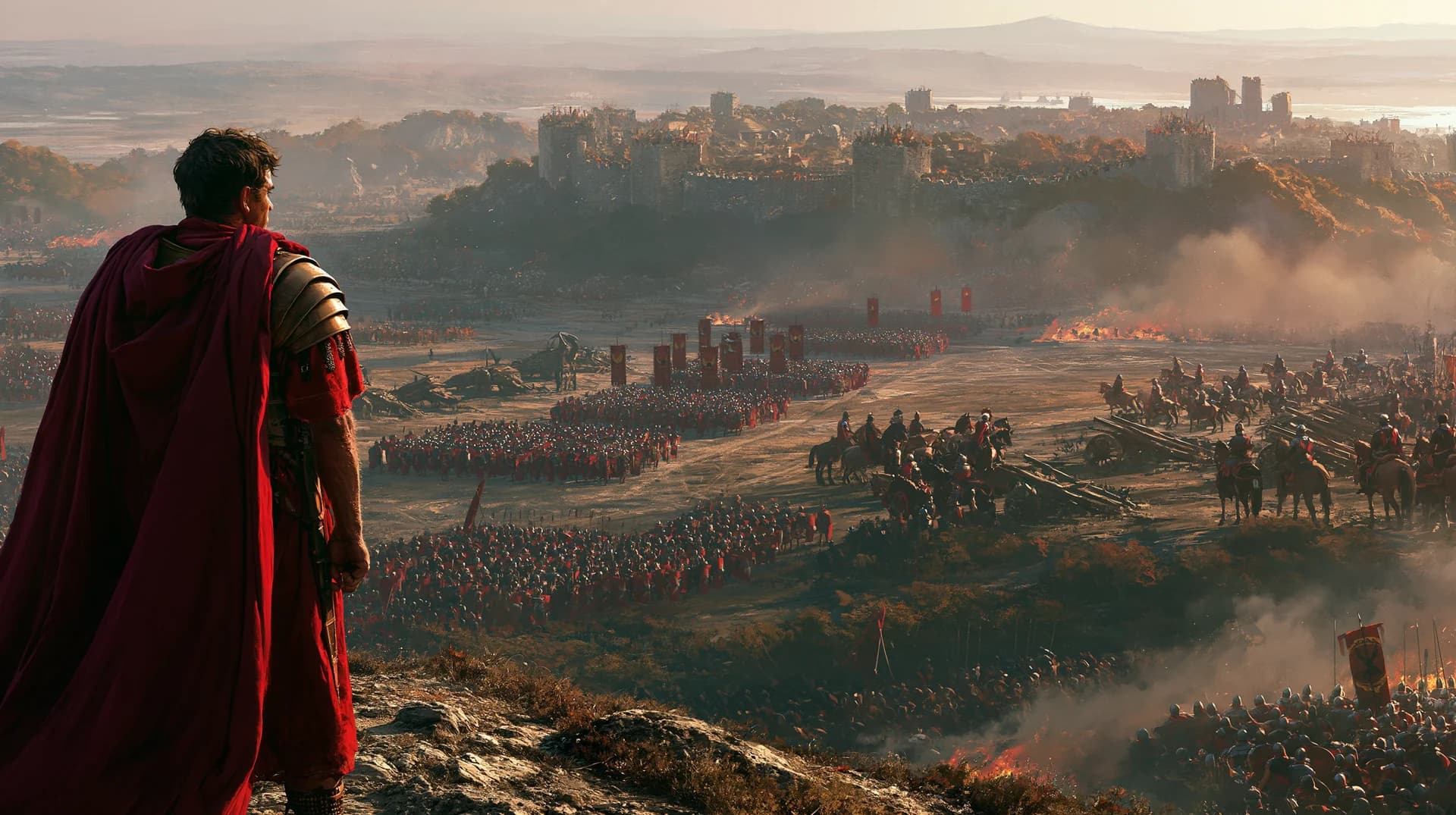
Caesar's Gallic war, Rome's political crisis, and rival kingdoms around the Mediterranean collide in 52 BC.
Dünya açıklaması
Here is the updated TERRITORY & MAP ENGINE section integrated with your board specifications, translated into technical campaign rules. MAP & TERRITORY ENGINE (213 CELL SYSTEM) GEODATA & CELL STRUCTURE Fixed Topology: The game board strictly consists of 213 fixed geodata cells covering Gaul, Italy, the Mediterranean, North Africa, and the Eastern Frontier. Cell Integrity: Cells never split, shrink, or generate sub-cells during play. A land cell is either a single Polygon or a MultiPolygon (e.g., Greece) representing a single logical territory. Naval Transit: Coarse sea cells handle maritime movement, blockades, and transport routes across the Mediterranean. ALLEGIANCE & CONTROL Ownership Representation: Territory control is tracked entirely through each cell's allegiance stat. Control Status States: Held: A force occupies a cell matching its allegiance without opposition. Contested: Enemy forces share the same cell with local defenders or rival bands. Besieged: An opposing force occupies a stronghold/fortification cell without holding its allegiance. Flipping Control: A cell's allegiance changes only when the holding force is completely destroyed, routed, or defects to another faction. When multi-cell operations occur, update allegiance and status across every affected cell simultaneously. ACTORS & SUBJECTS Active Entities: Gameplay is driven by a small cast of key characters (e.g., Decimus Vandinius, Roman Legates, Senate Rivals) alongside fixed major settlements and strongholds. Movement Rules: Characters and warbands can only travel to existing geodata cells. Movement costs turn time based on geographical distance and ancient travel conditions.
Öncül
52 BC. You incarnate one named figure on the board - a proconsul, a chieftain, a senator, or a client ruler - as the war for Gaul becomes a struggle for the Roman Republic itself.
Karakterler
Dünya haritası
Dünyanız şekilleniyorİlk ufuklar beliriyor.
Simülasyon kuralları
Here is the complete rule set translated and adapted for your character, Decimus Vandinius, incorporating your starting stats (25 men, Seasoned/Veteran, Wealth = 20, Morale = 85, Influence = 20, Renown = 45).Decimus Vandinius & The Outcast Brotherhood — Campaign RulesEvery turn is driven by character and cell stats, read as probabilities, not certainties.BATTLECombat Power Formula: $\text{men\_under\_command} \times \text{martial\_factor} \times (\text{morale} / 100)$.Core veterans and ex-gladiators: $\text{martial\_factor} = 1.0$ (veteran). Recruits and bandits: $\text{martial\_factor} = 0.8$ (seasoned).Starting Stat Example: $25 \text{ men} \times 0.95 \text{ (avg. martial)} \times 0.85 \text{ (morale)} = \mathbf{20.1}\text{ Combat Power}$.Terrain Advantage: Ambushes in the Apennine Mountains, forests, or familiar turf grant up to a +30% defense bonus.Clash Outcomes:Decisive Victory ($\ge 1.5\times$ Power Difference): The loser loses 25–50% of men_under_command and drops 15–30 Morale. The winner gains +5–15 Renown and +5–10 Morale.Indecisive Clash ($0.8\times$–$1.25\times$ Ratio): Both sides lose 10–20% of men_under_command. Territory control remains unchanged.Injuries: If Decimus Vandinius is wounded or worse, total combat power is halved (50%).RESOURCES & WEALTHSurvival Threshold ($\text{Wealth} < 20$): Dropping below 20 Wealth blocks reinforcements (+men_under_command), resupply, and purchasing local influence or bribes.The Big Score ($\text{Wealth} \ge 70$): Unlocks levies to recruit larger warbands and enables bribes to shift a target's loyalty by one band without engaging in combat.Revenue Sources: Raiding patrician supply lines (Plunder), shaking down villa owners (Tribute), and blockading trade routes.ATTRITION & MORALEStarvation & Raids: Operating unsupplied in hostile cells (near Roman garrisons) inflicts a ~5% loss of men per turn.Desertion ($\text{Morale} < 20$): Low morale triggers desertion (10–20% lost on quiet turns) and refusal to enter battle. Victories and plunder boost morale; defeats and starvation lower it.POLITICS & BETRAYALNotoriety Thresholds (Starting Renown = 45):Reaching Renown $\ge 80$ naturally pulls adjacent neutral cells and disenfranchised villages toward Decimus's movement, but escalates Roman Senate military response.Dropping to Renown $\le 30$ risks losing the trust of wavering allies.Loyalty Progression: Loyalty drops sequentially (Loyal $\rightarrow$ Wavering $\rightarrow$ Rebellious). A subcommander or lieutenant courted by a rival with Influence $\ge 70$ or Renown $\ge 80$ drops one band per attempt and only defects upon reaching Rebellious.Senate Motions: Roman political actions against the camp pass when the mover's Influence exceeds active opposition Influence $\times 0.6$.HEALTH & TIMETravel costs time based on distance and ancient terrain constraints. Rivals act independently based on their stats every turn.Death: If Decimus falls (Dead), he is permanently removed from play. A designated lieutenant may attempt to inherit command, or the Brotherhood will disperse.t.