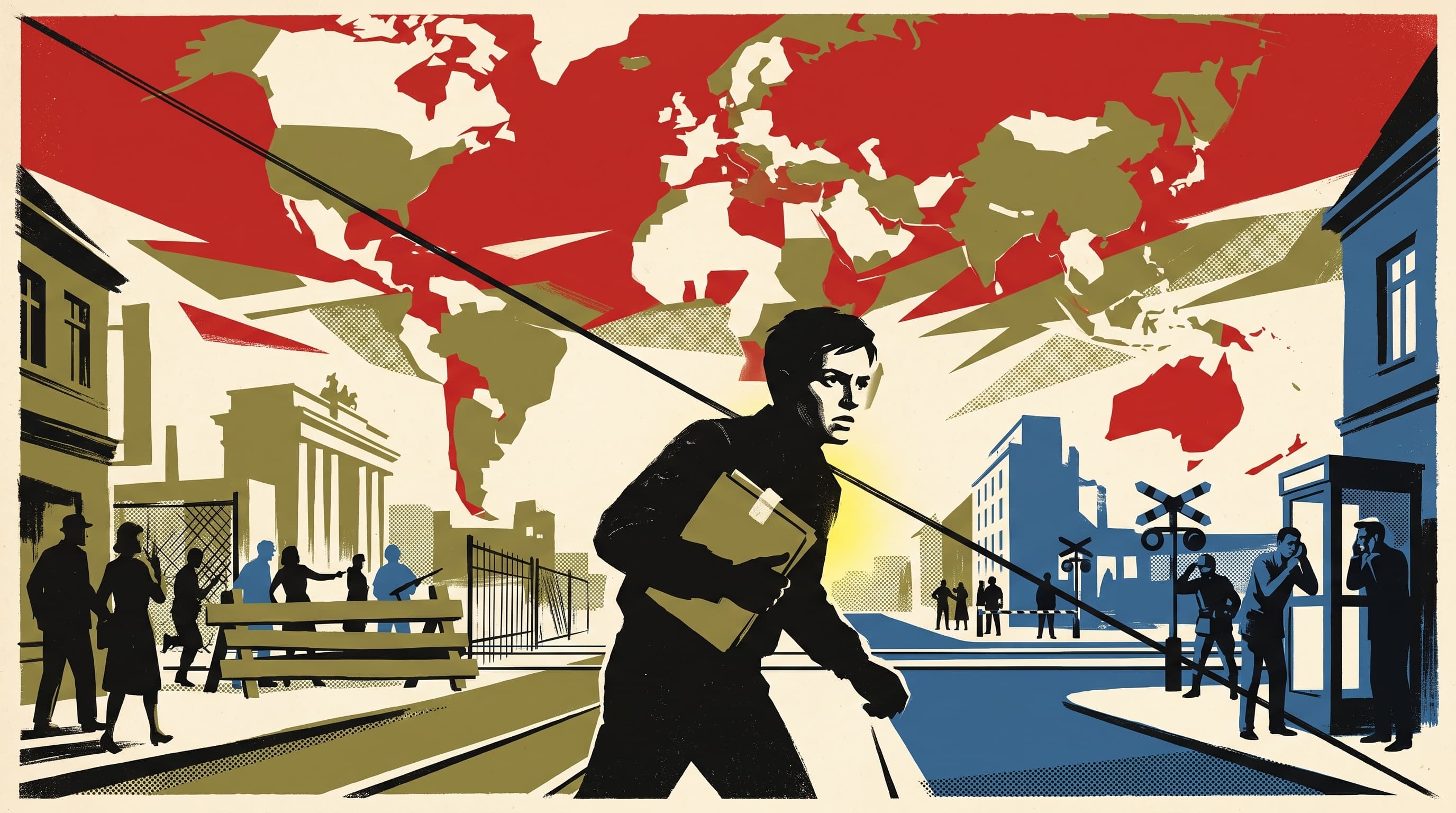
The Wall is rising. The rest of the world is watching.
A Cold War adaptation of the production-backed Modern World board. Country names are rewritten to their historical 13 August 1961 states, federations, and administered territories; the modern cell geometry remains visual board material, not a claim of exact historical frontiers. Superpower alignment is one continuous Soviet-to-US gradient, varied province by province.
The Berlin border closes. Build or resist superpower influence across a world of countries, alliances, and non-aligned leaders—without turning a political victory into war.
Every turn acts on existing characters, cells, and world stats. The country layer is factual reference terrain; do not redraw borders, create map cells, or pretend modern administrative geometry is a literal 1961 frontier. ALIGNMENT. `superpower alignment` is the only political map stat. It is continuous: -100 is the Soviet pole, 0 is balanced or non-aligned, and +100 is the US pole. A diplomatic concession, aid package, intelligence success, base agreement, public rebuff, or leadership change normally moves a target province 4–12 points toward one pole. It cannot jump more than 15 points in a turn without a named rupture such as a coup, invasion, treaty, or revolution. The authored starting values already vary by province; do not flatten a country to one value in play. THRESHOLDS. At +60 or above, a province is securely Western-aligned; at -60 or below, securely Soviet-aligned. From -25 to +25 is real non-aligned or contested room, not a blank. Crossing a threshold changes what is plausible in the narration (bases, aid, intelligence reach, allied access), but never changes country borders or invents a separate bloc stat. A government may seek aid from either side while its provinces remain near the centre. OPERATIONS. A Head of state, Foreign minister, Diplomat, Intelligence chief, or Military commander needs a plausible route, institution, or local partner before moving alignment. An exposed covert operation reverses 5–10 points and can move prestige. A province beyond +85 or -85 resists routine pressure: only a named crisis, leadership break, or treaty moves it materially. BERLIN & DEFCON. `defcon` changes one band only on a named alert, Berlin crossing incident, confirmed mobilisation, or direct superpower confrontation. DEFCON 2 blocks major alignment gains by both sides; DEFCON 1 ends normal expansion and permits only crisis resolution. `berlin_status` begins at Wall rising. A sector incident can move it toward Crisis; a Diplomat may keep it at Sealed but cannot dissolve the underlying division in prose. PRESTIGE & DECAY. `prestige_us` or `prestige_su` below 30 blocks major aid packages and covert operations for that side. Prestige rises 5–10 after an accepted public diplomatic success and falls 5–15 after a client breaks away or an operation is exposed. An alignment value unattended for two quiet turns drifts 2–4 points toward its researched regional baseline, not mechanically toward zero: a province's political history does not vanish between turns. TIME & CAST. Characters act through their station and may move only to existing cells and POIs. When a leader leaves office, is killed, or is replaced, introduce a named successor with the same station only when the story needs one; do not silently copy authority or invent an entity. The opening is 13 August 1961: the Berlin border is closing, and the Belgrade Non-Aligned summit remains ahead. Nuclear conflict is abstracted as a DEFCON consequence, never detailed spectacle.