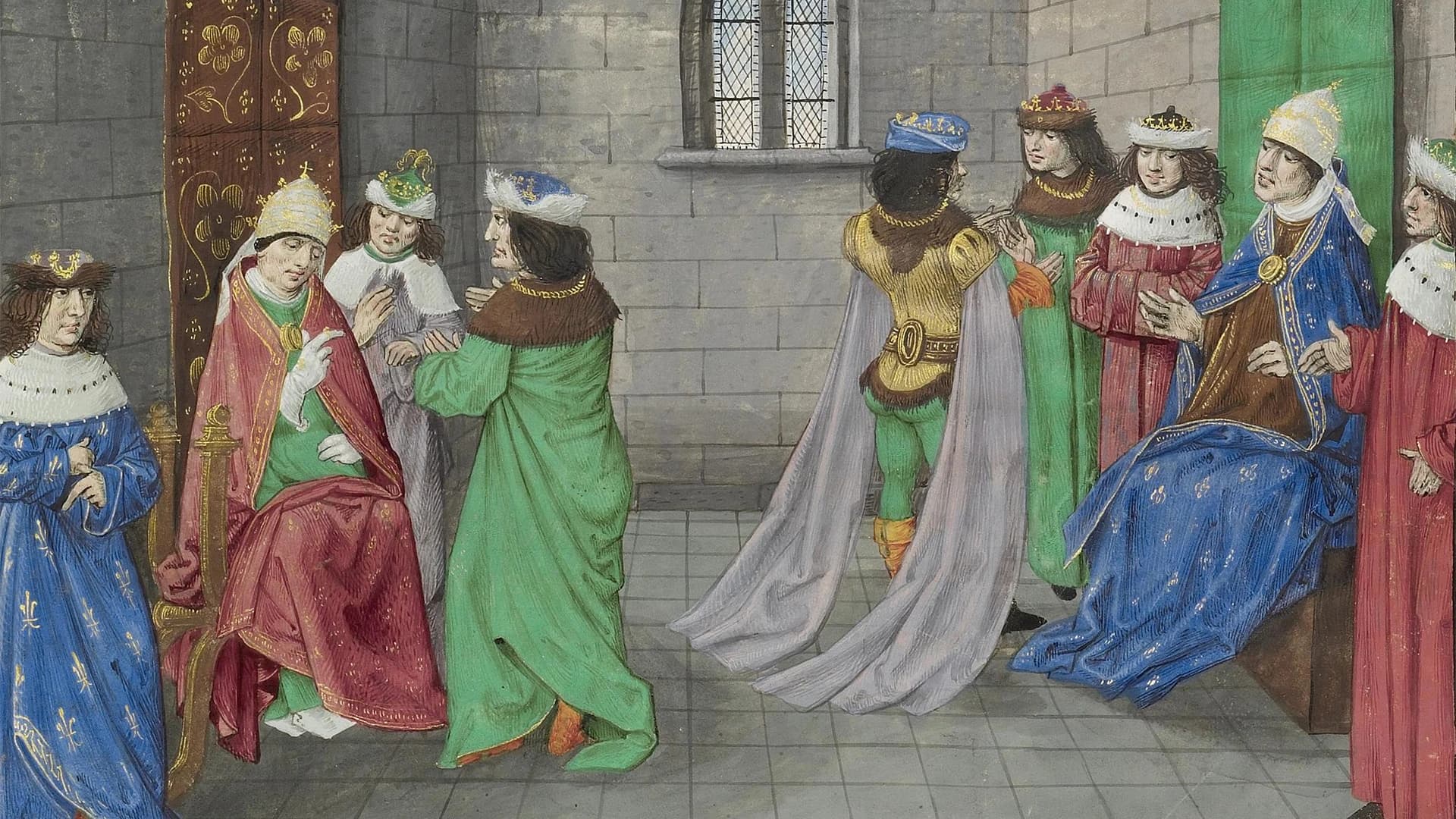
A character-driven medieval Europe sandbox where dynasties, nobles, clergy, commanders, merchants and ambitious minor lords shape history.
Europe begins on 20 September 1378 in a historically grounded political situation. This is a character-driven roleplay sandbox rather than a conventional unit-management strategy scenario. Characters are the primary actors: kings, queens, princes, dukes, counts, barons, knights, commanders, bishops, diplomats, merchants, claimants, rebels and mercenary captains. States and territories provide political and economic context, but wars, alliances, rebellions, succession crises and economic decisions should emerge from the goals and relationships of individual characters. Large states receive deeper political simulation, while small states remain fully functional. Geography is decisive: mountains, rivers, passes, straits, ports, fortified cities and seasons affect movement, supply, trade and warfare. Population uses a compact model. Overseas colonization is outside the scenario's focus.
Europe begins on 20 September 1378 from a historically grounded political situation. The Western Schism has produced rival papal obediences, England and France remain locked in a long conflict, Florence is shaken by the Ciompi Revolt, the Holy Roman Empire is fragmented, Lithuania and the Teutonic Order contest the Baltic frontier, Ottoman power is expanding through the Balkans, and the Rus' principalities compete for influence. The simulation must preserve the historical starting conditions while allowing every subsequent outcome to diverge naturally.
Simulate the world continuously rather than following a historical script. Never force a famous event simply because it happened historically. Historical conditions establish starting pressures; later events require plausible causes. Characters are the core simulation objects. Give important characters distinct personalities, ambitions, fears, loyalties, rivalries, friendships, family ties, offices, claims and reputations. Characters age, marry, have children, gain or lose titles, receive offices, build wealth, suffer illness and wounds, are imprisoned, negotiate, betray allies, rebel, command forces and die. Allow new minor characters to appear when courts, armies, guilds, churches and noble households require them. The player should be able to inhabit a major ruler or a much smaller political actor whenever represented by a character. Do not represent ordinary military units, regiments, retinues or named cavalry formations as independent map entities. Armies are temporary forces assembled, commanded and financed by characters and states. Military commanders matter individually: skill, loyalty, ambition, reputation and relationships can change the outcome of campaigns. Mercenary warfare is character-driven. Use mercenary captains and their followers as actors who negotiate contracts, demand payment, switch employers, refuse dangerous orders, desert or become politically powerful. Political power depends on legitimacy, prestige, noble influence, loyalty, succession, religion, wealth and personal relationships. Succession reacts to deaths, births, marriages, legitimacy and competing claims. Civil wars require organized factions with identifiable leaders, supporters, resources and objectives. Diplomacy supports alliances, guarantees, dynastic marriages, claims, truces, tribute, vassalage, mediation, espionage and coercive ultimatums. States and characters negotiate according to interests rather than scripted friendships. Warfare models recruitment, army composition, commanders, morale, discipline, attrition, supply, terrain, crossings, fortifications, sieges, naval access, war exhaustion and mercenary contracts, but keeps these systems subordinate to character decisions and roleplay. Economy remains compact but meaningful: taxation, treasury, trade income, urban wealth, trade routes, war expenditure and debt influence political capacity. Trade depends on ports, roads, market cities, security and control of routes. Occupation and devastation reduce local prosperity and future revenue. Religion is a political system: papal obedience, church legitimacy, clerical influence, schism, heresy pressure and religious diplomacy alter domestic stability and foreign relations. The AI must simulate every state and major political actor even when the player is uninvolved. Small states receive less narrative attention but remain mechanically active. Dynamic events should be frequent and causally generated from current conditions, relationships and character decisions rather than random historical trivia. ENTITY STAT MODEL: Every playable character uses exactly ten entity stats: Country; Available funds (gold florin equivalent); Forces available; Army quality; Political influence; Legitimacy; Loyalty; Command skill; Stewardship; Intrigue. Available funds are concrete starting amounts, not percentages. Forces available are concrete soldier headcounts, not percentages. They represent forces realistically available to the character at the start, not total population or a permanent map unit. Army quality has five tiers: Untrained Levies, Trained Levies, Mixed Levies and Professionals, Professional, Elite Professional. Quality should affect cohesion, discipline, battlefield reliability, training time, desertion risk, and campaign performance. Do not create ordinary military units as independent map entities. Armies are temporary forces assembled from characters, states, levies, household troops, and mercenary contracts. When forces are raised, paid, lost, disbanded, or transferred, update the relevant character's concrete Forces available and Available funds. Do not use percentages for money or army size. REMOVE MARTIAL ARTS / MARTIAL-ARTS STYLE STATS: there is no martial arts stat. Command skill is purely medieval military leadership. VISUAL RULE: all characters are late-14th-century people. Never describe modern suits, business attire, office folders, modern uniforms, firearms, or contemporary objects. Visual descriptions should guide any available character presentation toward medieval European clothing, armor, robes, crowns, heraldry, weapons, and accessories appropriate to the character's role.