
Building factions and territory
Assemble countries, armies, capitals, and political control from entities, landmarks, cells, and stats.
Start with the important distinction
Davia has no separate faction, country, army, or political-border object. These are game concepts you assemble from the world's four kinds of subject and their stats.
| What you want to build | Start with | Connect it through |
|---|---|---|
| A faction or country | A shared stat such as Allegiance | Characters, armies, a capital, and controlled cells; add a country entity only when it should be selectable |
| An army or fleet | An entity | Location, strength, morale, supply, and allegiance |
| A capital or stronghold | A landmark | Location, status, allegiance, and rules about capture |
| Controlled territory | Cells | A colored cell stat such as Allegiance or Control |
| A political border | No extra object | The visible edge between neighboring cell values |
This assembly is useful because each part can change independently. An army can move without moving its country, a capital can fall before every cell changes hands, and a contested cell can keep its geometry while its control changes.
Recipe: build one faction
Decide which actors should be selectable
Every entity appears as a selectable role when a player starts the game. Create a faction, country, government, clan, or organization as an entity only when you want players to choose that political actor directly.
If the country itself should not be a role, you do not need a country entity. Its characters and armies can be entities, its capital can be a landmark, and its territory can share one Allegiance value. Add each leader or mobile force as a separate entity when its location and condition matter independently.
An army that moves independently is an entity, not an entity stat, so it also appears in the role chooser. Army Strength, Morale, or Supply are properties that describe that entity; they do not create the army.
Create a shared allegiance stat
In the Game Stat Table, add a State stat such as Allegiance. Under Who has this value?, select every section that needs to answer the same question:
- Cell for territorial control;
- Entity for people, governments, and forces;
- Landmark for capitals, ports, forts, and other fixed places.
Add one named value and color for each side. The stat definition is the property; each subject's current value is its answer.
Turn on Allow new values during play when a new political side may emerge through revolt, secession, or coalition. Leave it off when every side is known before play. A new Allegiance value does not create a country, government, character, or army entity.
Paint the starting territory
Open Cells, display Allegiance, choose the faction's value, enable Paint continuously, and drag across the cells it controls. Repeat for the other sides.
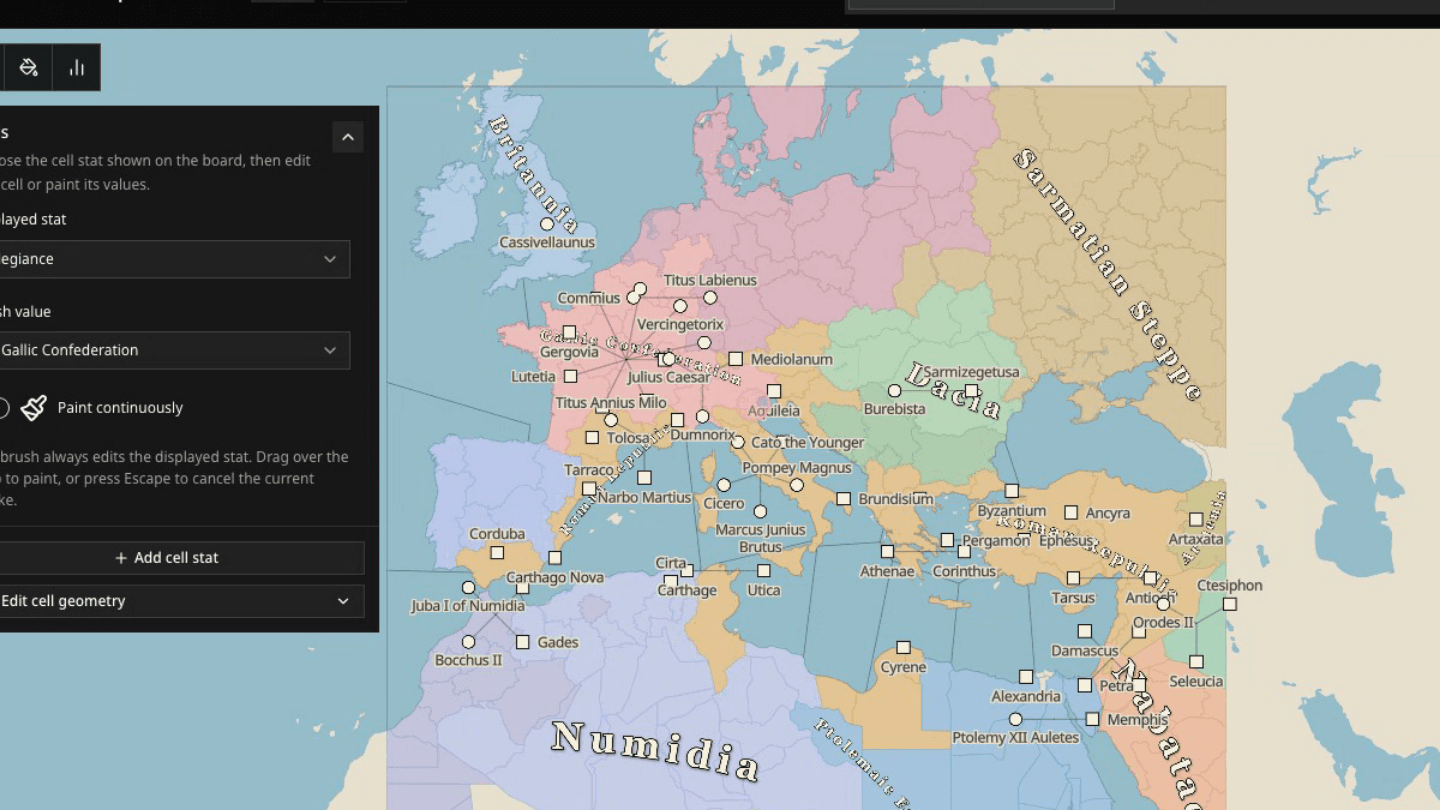
In Rome: Republic at War, Roman Republic, Gallic Confederation, Germanic Tribes, and neighboring powers are named Allegiance values. Colored cells make their starting control readable, while entity and landmark values connect actors and places to the same political picture.
Add a capital and mobile forces
Create the capital as a landmark and give it the faction's Allegiance value. Create each army, fleet, or mobile group as an entity with the same value, then add only the extra stats that produce decisions: strength, morale, supply, loyalty, or another game-specific fact.
Do not duplicate a faction's full description in every member. Use names, stats, locations, and Simulation Rules to make the relationship playable.
Explain how control changes
The cell stat's change instruction should define what can change one cell. Use Simulation Rules for interactions that involve armies, capitals, distance, or several stats.
A practical starting rule might say:
A cell changes Allegiance only after its current holder withdraws, surrenders, defects, or loses effective control. An army merely passing through does not transfer the cell automatically.
Add separate rules when capitals, supply lines, or contested values have special effects.
Geometry is not sovereignty
Use Edit cell geometry when the fixed areas themselves are wrong: a coastline is poor, a city is split between cells, or one cell is too large to support meaningful movement.
Use a cell stat when control changes. Painting Allegiance does not alter cell shape, and reshaping a cell does not decide who owns it.
Do not redraw cell boundaries every time a faction gains territory. Political control is state and should be able to change during play; cell geometry is the stable spatial structure underneath it.